




Crypto stopped being the experimental corner of iGaming some time ago. According to TRM Labs, on-chain gambling volume reached $51 billion in 2025, set a quarterly record of $15 billion in Q4 2025 and held at $14 billion in Q1 2026. It did that while most of the crypto market was in a correction.
That last detail matters more than the headline number. Gambling volume didn’t follow Bitcoin’s price down. Players who had already gambled with crypto kept coming back and, on average, bet more each time.
For operators, this changes the question. Launching a crypto casino in 2026 isn’t a wager on the next bull run. It’s a payments and retention business that happens to settle on blockchains. And with regulators, Curaçao in particular, now writing crypto-specific rules, the platform you pick decides how much of the next two years goes into growth and how much goes into rebuilding infrastructure you should have had on day one.
Here’s what to look at, based on where the money is actually moving and what licensing authorities now expect.
1. Payment infrastructure: build for stablecoins, not Bitcoin
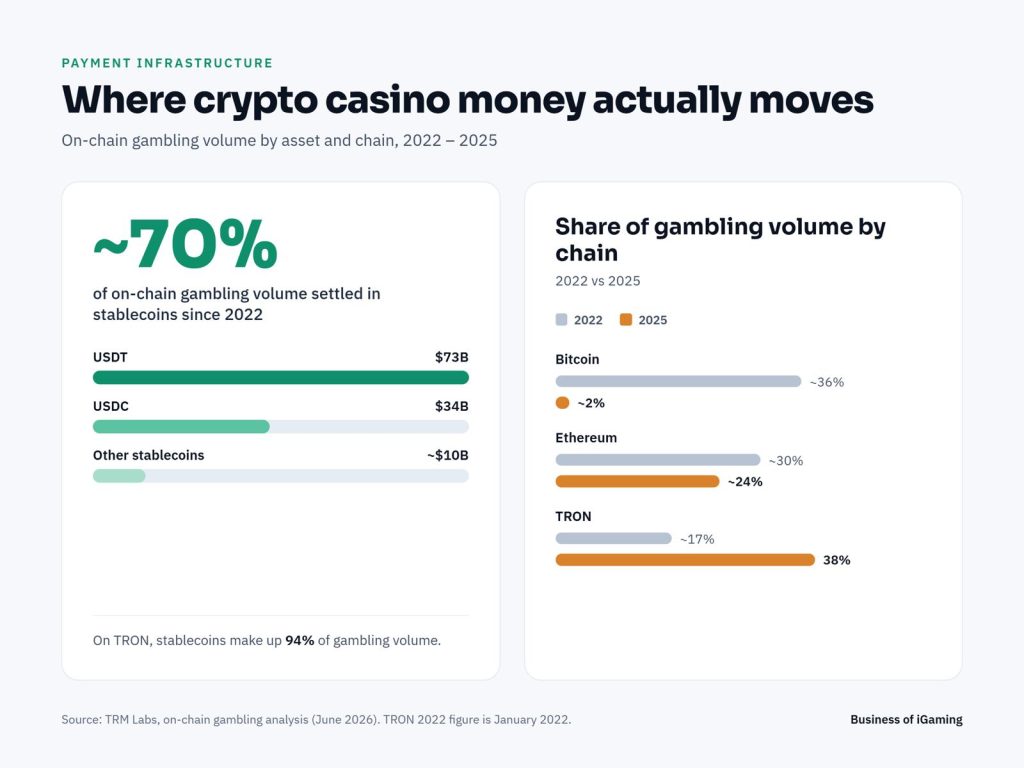
Most platform pitches still lead with “Bitcoin accepted.” The data says that’s the wrong headline. TRM’s analysis shows stablecoins made up roughly 70% of all on-chain gambling volume since 2022, about $117 billion of $169 billion, led by USDT at $73 billion and USDC at $34 billion. On TRON, where transfers cost almost nothing, the stablecoin share is 94%.
The chain mix has shifted just as sharply. Bitcoin’s share of gambling volume fell from around 36% in 2022 to about 2% in 2025, while TRON took 38% of 2025 volume. Polygon posted its best quarter on record in Q1 2026. Players are routing around fees and slow confirmations, and they’ll route around your cashier too if it adds friction.
When you review a platform’s payment layer, check:
- Chain coverage, not just coin coverage. USDT on TRC-20, ERC-20 and Polygon are three different rails with different fees and confirmation times. A cashier that only supports one forces players to bridge.
- Per-chain confirmation rules. You should be able to set how many confirmations credit a deposit on each network, rather than living with a single global setting.
- Bonus and wagering logic in stable units. If bonuses are calculated in volatile assets, your liability moves with the market. A platform should let you denominate promotions in USDT or a fiat reference.
- Withdrawal speed you can actually control. Automated payouts under a threshold, manual review above it, with the threshold set by you.
Which assets to prioritise is a commercial decision as much as a technical one. This site’s breakdown of the top crypto picks for casinos and iGaming firms is a useful starting point. And if you plan to run fiat alongside crypto, the iGaming payment processing guide for operators covers the card and APM side of the cashier.
2. Security and compliance: the floor just moved
For years, a Curaçao licence was the low-friction route into crypto gambling. That era is over. The National Ordinance on Games of Chance (LOK) took effect on 24 December 2024 and put licensing directly under the Curaçao Gaming Authority. Then, in June 2026, the CGA published a dedicated crypto policy guideline for B2C licensees.
Some of it applied immediately. Licensees can’t accept funds linked to sanctioned addresses, mixers or tumblers. Player, operational and treasury wallets must be separated, with player funds held in segregated wallets. Withdrawals should normally go back to the same wallet and asset the player deposited from. The rest is phased: crypto policies were due on the CGA portal by September 2026, risk assessments and transaction monitoring procedures by December 2026, and full wallet segregation, blockchain analytics, reconciliation and withdrawal whitelisting by June 2027.
If your platform can’t do these things natively, you’ll be bolting them on under deadline pressure. So ask vendors directly:
- Is on-chain wallet screening built in at both deposit and withdrawal, and which analytics providers does it connect to?
- Can the system enforce same-wallet withdrawals and whitelisting without manual workarounds?
- Are player funds and house treasury structurally separated, with reconciliation reports an auditor can read?
- What does the audit trail look like for every manual approval?
Security belongs in the same conversation. TRM points out that crypto casinos face three distinct threats: being used to launder funds, being frauds themselves, and being targeted by attackers. The $41 million theft from Stake, attributed to North Korea’s Lazarus Group, is the case everyone remembers. Hot wallet limits, multi-signature treasury controls and role-based admin permissions aren’t optional extras.
Player protection rounds this out. Deposit limits, cool-off periods and self-exclusion should work in crypto just as they do in fiat. Regulators that have watched licensing regimes fail are paying close attention to whether offshore hubs can enforce these tools, and Curaçao clearly wants to be on the right side of that story.
3. Game content that works in crypto, not just next to it
A big lobby is easy to promise. What matters is whether the games run properly in crypto-denominated wallets. Some providers support crypto currencies natively. Others need the platform to convert balances at the game level, and if that conversion is clumsy, players see odd decimal stakes or bet limits that don’t match their balance.
Crypto audiences also play differently. High-frequency, low-margin formats like crash, dice, plinko and fast slots carry a large share of activity, which is exactly why those products moved to stablecoin rails first. Your platform should give these instant games first-class placement, not bury them under a generic slots grid.
Provably fair support is the other piece. Crypto-native players expect to verify outcomes using server seeds, client seeds and nonces. Even if most never check, the option builds trust that a licence badge alone doesn’t. Ask whether the platform supports provably fair titles out of the box and whether players can run verification inside the casino interface.
4. Back office and scalability: plan for whales and spikes
TRM’s wallet analysis is the most useful thing an operator can read this year, because it shows how lopsided crypto player value is. High rollers make up about 6% of personal gambling wallets but generate roughly 92% of personal-wallet volume, with an average bet of around $13,500. Meanwhile, casual bettor volume grew 11x between early 2022 and March 2026, and “daily grinder” volume grew 12x.
That creates two very different jobs for your back office. You need VIP tooling sharp enough to spot, reward and protect a small group of players who carry the P&L. You also need automation that handles a growing base of small, frequent depositors without manual effort. Both depend on player segmentation, a flexible bonus engine and real-time risk scoring that can catch bonus abuse spread across fresh wallets.
Traffic isn’t smooth, either. TRM found dormant wallets wake up around the Super Bowl, March Madness and the World Cup, then go quiet again. Ask any vendor for uptime history and how the platform handled load on its busiest event days.
If you’re evaluating packaged crypto casino software, look for one back office that covers multi-chain wallets, real-time transaction monitoring, bonuses and affiliate payouts together. Running those across separate tools is where reconciliation errors and slow withdrawals usually start. Affiliates matter here too: crypto programmes often pay richer revenue share than regulated markets, as covered in this roundup of crypto casino affiliate programs, so tracking and crypto payouts need to be accurate from launch.
5. Trends worth building for now
Retention beats acquisition. New wallets entering crypto gambling have fallen about 54% from their Q3 2022 peak, while returning wallets grew roughly fourfold. The ratio of new to returning wallets narrowed from 9:1 in early 2022 to 1.4:1 by Q1 2026. Growth now comes from keeping players, so loyalty mechanics, cashback and VIP management deserve as much platform scrutiny as the cashier.
Prediction markets are next door. In Q1 2026, prediction markets recorded $36.6 billion in on-chain volume against $14 billion for gambling, the first quarter they pulled ahead. Hybrid wagering products already sit between the two. A platform that can add new product verticals without a rebuild gives you options.
Regulated crypto is coming into view. In February 2026, the UK Gambling Commission said it would explore a route for cryptoasset payments in licensed gambling. It’s early, but the direction is clear: crypto acceptance with full KYC and AML controls, not instead of them.
Growth markets look different. Some of the fastest-growing crypto casino audiences are in places with inflation histories and patchy banking, as this piece on LatAm crypto casino growth explains. Localised languages, currencies and payment flows matter as much there as coin support.
A quick vendor checklist
Take these questions into every demo. A vague answer to any of them is worth following up in writing.
| Area | What to Ask |
|---|---|
| Payments | Which chains are supported for USDT and USDC, and can confirmation thresholds be set per chain? |
| Wallets | Are player, operational and treasury wallets segregated by design? |
| Compliance | Is wallet screening built in at deposit and withdrawal, with whitelisting and same-wallet payouts? |
| Security | How are hot wallet limits, multi-sig and admin permissions handled? |
| Games | Do providers run natively in crypto, and is provably fair verification available in the lobby? |
| Back Office | Can bonuses be set in stable units, and does risk scoring catch multi-wallet abuse? |
| Scale | What uptime and peak-load figures can the vendor show from major sporting events? |
The bottom line
The crypto casino market of 2026 rewards operators who treat it as serious payments infrastructure. Players have moved to stablecoins and cheap chains. The growth story is retention, not novelty. And Curaçao’s guideline means compliance gaps now come with dates attached.
Pick a platform that already handles these realities, and your team can spend its time on product, partners and players. Pick one that doesn’t, and you’ll spend 2027 catching up.