

In a recent thought-provoking post on LinkedIn, Rus M. drew attention to a powerful insight from Atomic Habits by James Clear — an insight that should be required reading for anyone building iGaming products.
“Gamblers get a dopamine spike before they bet. Not after they win.”
This idea might seem counterintuitive at first. We often associate the thrill of gambling with winning – hitting the jackpot, scoring a big multiplier, unlocking free spins. But neuroscience tells a different story.

The real chemical rush? It happens before the outcome. In the anticipation. In the suspense. In the “what if.”
Let’s unpack why this matters and how iGaming product teams are already, perhaps unintentionally, designing for this.
The Dopamine Effect: It’s About Anticipation, Not Outcome
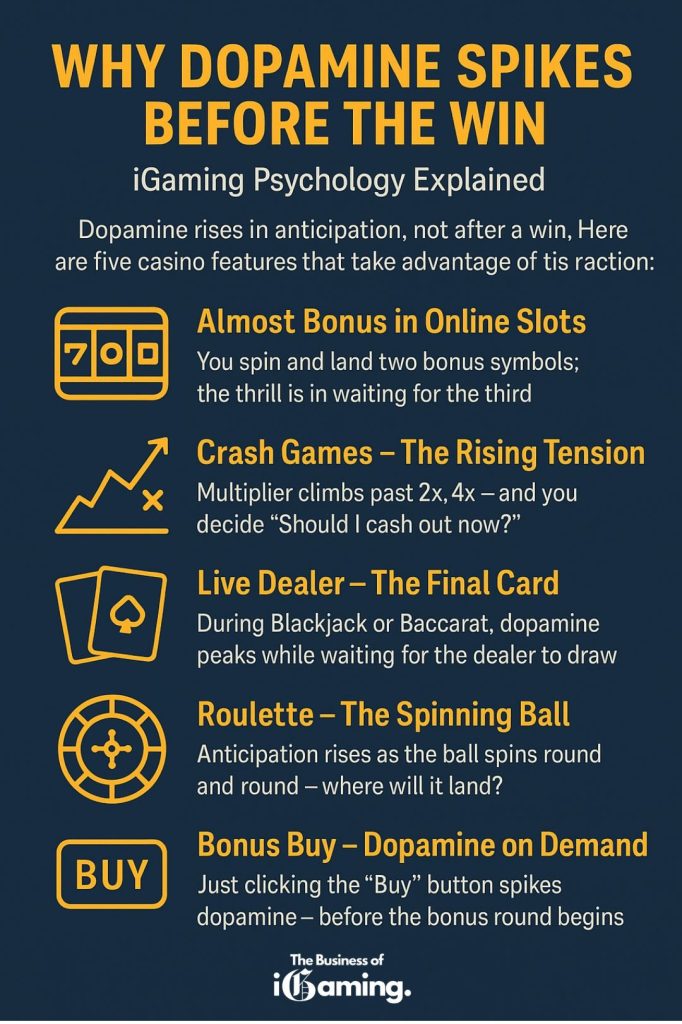
Dopamine, often dubbed the “pleasure chemical,” isn’t just about reward — it’s about motivation. It spikes when the brain expects something exciting to happen. Not after it happens.
This explains why features that build suspense are so effective in gambling products. Players don’t just crave the result — they crave the possibility.
As Rus M. notes, this principle is already embedded deep in modern casino mechanics. Let’s take a look at five common features that trigger anticipation – and thus, dopamine.
1. “Almost Bonus” in Online Slots
You spin and land two bonus symbols. The third reel slows down. Maybe it flickers. Maybe it flashes. Your heart races.
Even if that final bonus symbol doesn’t land, the dopamine has already done its job before the outcome. It’s not about the win. It’s the thrill of the almost.
2. Crash Games – The Rising Tension
As the multiplier climbs — 2x, 4x, 6x — the tension builds.
“Should I cash out now? Or risk it all for 10x?”
That inner dialogue is the dopamine. The longer the multiplier ticks upward, the stronger the chemical engagement. The crash is almost secondary.
3. Live Dealer Games – The Final Card Suspense
In Blackjack or Baccarat, when the dealer slowly reveals that final card, players experience a micro-drama.
That moment of pause – the uncertainty – is engineered to maximize emotional investment. It’s a small moment with massive engagement.
4. Roulette – The Spinning Ball
A spinning roulette ball is more than visual flair. It’s a built-in timer for dopamine anticipation.
The randomness. The waiting. The unknown. All create a chemical cocktail in the player’s brain, long before the ball lands on red or black.
5. Bonus Buy – Dopamine on Demand
Even clicking the “Buy Bonus” button provides a dopamine spike.
Why? Because the moment you press it, you’re not guaranteed a win — you’re guaranteed possibility. You’ve initiated a chain of unknowns. And your brain loves that.
The Bigger Picture: iGaming Products as Psychology Engines
What Rus M. brilliantly reminds us is that none of these mechanics are accidental. They’re designed — intentionally or not — to tap into human psychology.
“It’s psychology → turned into mechanics → that boost time-in-game, repeat wagers, and retention.”
For iGaming product designers, marketers, and affiliates alike, the key takeaway is this:
💡 Winning is not the hook. Anticipation is.
That means if you’re building iGaming products — even outside of games themselves — understanding where your users’ dopamine spikes occur could be the difference between sticky engagement and casual churn.
Sometimes the magic isn’t in the outcome. It’s in what could happen next.
Final Word
If you’re in the business of building experiences that captivate users, you can’t afford to ignore the science behind when and why people get hooked. As Rus M. puts it, we need to design for the anticipation, not just the outcome.
Because in iGaming — just like in life — it’s the build-up that keeps us coming back.