


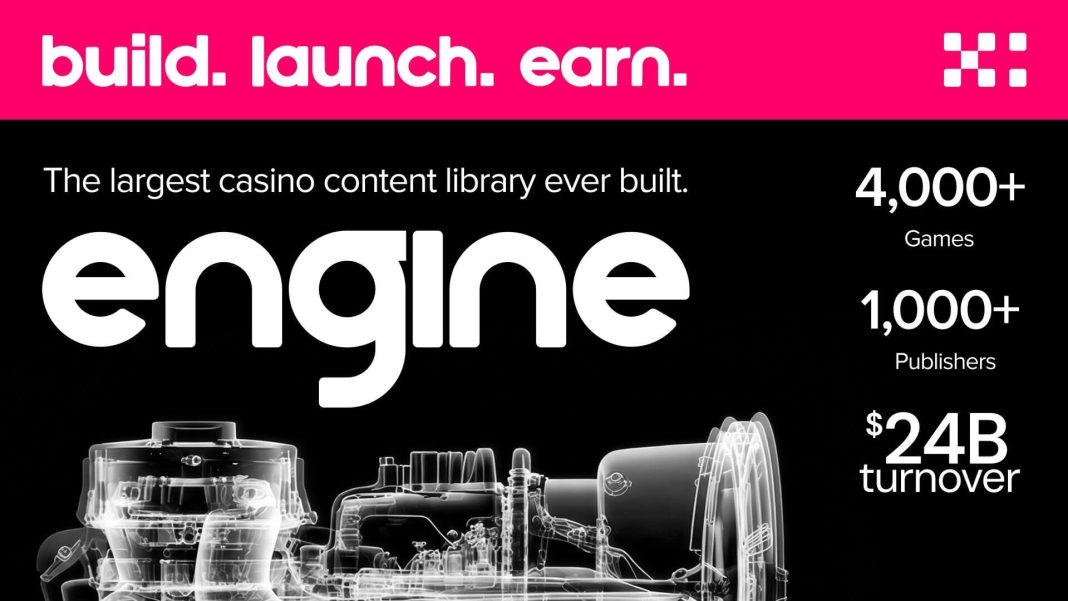

Stake is taking one of its most ambitious content projects beyond its own casino ecosystem. Stake Engine has officially rebranded as Engine, transforming what was previously an internal content platform into an industry-wide infrastructure designed to connect operators with more than 1,000 game creators.
Announced on 15 September 2026, the move means that games created and distributed through Engine will no longer be limited to Stake. Instead, operators across the betting and gaming industry will be able to integrate Engine and gain access to its rapidly expanding catalogue through a single integration.
The numbers behind the platform are already significant. According to the company, games built through Engine have generated more than $23 billion in turnover from over 9.7 billion bets, while more than 250 new titles are currently being produced every week.
But the bigger story may be what Engine represents for the way casino games are created.
From Stake Engine to an industry-wide platform
Stake Engine was originally built around publishing exclusive content for Stake. Its evolution into Engine changes that model considerably.
Instead of developing games for one operator, Engine is positioning itself as infrastructure connecting creators, developers, studios and publishers with potentially numerous casino operators.
The platform currently brings together more than 1,000 individual game creators, giving operators access to something closer to a continuously expanding content pipeline than a conventional game-provider catalogue.
A developer can create a game through Engine and potentially distribute it across multiple operators using the same ecosystem. Operators, meanwhile, gain access to new games without having to establish individual integrations and commercial relationships with every creator.
It is a model that could substantially lower the barriers to both game development and distribution.
More than 250 new games being created every week
Perhaps the most striking figure from the announcement is Engine’s current production rate. More than 250 titles are being created each week.
If Engine can maintain anything close to that pace while expanding its operator network, it would represent a very different approach from the traditional casino-content model, where established studios typically operate structured development pipelines and release schedules.
Engine is effectively attempting to apply the principles of the creator economy to casino gaming.
Instead of relying exclusively on established studios, the ecosystem can include independent developers, streamers, affiliates and other creators capable of producing games or potentially building communities around them.
That could make casino content considerably more experimental and faster-moving.
Could Engine become iGaming’s largest content pipeline?
The scale creates an interesting question for the wider industry: could Engine eventually become the largest casino content pipeline in iGaming?
Traditional aggregators have spent years building libraries containing thousands of games from hundreds of studios. Engine is approaching the problem differently.
Its potential advantage is not simply the size of its existing catalogue, but the number of people creating content and the speed at which that content can theoretically be produced.
Engine says developers have already demonstrated that they can move from an idea to a live game in as little as 24 hours.
Opening that infrastructure to additional operators dramatically changes the economics of that proposition. A creator no longer necessarily develops something for an audience on a single casino. One successful game could potentially be distributed across an expanding network of operators.
If the network grows, it creates a potentially powerful flywheel: more operators increase distribution opportunities for creators, greater distribution attracts more creators, and more creators generate additional content that makes Engine more attractive to operators.
The creator economy comes to casino games
This could also blur some of the traditional boundaries within iGaming.
Historically, the relationship has generally been relatively straightforward: studios create games, aggregators distribute them, operators offer them and affiliates or streamers promote them.
Engine potentially allows those roles to overlap.
A streamer with a large audience could become involved in creating a game. An affiliate that understands what its audience plays could develop content specifically for that community. Independent developers could experiment with concepts without needing the same infrastructure normally required to become a conventional casino studio.
Operators could even use the infrastructure to develop their own creator ecosystems, working with personalities and communities that already have relationships with their players.
That could ultimately prove more important than simply adding another few thousand games to casino lobbies.
A possible shift from game libraries to content ecosystems
For years, online casinos have competed partly on the number of games available.
That distinction has gradually become less meaningful as aggregators have made enormous libraries accessible to operators. A casino offering 8,000 games does not necessarily have a meaningful competitive advantage over one offering 6,000.
Engine points toward another possibility: casinos competing through their content ecosystems rather than catalogue size alone.
An operator could potentially work with creators to develop exclusive or early-access titles, games connected to streamer communities, experimental formats or content designed around particular player segments.
The result could resemble what has happened elsewhere in digital entertainment, where platforms increasingly compete over creators, communities and continuously refreshed content rather than static libraries.
Provably fair mechanics across the platform
Engine says every game distributed through the platform will use provably fair mechanics, allowing outcomes to be independently verified.
That element is particularly important given the more open nature of the development ecosystem.
Opening game creation to a much broader group of developers naturally creates questions around standards, trust and quality control. Building verification into the underlying infrastructure gives Engine a common technical foundation across games produced by different creators.
The commercial infrastructure is also being standardised.
Engine says operators and creators will work under a single standardised contract, while Engine handles settlement across creators through one monthly invoice. Operators retain what the company describes as the substantial majority of revenue generated.
The objective is clearly to remove much of the operational complexity that normally accompanies relationships between operators and numerous individual content suppliers.
Ed Craven: Engine could change how casino content is created

Stake co-founder Ed Craven believes the platform has already demonstrated that creator-led game development can work at scale.
“Engine has already proved that a creator-led community can create some truly fantastic, quality games, at scale.”
Craven said the project initially began as a way to reduce barriers to game development but has evolved into something significantly larger. The next stage is therefore about distribution. By moving beyond Stake, creators gain access to potentially much larger audiences, while operators gain another source of original content.
With more than 1,000 creators already involved and hundreds of games entering the pipeline every week, Craven argues that the model could fundamentally change how casino games are created and distributed.
From idea to live casino game in 24 hours
Engine Head of Operations Hayden Bruin highlighted development speed as another important part of the proposition. According to Bruin, Engine brings development, testing, approval, deployment, distribution and monetisation together within the same infrastructure.
That has already enabled developers to take a concept from an idea to a live game in as little as 24 hours.
Opening the platform to multiple operators makes that speed considerably more meaningful. Rather than quickly launching a game on one casino, developers could theoretically create something and then distribute it to audiences across an entire network.
For smaller developers in particular, that removes one of the largest obstacles in the industry: distribution.
Engine could create a new generation of casino studios
There is another possible consequence worth watching. Some of today’s biggest game studios began relatively small before eventually becoming major suppliers. Engine could accelerate that process.
A talented independent developer might launch several games through the platform, discover that one performs exceptionally well and gradually build a studio around that success.
Engine therefore has the potential to operate partly as an incubator for the next generation of casino studios.
Instead of convincing operators to integrate with an unknown supplier before receiving meaningful distribution, developers could potentially prove demand inside Engine first.
Successful creators could then evolve into brands in their own right.
The TikTok or YouTube model for casino games?
The comparison should not be taken too literally, but there is an interesting parallel with platforms such as YouTube and TikTok.
Those platforms did not become dominant because they employed thousands of people to produce every piece of content themselves. They built infrastructure that allowed enormous creator communities to produce content, while the platform handled distribution.
Engine appears to be applying part of that philosophy to casino gaming. Stake itself demonstrated how powerful creator-led distribution could become through streaming, influencers and online communities. Engine now extends the creator concept further down the value chain — from promoting games to actually building them.
If operators embrace the model, the implications could be significant.
Casino game development could become faster, more decentralised and considerably more influenced by creators and player communities.
A new chapter for casino content
There are still important questions. Producing hundreds of games every week does not automatically mean producing hundreds of games players actually want to play. Discovery could become increasingly difficult, and quality control will become crucial as the number of creators grows.
Established studios such as Pragmatic Play, Evolution, Hacksaw Gaming, Play’n GO and others have built their positions through years of game design, mathematics, branding and player understanding. Volume alone will not replace that expertise.
But Engine does not necessarily need to replace traditional studios to have a major impact.
Its opportunity is to create an additional layer of the casino-content economy: one where independent developers, creators, streamers, affiliates and operators can experiment far more quickly than before.
With more than 1,000 creators already participating, 250-plus games being created every week and billions of bets already processed through games built on the technology, Engine is starting its industry-wide expansion with considerably more scale than the typical new gaming platform.
Stake Engine began as a way to create content for Stake. Engine now wants to become infrastructure for everyone. And if its creator ecosystem continues growing, this could be the beginning of a much broader change in how the iGaming industry thinks about who gets to create the games players ultimately see in their casino lobby.
Operators can apply to join the Engine network.