


A new SEO scandal is unfolding — and almost nobody in Brussels seems to understand it
When Lars Lofgren criticized the European Commission on LinkedIn for investigating Google’s action against parasite SEO, he struck a nerve across the tech and content industries. And rightly so.
Because while regulators are chasing Google for allegedly “unfair” anti-spam enforcement, the European search landscape is quietly being flooded by another phenomenon — one they have yet to acknowledge:
The industrial-scale hijacking of expired authority domains to promote unlicensed casinos.
It is a structural problem. It is measurable. And it is rapidly reshaping the multi-billion-euro iGaming affiliate market.
One of the best (and most absurd) examples is a domain that should never, in any world, rank for gambling-related search terms:
GFAR.net — formerly the Global Forum on Agricultural Research.
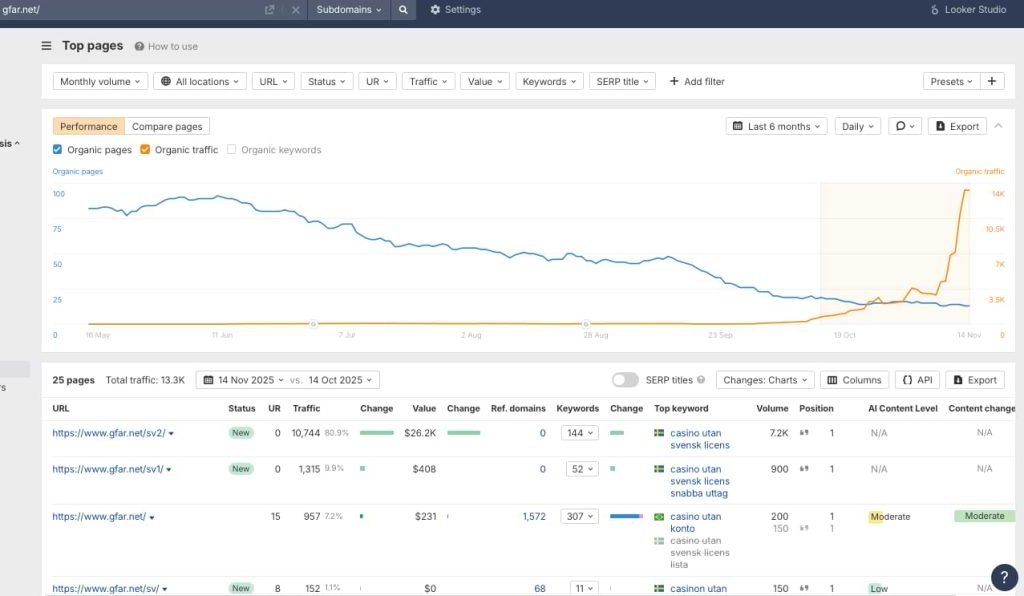
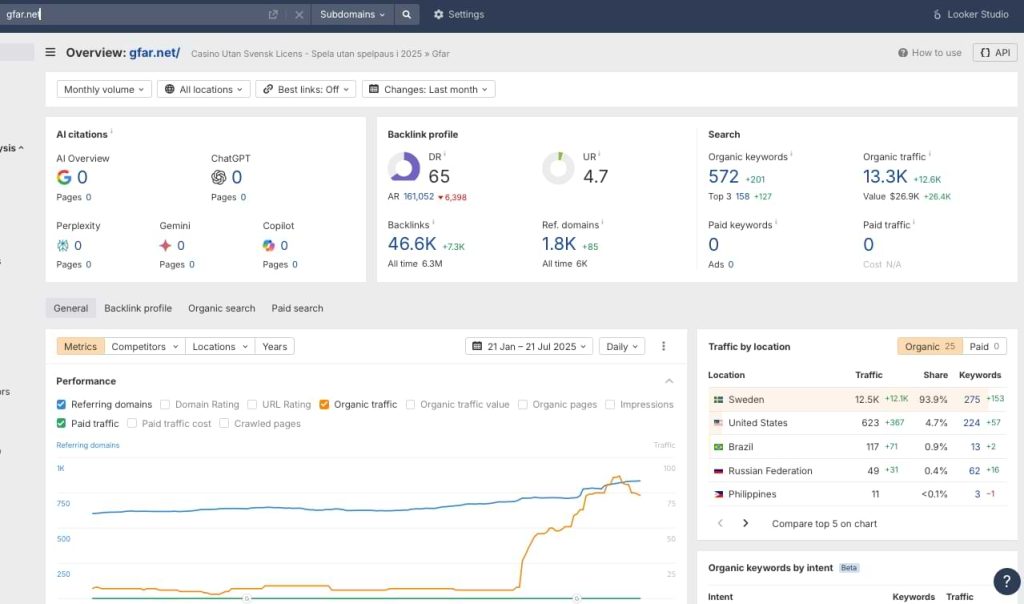
Today, according to Ahrefs, it ranks #1 in Sweden for “casino utan svensk licens”, the single most valuable keyword in the entire Swedish gray-market gambling ecosystem.
Not #50.
Not #20.
Number one.
And this bizarre case illustrates a deeper truth: Europe’s regulators are fighting the wrong battle.
From global agriculture governance to “best casinos 2025” — overnight
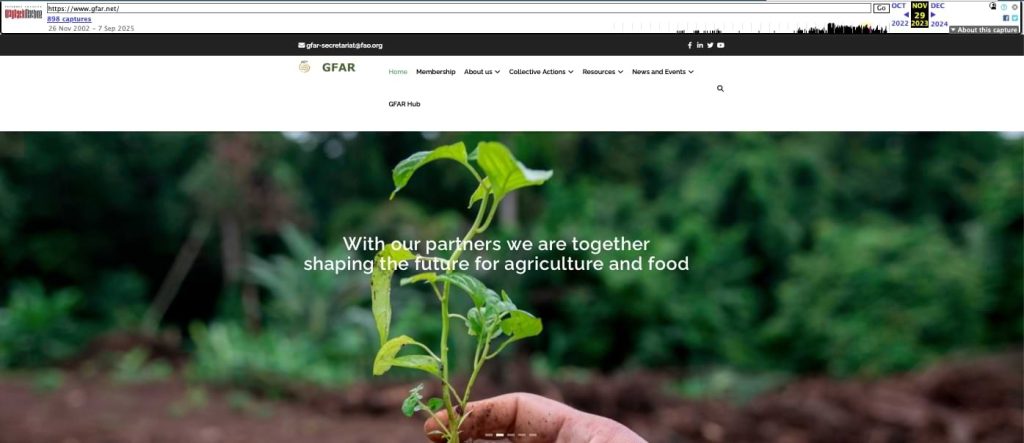
GFAR.net was not just any website. It was the public face of a UN-related agricultural research network, backed by institutions such as the FAO and dozens of international universities. Its backlink profile includes:
- Wikipedia
- Cornell University
- Springer
- BBC
- MDPI
- UBC
- FAO.org
- Georgetown University
- Major news outlets across Europe and North America
These organisations linked to GFAR because it published research, strategy documents, and policy papers.
When the project expired — as many EU-funded initiatives eventually do — the domain was left to lapse.
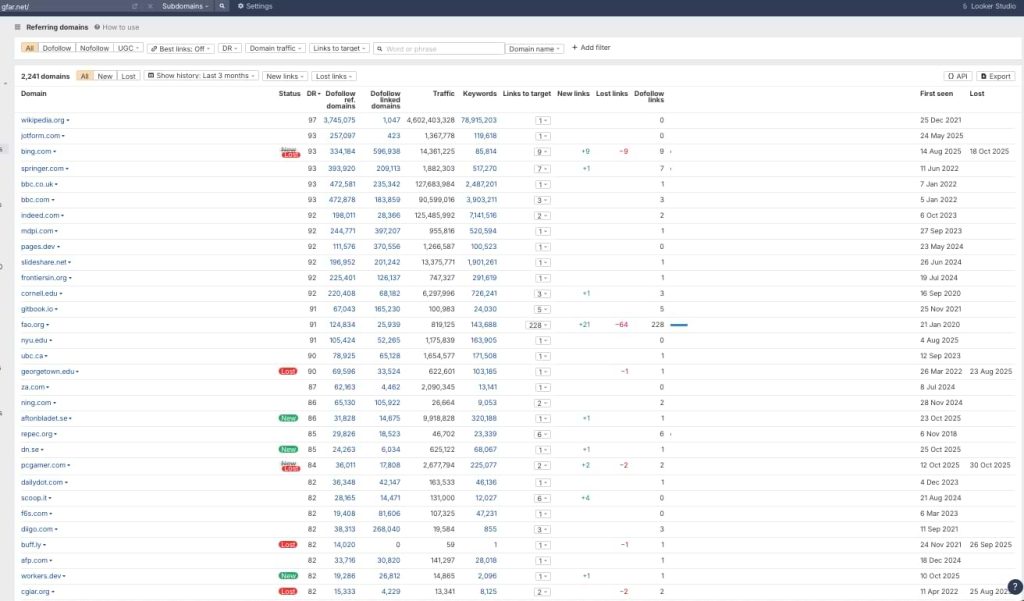
That’s when it was acquired, rebuilt, and rapidly repurposed into a casino affiliate site.
The transformation was not subtle. Today the front page is a casino portal. The top-ranking articles target Swedish players seeking to bypass the national licensing system. The site is fully optimized for “Spela utan Spelpaus,” “casino utan svensk licens,” and other high-value Swedish queries.
Even more remarkable is the speed at which it climbed the SERPs. Ahrefs data shows:
- Organic keywords: +200 in one month
- Organic traffic: +12,000%
- Ranking #1 for multiple ultra-competitive terms
This is not because the content is exceptional. It is because the domain arrived with hundreds of high-authority dofollow links from institutions that would neverknowingly endorse gambling — let alone unlicensed gambling.
This is what authority abuse looks like in practice.
“EU-funded parasite SEO” — a quiet but widespread trend
GFAR.net is only one example. When you start mapping the landscape, patterns emerge.
Across Europe, a worrying number of expired websites from:
- former EU research projects
- local development initiatives
- academic sub-domains
- cultural heritage sites
- NGOs
- regional innovation programmes
…are now quietly functioning as casino affiliate hubs.
Their previous lives often involved multi-million-euro funding packages, public-private partnerships, and links from trusted institutions. When these domains expire:
- They are snapped up by SEO operators.
- Casino content is deployed within days.
- The domain’s institutional trust is instantly recycled into ranking power.
The unintended result?
EU-funded link equity is now promoting unlicensed gambling across the continent.
This isn’t speculation — it’s visible in Ahrefs, Sistrix, Majestic, and public archive data. And once you know what to look for, the SERPs are littered with examples:
- expired cultural foundations now ranking for casino bonuses
- former academic institutes repurposed into slot review hubs
- ex-charity websites that now publish guides to crypto casinos
- local community project domains promoting “spel utan licens”
- expired restaurant or tourism site domains turned into affiliate farms
Some of these domains accumulated backlinks worth the equivalent of millions of euros in SEO value — funded directly or indirectly by public institutions.
The irony is painful.
The Swedish case: why this matters more than most realise
Sweden’s “casino utan svensk licens” market is among the world’s most competitive gray zones. It is:
- high-value
- high-volume
- high-risk
- heavily targeted by offshore operators
Demand remains enormous, driven in part by players seeking bonuses unavailable under the Swedish regulation.
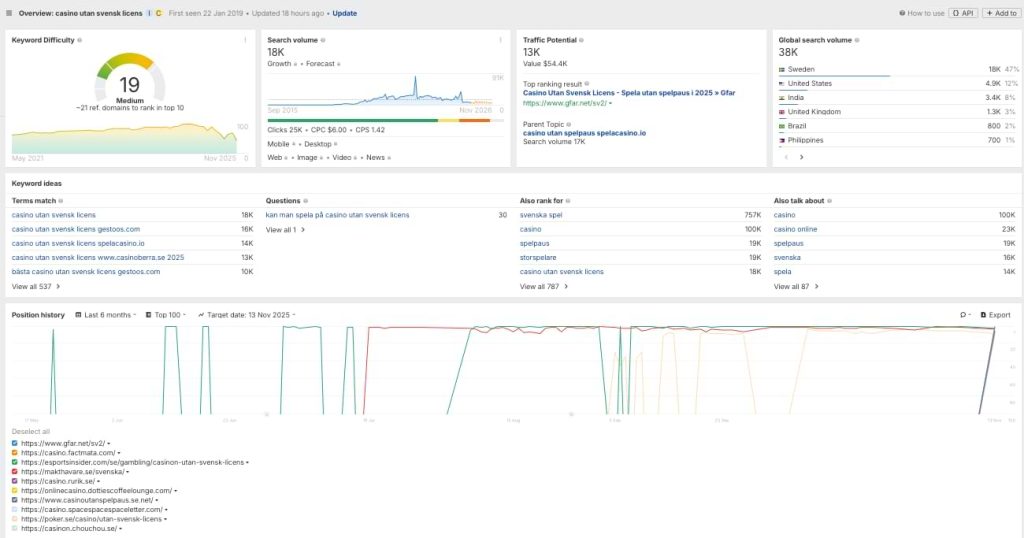
This makes Sweden the perfect laboratory for tracking SEO abuse — because the incentives are huge.
GFAR.net now outranks companies, media outlets, and affiliates who have operated legitimately for years. But this isn’t due to superior content or user trust. It’s due to:
- inherited authority from institutions like Cornell, the BBC, MDPI, and Wikipedia
- a backlink profile built for agriculture policy, not iGaming
- the absence of timely enforcement from Google
In short: It ranks because Google trusts the wrong people.
The bigger picture: Europe misunderstands the real threat to the SERPs
The European Commission is currently investigating Google for suppressing “parasite SEO.” The logic seems to be that Google may be unfairly demoting media organisations who sell sub-domains and editorial space to third-party content providers.
But the Commission has not addressed — or even acknowledged — the structurally far more damaging pattern:
The recycling of abandoned institutional authority into high-ranking casino affiliate operations.
Parasite SEO is a problem, yes. But authority abuse of expired domains is bigger, more scalable, and harder to regulate.
And unlike parasite SEO, which at least involves the original domain owner, expired-domain abuse involves:
- no continued oversight
- no compliance
- no ethical review
- no transparency
- no connection between past link donations and present content
The fact that a former UN-linked agriculture site now leads Sweden’s gray-market gambling SERPs should be a wake-up call for policymakers.
Instead, Brussels is currently arguing that Google shouldn’t penalize spam.
Why iGaming affiliates love expired domains
The incentives are simple:
1. They rank extremely fast
New casino domains can take 12–24 months to gain traction. Expired authority domains can rank in weeks.
2. They bypass link-building costs
Buying editorial links from major media outlets can cost €1,000–€5,000 each. GFAR.net inherited thousands — for free.
3. They create an illusion of trust
A domain linked by universities and scientific institutions seems “clean” to Google’s algorithm.
4. They provide plausible deniability
Owners rarely list themselves. Many operate behind shell companies or offshore registrars.
5. They allow instant multi-market expansion
One expired domain with enough authority can rank for:
- Swedish
- German
- Brazilian
- English
- Dutch
…in a matter of weeks.
What this means for the future of the European gambling web
Europe is already one of the world’s most fragmented and heavily regulated gambling markets. The rise of expired-domain casino networks adds another layer of complexity:
For regulators:
Their enforcement models are outdated. Link equity and domain authority are now being weaponised faster than legislation can adapt.
For operators:
Unlicensed casinos gain enormous SEO advantages, undermining licensed markets.
For affiliates:
Legitimate publishers are being outranked by domains that should never be in the gambling ecosystem.
For players:
Traffic is being funnelled to offshore operators with zero consumer protections — because Google believes a domain backed by Cornell University must be trustworthy.
Conclusion: Europe must address the right problem
Lars Lofgren was right: the current regulatory response targets the wrong villain.
Instead of accusing Google of being too strict on spam, regulators should ask:
- Why are expired institutional domains dominating high-risk sectors like gambling?
- Why is EU-funded authority being recycled to promote unlicensed casinos?
- How can search engines detect institutional authority hijacking more effectively?
- Why are the world’s most trusted institutions unknowingly endorsing offshore operators?
Until these questions are addressed, Europe’s most important SERPs will remain vulnerable to whoever is fastest to purchase expired authority — regardless of ethics, legality, or consumer safety.
And GFAR.net will remain the perfect symbol of this moment:
A global agricultural research initiative…transformed into Sweden’s leading portal for unlicensed casinos.
Welcome to the new era of authority abuse.