


In iGaming, a successful product is shaped not only by numbers and analytics, but also by accurate market signals captured by the sales team.
Sales acts as the bridge between the market and the product: through close work with partners, analysis of player behaviour, and constant monitoring of GEO-specific nuances, they are often the first to identify which products are ready to scale – and which still need refinement.
Angela, Team Lead Sales at DEVILS, shared her experience and explained how the role of sales goes far beyond selling and becomes a key driver of product growth.
How has the role of sales changed recently?
Nowadays, sales teams are no longer just sellers – they are the first to identify key market signals, gather insights from partners and users, and determine where the product is ‘alive’ and ready for scaling.
‘We gather raw data from our interactions with partners – why the product isn’t launching, what metrics are hindering scaling, which creatives perform well and which don’t,’ explains Angela.
These observations help identify trends long before they appear in analytical reports.
How is market and GEO analysis conducted?
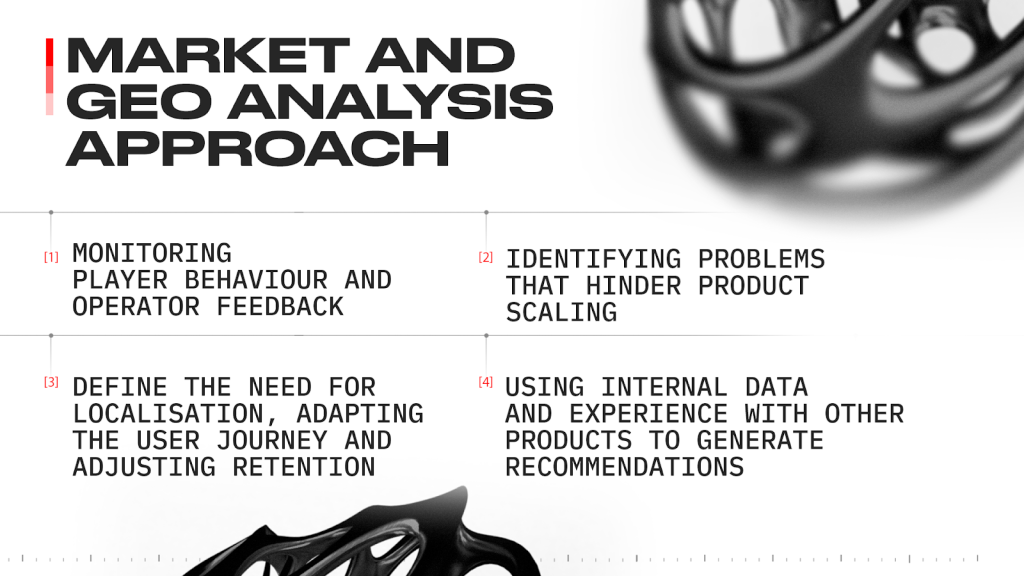
For sales teams, market awareness and exposure to various product types, both new launches and long-established ones, is essential. Continuous collaboration with the business development team helps them understand how top-performing products work, better sense dynamics among regions, and provide partners with recommendations based on real player behaviour patterns.
Source: Devils
DEVILS Sales relies on its own resources and analytics, which allows it to identify hidden patterns and make informed decisions at an early stage. This approach ensures stable product growth and effective adaptation to different regions.
How are insights shared within the teams?
In sales, it is important not only to identify problems or market signals but also to communicate them correctly to the development and marketing teams. It is at this stage that the value of insights is formed: if information is provided promptly and in the proper context, the product has the opportunity to grow faster, avoid mistakes, and adapt to specific GEOs.
‘If something goes wrong at a particular stage, we analyse the problem and give specific recommendations,’ explains Angela.
This type of work is closer to crisis management: by analysing a specific problem, the sales team develops practical steps to solve it. In some cases, initial product screening is conducted, but often adjustments are based on a combination of observations and experience gained from interacting with the product.
Case study: The DEVILS team noticed that one of the landing pages was not converting clicks into registrations as effectively as it could. We suggested some design improvements and demonstrated how the landing page could be more effective. After the changes were implemented, the conversion rate from installation to registration doubled. For the team, this meant that some of the installations that previously did not lead to registrations now started to work, generating additional revenue. The advertiser benefited as well: they could now spend less on attracting users by using this mechanism.
The effectiveness of this approach is based on the team’s expertise – a combination of data, experience, analysis of player behaviour, and a deep understanding of which product elements are critical for a specific GEO.