


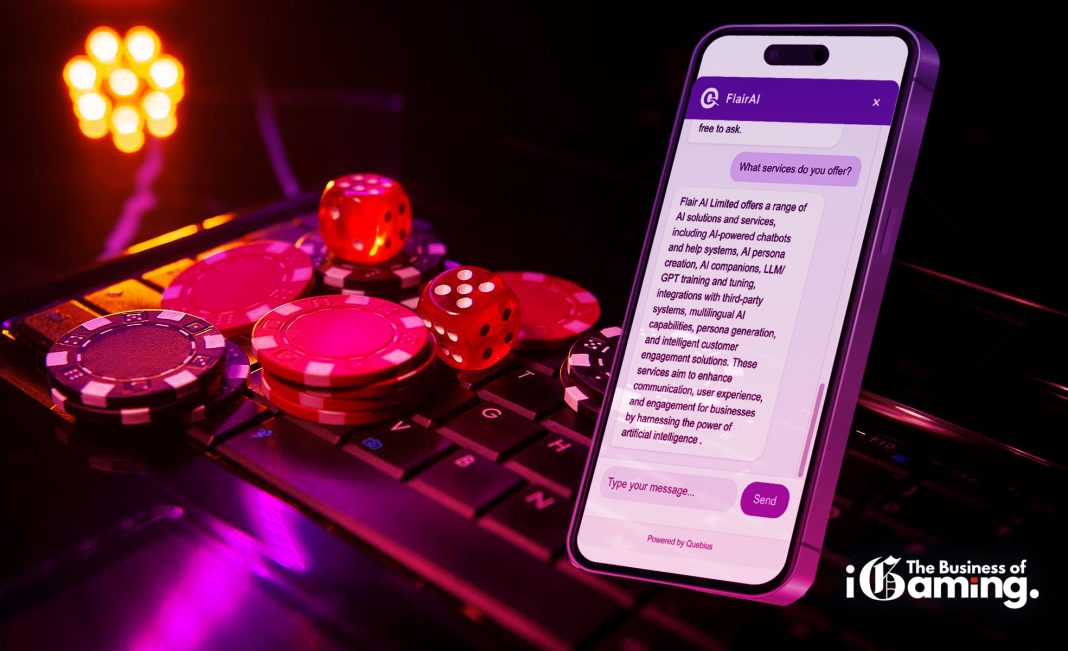

Every iGaming operator has a version of the same problem. Players ask the same handful of questions, over and over, at every hour of the day. How do I verify my account. Where is my withdrawal. What are the terms on this week’s bonus. Answering all of it with a human support team is expensive, and answering none of it fast enough costs conversions and goodwill. That is the exact gap an AI chatbot for iGaming operations is meant to close, and it is worth looking at what Quebius, from FlairAI, actually offers before assuming it is just another chat widget.
What Quebius Actually Does
Quebius is an AI-powered chat assistant platform built by FlairAI, positioned as a way to enhance customer service and streamline operations through natural language processing rather than simple keyword matching. The company describes it as combining AI with industry-specific configuration, so the assistant can be trained on a business’s own material rather than working from a generic script.
The setup process, as described on the Quebius site, follows four steps: connect the assistant to a website with a single code snippet, customise its appearance to match the brand, train it by uploading documents or pointing it at existing website content, and launch it to provide round-the-clock coverage. That last point matters more in iGaming than in most sectors, since players are active across time zones and support queues rarely go quiet.
Where an iGaming Operator Would Actually Use It
Quebius does not currently list iGaming as one of its named industry solutions. Its published verticals are government, healthcare, education, enterprise and workplace use cases. That said, the underlying mechanics, a trainable, customisable, document-fed chat layer sitting on top of a website, map fairly directly onto several recurring needs in an iGaming support operation.
Account and Payment Queries
A large share of operator support tickets are not complex. They are status checks: has my deposit landed, why is my withdrawal pending, what documents does verification need. These are exactly the kind of routine, repeatable questions Quebius is designed to absorb, based on the platform’s stated focus on handling routine customer service tasks so human teams can concentrate on harder cases.
Bonus Terms and Promotions
Wagering requirements, game weightings and promotional terms generate a steady stream of confusion, and getting the answer wrong has real consequences for player trust. An assistant trained directly on an operator’s own terms and conditions pages, rather than a generic model guessing at industry norms, is better placed to answer accurately, provided the underlying documents are kept current.
Lead Generation and Onboarding
One of the client testimonials on the Quebius site describes the chatbot engaging website visitors and guiding them toward the information they need, functioning, in the client’s words, like a salesperson available around the clock. For an operator’s marketing or affiliate-facing pages, that same behaviour could plausibly help move a visitor from a landing page toward signing up, though this would need testing against an operator’s own funnel rather than assumed.
Internal Knowledge for Support and Compliance Teams
Beyond the player-facing chat widget, Quebius is also described as giving employees instant access to internal information, reducing pressure on HR and IT teams. In a licensed iGaming business, where support staff often need quick, accurate answers on jurisdiction-specific rules, that same internal-facing use case could help reduce the time agents spend digging through policy documents mid-conversation.
Where Operators Need to Be Careful
None of this removes the need for human oversight, and gambling is a more sensitive category than most of the sectors Quebius currently serves publicly. Responsible gambling messaging, self-exclusion requests and anything touching on a player showing signs of distress need to route to a trained human, not be resolved entirely by an automated assistant. Any operator considering an AI chatbot for iGaming support should treat this as a configuration and escalation-routing decision from day one, not an afterthought.
Licensing and data handling requirements also vary by jurisdiction, so operators would need to confirm how player data is stored and processed before connecting any third-party AI layer to a regulated gambling website, in the same way they would vet any other vendor touching player information.
Security and Customisation
Quebius markets itself around three consistent pillars beyond the AI layer itself: security of the chat integration, customisation to match a business’s branding, and scalability from a small operation to a larger enterprise. For an operator running multiple brands or skins, as is common across the iGaming affiliate and white label space, the ability to retrain and rebrand the same underlying assistant for each property is a practical advantage over building separate support tooling per brand.
Final Thoughts
Quebius was not built with a casino floor in mind, and it shows in the industries it lists on its own site. But the actual mechanics behind it, trainable on real documents, quick to deploy, customisable per brand, built to reduce load on human teams, line up closely with the everyday support burden an iGaming operator carries. The sensible next step for any operator is not to assume it is a drop-in fit, but to trial it against a narrow set of routine queries first, keep a clear human escalation path for anything sensitive, and expand from there if the results hold up.
For more on where artificial intelligence is actually landing across the sector right now, see our ongoing AI in iGaming coverage, and follow the latest iGaming innovation stories as new tools reach operators.