




An analysis of Blask’s latest research reveals what happens when a regulated gambling industry is abruptly shut down. India’s experience suggests that consumer demand can survive prohibition, even as licensed operators lose customers, tax revenues disappear and gambling activity moves into less transparent channels.
Brazil’s decision to prohibit online sports betting and casino operations has created one of the most dramatic regulatory reversals in the modern iGaming industry. After spending years establishing a licensing framework and attracting international operators, the country has moved to dismantle a regulated market that generated an estimated $6.6 billion in gross gaming revenue during 2025.
The immediate consequences are already becoming visible. Licensed operators have experienced a sharp decline in traffic, advertising activity has been disrupted and businesses face uncertainty over investments made to satisfy Brazil’s regulatory requirements. Yet the most important question is not how quickly licensed platforms disappear. It is what happens to the millions of consumers who previously used them.
A new 33-page study published by Blask on 6 October 2026 offers an unusually detailed perspective. By examining India’s restrictions on real-money gaming in 2025 and comparing subsequent browsing behavior with Brazil, the research provides evidence of how gambling demand can persist after legal channels are removed.
The findings suggest a potentially uncomfortable outcome for policymakers: prohibition may substantially reduce participation in licensed gambling without producing an equivalent reduction in gambling activity overall.
However, India’s experience also reveals an important qualification. Not every displaced player immediately moves offshore. Some stop gambling, at least temporarily, while others gradually find alternative platforms. Understanding that transition is essential to assessing what could happen in Brazil.
India Provides an Important Warning for Brazil
India’s experience is particularly relevant because its restrictions affected an established domestic real-money gaming industry, including fantasy sports, rummy and other paid gaming products.
The Promotion and Regulation of Online Gaming Act was passed in August 2025, prompting major domestic platforms to withdraw cash gaming offerings. The legislation subsequently came fully into force in May 2026.
The consequences for established domestic operators were severe. Companies that had invested heavily in technology, customer acquisition and product development suddenly faced a business environment in which their principal revenue-generating activities could no longer continue.
Yet offshore gambling platforms did not experience the same collapse.
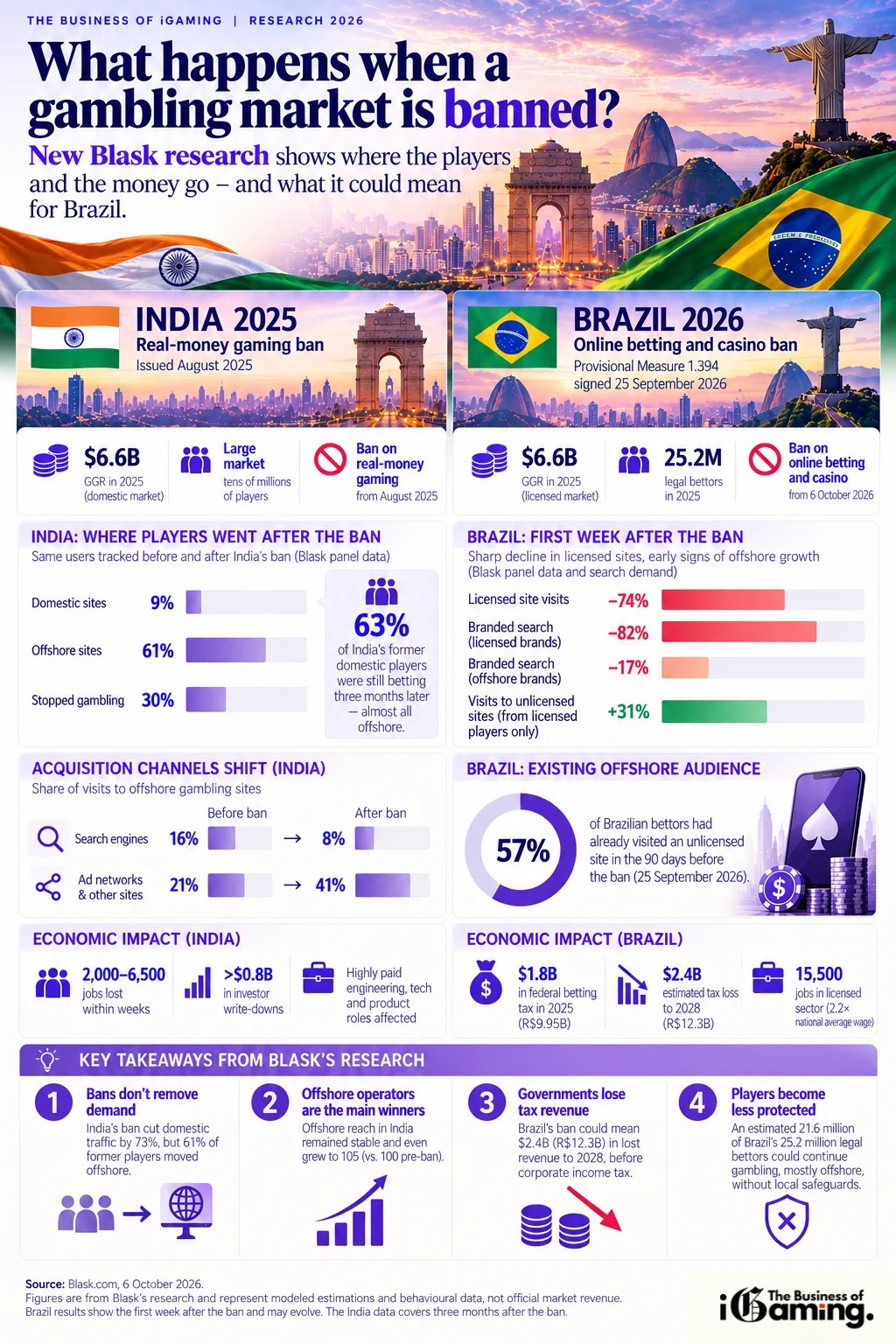
Blask’s research followed a fixed group of internet users before and after the Indian restrictions. Among 657 panel participants who had previously visited domestic real-money gaming sites, approximately 63% continued visiting gambling sites during the three months following the legislative change. Around 61% visited offshore platforms, while only 9.3% returned to domestic real-money gaming sites.
The comparison with Brazil is important. In a comparable Brazilian group not subject to a ban during the same period, 73.5% continued gambling. India’s restrictions therefore reduced continued participation relative to the control group, but the reduction was considerably smaller than the collapse in domestic gambling-site usage.
This distinction matters. The disappearance of legal operators from a market is not the same as the disappearance of their former customers.
The findings do not establish that all displaced gambling expenditure transferred offshore. The behavioral panel measures visits rather than deposits, betting volume or revenue. Nevertheless, it provides evidence that a substantial proportion of users continued seeking gambling products despite the removal of domestic alternatives.
Brazil’s Licensed Operators Were Already Losing Traffic Before the Shutdown
Brazil’s regulatory reversal was exceptionally rapid. According to the Blask report, Provisional Measure 1.394 was signed on 25 September 2026, restricting fixed-odds sports betting and online casino operations. Licensed platforms were required to stop accepting deposits, allow customers to withdraw balances and prepare for the shutdown of their services.
The research captures the first week of this transition, ending on 1 October.
During that period, the share of Blask’s Brazilian browsing panel visiting licensed betting websites fell sharply. By 1 October, licensed-site reach was approximately 73.5% below its normal level.
The company’s branded-search data showed a similar pattern. Demand for licensed gambling brands declined by more than 80%, while offshore brands experienced a considerably smaller reduction.
At first glance, this might suggest that gambling demand was disappearing. However, the early behavioral evidence presents a more complicated picture.
Among 5,970 panel participants who had previously used only licensed platforms, visits to unlicensed gambling websites increased from approximately 5.1% during a normal week to 6.7% following the announcement.
That represents a relative increase of roughly 31%, but it remains a relatively small proportion of the affected group.
In other words, the early evidence does not demonstrate an immediate mass migration to offshore operators. Many consumers appear to have stopped using gambling sites during the transition, potentially while withdrawing funds, waiting for clarity or reconsidering their options.
This is one of the most important findings in the report. The licensed market can contract almost immediately, while the longer-term redistribution of demand takes considerably more time to become visible.
The Real Winner Could Be Offshore Gambling
The central risk for Brazil is that consumers who continue gambling may increasingly turn toward operators outside the country’s licensing framework.
Before the prohibition announcement, unlicensed gambling was already part of the Brazilian market. Blask’s research found that 57% of Brazilian panel participants who had visited a betting website during the preceding 90 days had also accessed an unlicensed site.
This means that offshore alternatives were not entirely unfamiliar to many consumers.
The report also identifies overlapping networks of gambling websites serving users in both India and Brazil. Some operators maintain multiple domains, including alternative addresses that do not prominently display their principal brand names.
These networks create a different competitive environment from the regulated market. Licensed operators must maintain identifiable entities, comply with local rules and operate through approved systems. Offshore platforms may be harder to monitor, particularly when traffic is distributed across changing domains and intermediary websites.
Blask projects that approximately 21.6 million of Brazil’s 25.2 million previously licensed bettors could continue gambling following the ban, with much of that activity potentially moving offshore.
That figure should be treated as a scenario derived from India’s experience, not an observed Brazilian outcome.
Brazil and India differ in important respects, including gambling products, payment infrastructure, enforcement capabilities and previous consumer familiarity with offshore websites. These differences could produce either faster or slower migration.
Nevertheless, the economic incentives are clear. If demand survives while licensed supply disappears, operators willing to serve that demand outside the regulated system may gain a competitive advantage.
A Gambling Ban Could Also Transform Affiliate Marketing
One of the most interesting findings in the Blask study concerns the channels through which consumers discover gambling platforms. Before India’s restrictions, search engines accounted for approximately 16% of visits to offshore gambling websites. By the period from May to September 2026, that share had fallen to 8%.
Over the same comparison, advertising networks and other referring websites increased their share from 21% to 41%.
| Acquisition channel | India before restrictions | India, May–September 2026 |
| Search engines | 16% | 8% |
| Advertising networks and other websites | 21% | 41% |
Source: Blask behavioral panel. Figures represent shares of visits to offshore gambling sites, not shares of advertising expenditure or gambling revenue.
This suggests that restrictions can change not only which operators attract customers, but also how those customers reach them.
In a regulated market, acquisition is typically built around recognizable brands, search visibility, advertising partnerships and licensed affiliate relationships. Once those channels are restricted, consumers may increasingly encounter gambling platforms through alternative domains, redirects, messaging services and less transparent advertising networks.
The implications for established affiliates are substantial.
A prohibition can eliminate legitimate commercial partnerships without eliminating the underlying demand that previously supported them. Meanwhile, less accountable traffic intermediaries may continue operating outside the structures that licensed affiliates are expected to follow.
This does not mean that regulated affiliates should attempt to follow consumers into prohibited channels. On the contrary, businesses operating in Brazil must consider the legal restrictions on gambling promotion and intermediation.
The wider lesson is that regulation can reshape the entire acquisition ecosystem, sometimes in ways that make gambling activity less visible to authorities and conventional market researchers.
Why Search Data May Underestimate Gambling After a Ban
There is another important analytical consequence. Blask reports that branded search demand for gambling operators in India declined substantially following the implementation of its restrictions. By August 2026, its search-based index was approximately 33% below the corresponding month in 2025.
However, its behavioral panel indicated that offshore website visits remained broadly stable relative to the Brazilian control.
These findings are not necessarily contradictory. They measure different activities.
A consumer who repeatedly accesses a gambling website through a bookmark, direct link or alternative domain may generate fewer branded searches than someone discovering or researching an operator for the first time.
As a result, a decline in search activity does not necessarily establish an equivalent decline in gambling participation.
This distinction is particularly relevant for companies that rely on search-based intelligence to estimate market size, brand strength or commercial potential.
Metrics such as Blask Index and Competitive Earning Baseline can provide valuable information about consumer attention and modeled commercial activity. However, the relationship between those indicators and actual gambling expenditure may change when consumers move away from conventional discovery channels.
For Brazil, this means that future market analysis should ideally combine search demand, website behavior, payment data and independently reported financial figures rather than relying on a single source.
Brazil Risks Losing More Than Gambling Tax Revenue
The economic implications extend well beyond the operators themselves. According to figures cited in Blask’s report, Brazil’s regulated betting sector generated approximately $6.6 billion in gross gaming revenue during 2025 and contributed around $1.8 billion in federal betting taxes.
The country also collected approximately $456 million in licensing fees from 85 authorizations.
These amounts represent different economic categories. Gross gaming revenue measures operator revenue after winnings are paid, whereas tax receipts and licensing fees represent government income. They should not be added together as though they were interchangeable measures of market value.
The industry’s investments also supported employment in technology, compliance, cybersecurity, marketing, customer service and payments.
Blask cites estimates of approximately 15,500 jobs associated with the licensed sector, including around 10,000 direct positions.
A sudden regulatory reversal creates uncertainty for these employees and for the suppliers serving the licensed industry. International operators may redirect investment toward other markets, while domestic companies face the possibility that infrastructure built specifically for Brazil will no longer be commercially useful.
Sports sponsorships are another important consideration. Gambling operators have become significant commercial partners for Brazilian football clubs, and restrictions on advertising could affect sponsorship arrangements and club finances.
The precise long-term losses will depend on the duration of the restrictions, court decisions, legislative developments and the extent to which other commercial partners replace gambling-related spending.
India offers a warning about potential disruption, but it cannot provide a precise forecast of Brazilian job losses or tax receipts.
The Player Protection Paradox
The strongest argument for strict gambling restrictions is that governments have a legitimate interest in reducing addiction, financial harm, fraud and exposure among vulnerable consumers.
Those concerns should not be dismissed. A reduction in gambling participation could produce meaningful public-health benefits, and the early Brazilian data suggests that at least some consumers temporarily stopped using gambling websites.
However, the policy question becomes more complicated when consumers continue gambling through unlicensed platforms.
Brazil’s regulated framework established requirements relating to customer identification, age verification, responsible gambling and financial monitoring. Offshore websites operating outside that framework may not follow equivalent standards.
If a significant proportion of consumers migrate to those platforms, regulators could lose visibility over the very activities they are trying to control.
The result could be a market with fewer licensed operators but persistent gambling demand, weaker domestic oversight and greater difficulty enforcing consumer safeguards.
That outcome is not inevitable. Effective restrictions could reduce total gambling participation, particularly if enforcement covers payment systems, advertising and access to illegal operators. But India’s experience indicates that shutting down domestic businesses alone may not be sufficient.
The appropriate measure of regulatory success should therefore include changes in total gambling participation, consumer harm and offshore activity, rather than simply the number of licensed websites that have closed.
What Should Operators and Affiliates Do Next?
For businesses exposed to Brazil, the immediate challenge is to separate short-term legal compliance from long-term strategic planning.
Operators must respond to applicable restrictions, protect customer balances, maintain records and assess their obligations to employees, partners and regulators. They also need to evaluate whether preserving local infrastructure is commercially sensible while the legal position remains unsettled.
Affiliates face a different problem. Their Brazilian traffic and existing commercial relationships may retain economic value, but that does not mean they can legally continue promoting gambling products.
For companies with international operations, diversification across jurisdictions may reduce dependence on any single regulatory framework. However, expansion into other countries requires its own assessment of licensing conditions, competitive dynamics and customer acquisition economics.
The situation also highlights the importance of regulatory risk in market valuation. A large market with rapid demand growth can become commercially inaccessible almost overnight if its legal framework changes.
For operators, suppliers and investors, regulatory stability may ultimately be as important as market size.
Three Possible Scenarios for Brazil
The next phase will depend heavily on political and legal developments.
Scenario 1: The restrictions remain in place. Licensed gambling activity contracts sharply, and some existing customers may gradually migrate to offshore platforms. Total participation could fall, but the size of any reduction remains uncertain.
Scenario 2: Sports betting returns under a revised framework. Lawmakers could distinguish between sports betting and online casino products, allowing part of the regulated industry to resume. Operators would then face the challenge of rebuilding consumer trust, distribution and commercial partnerships.
Scenario 3: The measure is suspended or expires. A legal reversal could create a pathway back toward regulated operations, although the disruption to investment, staffing and sponsorships would not necessarily disappear immediately.
These are analytical scenarios, not predictions of legislative or judicial outcomes. Their likelihood cannot be established from the Blask behavioral dataset alone.
Conclusion: Prohibition Changes the Market, but Does It Eliminate Demand?
Brazil’s gambling prohibition represents an important test of the relationship between regulation, consumer behavior and the economics of the iGaming industry.
India’s experience demonstrates that the disappearance of domestic real-money gaming businesses does not necessarily eliminate consumer demand. Blask’s behavioral research found that a substantial proportion of former domestic users continued visiting gambling platforms, predominantly offshore.
Brazil’s initial data shows an immediate collapse in licensed-site activity, but it is too early to conclude that the country’s entire gambling audience has already migrated elsewhere.
The longer-term outcome will depend on enforcement, consumer preferences, alternative payment channels and whether the regulatory environment changes again.
For policymakers, the challenge is to determine whether restrictions genuinely reduce gambling-related harm or simply redirect activity into channels that are harder to monitor.
For the iGaming industry, the lesson is equally important. Commercial demand and legally accessible demand are not the same thing, and a market’s regulatory framework can change far more quickly than the behavior of its consumers.
The ultimate success or failure of Brazil’s restrictions will not be determined by how many licensed websites disappear. It will be determined by what happens to the players after they do.
Sources
Blask (6 October 2026) — What Brazil’s Betting Ban Will Do to Its Market: India’s 2025 Ban Shows Where the Players and the Money Go. Primary source for behavioral panel findings, search-demand analysis, economic estimates and forward scenarios.
Editorial note: This article is an independently written analysis by The Business of iGaming, based primarily on Blask’s 6 October 2026 research.