


Brazil had spent years transforming one of the world’s largest offshore gambling economies into a licensed, taxable and increasingly mature regulated market. Then, in September 2026, the direction changed almost overnight. The consequences will extend far beyond operators themselves – to suppliers, affiliates, media companies, football clubs, payment providers and thousands of people whose jobs were built around the Brazilian opportunity. The bigger question is whether gambling demand disappears with the regulated market, or simply moves somewhere Brazil can no longer control.
Let’s go back to last week’s biggest story in iGaming. On 25 September 2026, President Luiz Inácio Lula da Silva signed a provisional measure prohibiting the operation, offering, intermediation and advertising of fixed-odds betting in Brazil. The prohibition covers sports betting and online casino gaming. New deposits stopped immediately, players were given until 5 October to withdraw funds voluntarily, and licensed betting websites and apps are scheduled to go offline from 6 October. The measure must still pass through Congress to remain in force beyond its provisional period.
It is difficult to overstate what a reversal this represents. Less than two years earlier, on 1 January 2025, Brazil’s fully regulated federal betting market had opened. International operators invested heavily, Brazilian brands expanded, suppliers fought for distribution, affiliates built businesses around the market and the government collected billions of reais from licensing and taxation. Brazil appeared to be moving towards becoming one of the defining regulated iGaming markets of the decade.
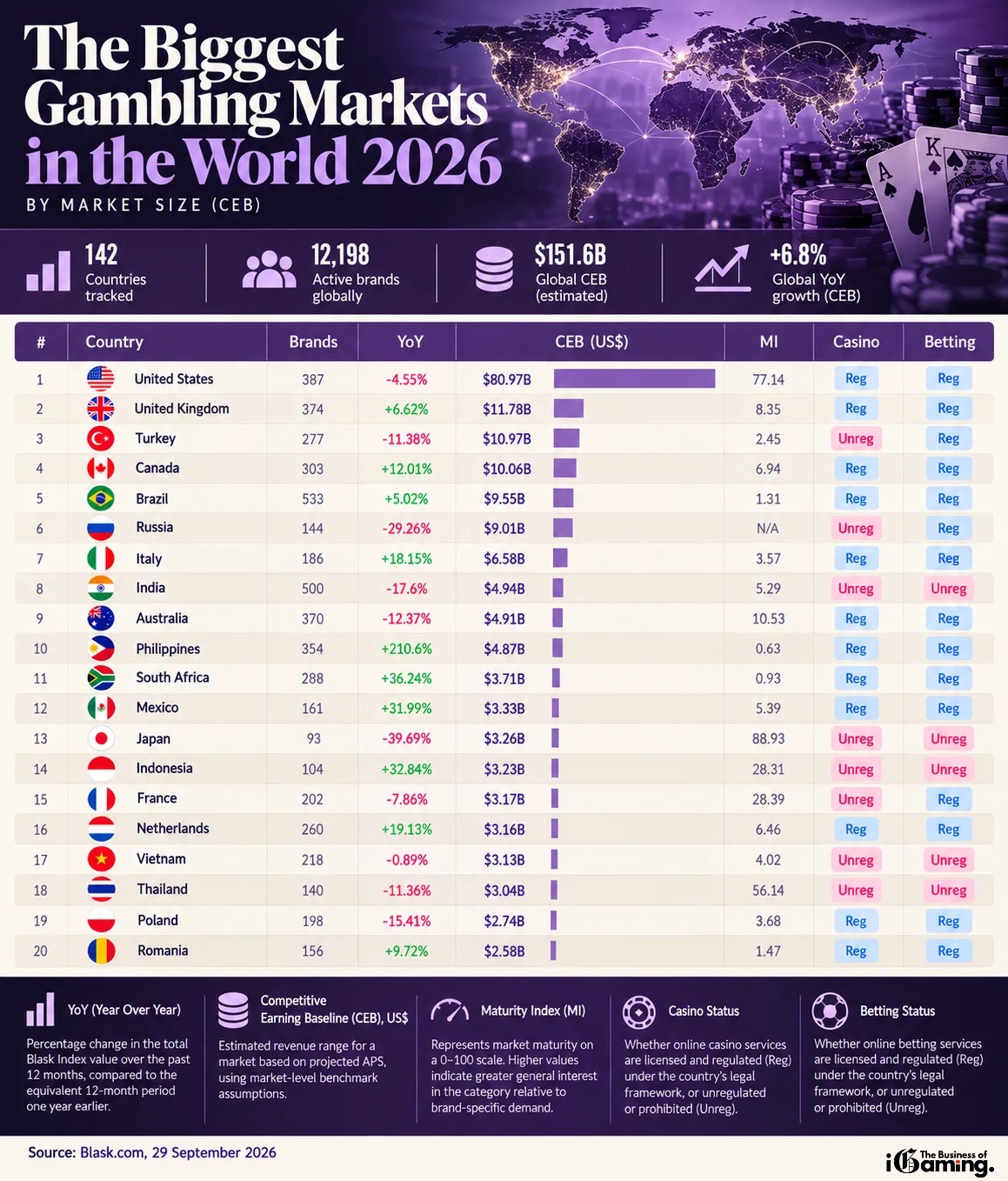
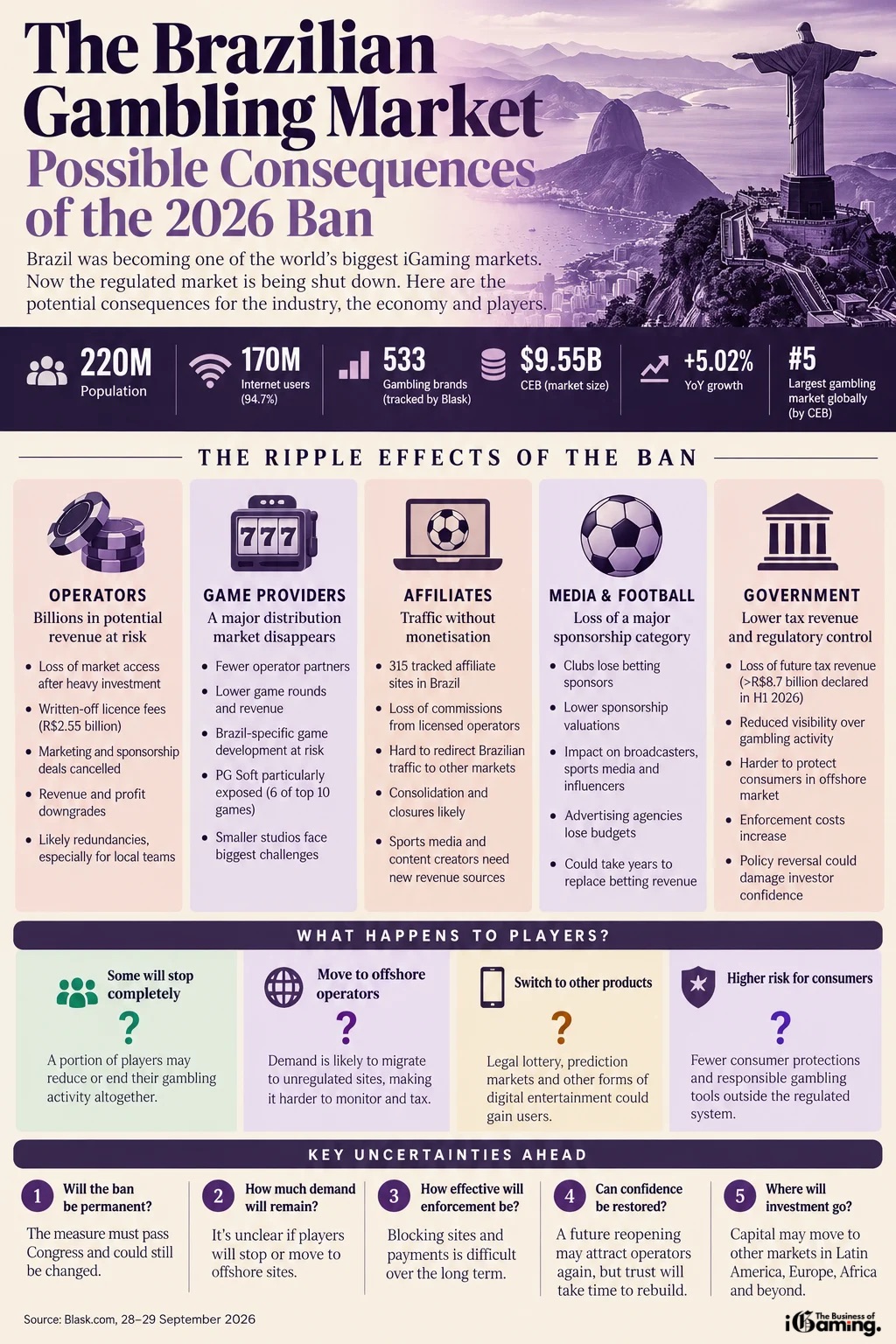
The latest Blask.com data provides what may now become a snapshot of that market close to its high-water mark. As of 28–29 September 2026, Brazil had 533 tracked gambling brands, 82.39 million APS and a Competitive Earning Baseline of approximately $9.55 billion. Brazil ranked fifth among the 142 countries, behind only the United States, United Kingdom, Turkey and Canada.
Those figures do not simply tell us what Brazil was. They provide a glimpse of what the market could have become if the regulatory experiment launched in 2025 had been allowed to mature. That is why the story is considerably bigger than the closure of a collection of betting websites.
Brazil had already become one of the world’s most important iGaming markets
The scale becomes clearer when Brazil is viewed internationally. The United States led with approximately $80.97 billion in CEB, followed by the UK at $11.78 billion, Turkey at $10.97 billion and Canada at $10.06 billion. Brazil came next at $9.55 billion, ahead of Russia at $9.01 billion, Italy at $6.58 billion, India at $4.94 billion and Australia at $4.91 billion.
Blask’s CEB – Competitive Earning Baseline – should not be confused with reported GGR. It is a modelled estimate of the revenue potential available to a brand under benchmark assumptions, incorporating factors such as projected APS, user retention and average revenue per user. Nevertheless, it provides a useful comparative indicator of market scale. By that measure, Brazil had entered the global top five while the market was still developing.
Brazil’s CEB was 5.02% higher year-on-year in the latest snapshot, despite falling 11.56% month-on-month amid the extraordinary disruption surrounding the ban. The market contained 533 tracked brands, while the demographic information supplied by Blask puts Brazil’s population at approximately 220 million and its internet population at around 170 million.
This was no longer a speculative emerging market that operators hoped might eventually become important. Brazil had already become one of global iGaming’s major commercial battlegrounds.
The 10 biggest gambling operators in Brazil
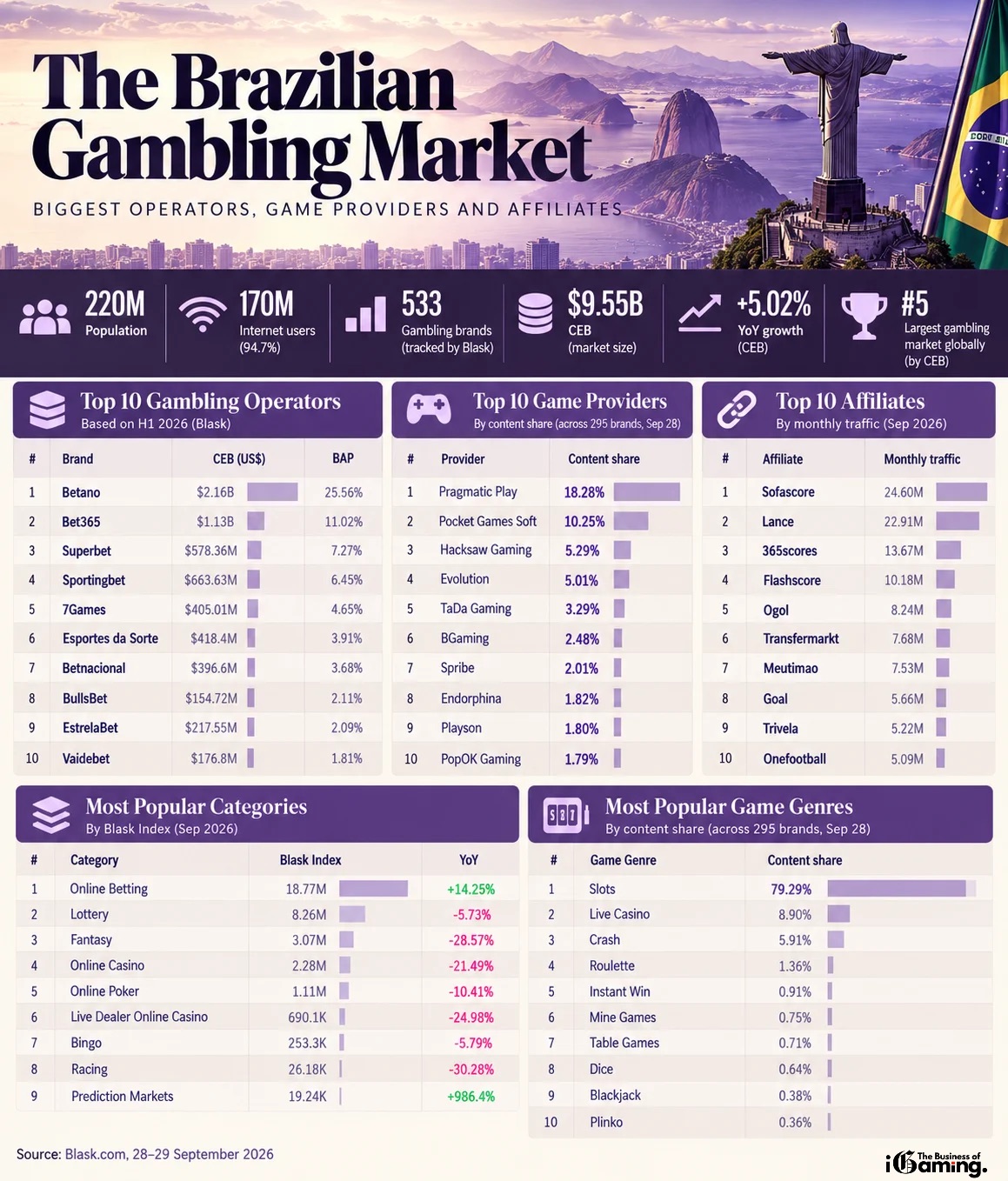
The latest public Blask market snapshot places Betano far ahead by consumer interest, with a BAP of 31.56%, followed by bet365 at 8.77%, Superbet at 7.01%, Sportingbet at 5.81% and Esportes da Sorte at 3.97%.
For a complete top ten with CEB, the most recent complete published Blask ranking available is its H1 2026 dataset. The distinction matters: the table below should therefore be read as the H1 2026 operator benchmark, rather than as an exact ranking for 29 September.
| Position | Brand | BAP | Average monthly CEB | Change vs H1 2025 |
| 1 | Betano | 25.5% | $234.7M | +5.2 pp |
| 2 | bet365 | 11.0% | $136.5M | +1.2 pp |
| 3 | Superbet | 7.8% | $73.7M | +3.1 pp |
| 4 | Sportingbet | 6.1% | $78.6M | −2.4 pp |
| 5 | 7Games | 4.7% | $50.2M | +1.3 pp |
| 6 | Esportes da Sorte | 4.0% | $49.5M | −3.7 pp |
| 7 | Betnacional | 3.5% | $46.6M | −2.1 pp |
| 8 | BullsBet | 2.5% | $20.1M | +1.9 pp |
| 9 | EstrelaBet | 2.1% | $26.0M | −0.5 pp |
| 10 | Vaidebet | 1.8% | $21.4M | −0.7 pp |
Source: Blask.com 29 September 2026.
What is striking about the table is not simply Betano’s dominance, but the amount of investment represented across the top ten. These companies fought for Brazilian market share through football sponsorships, affiliate programmes, television advertising, performance marketing, bonuses, product localisation, CRM, customer service and technology. Betano’s position alone represents years of accumulated brand equity, and its share of measurable consumer interest appears to have strengthened further during the second half of the year.
Much of that investment was made on the assumption that Brazil was becoming a long-term regulated market. A licence was not supposed to be a short-lived ticket into a market that might disappear within two years. Operators were building businesses around the expectation that the Brazilian opportunity would mature over the remainder of the decade.
That assumption has now been fundamentally challenged.
Brazil had achieved something regulators around the world struggle to achieve
Perhaps the most important part of the Brazilian story is how successfully gambling had been channelised into the regulated market. According to Blask’s H1 2026 analysis, licensed and local operators represented approximately 96.4% of CEB, compared with 87.9% a year earlier. International and offshore operators had consequently fallen from 12.1% to only 3.6%.
At the same time, average monthly CEB increased from $430 million in H1 2025 to $1.13 billion in H1 2026, while the number of active brands increased from 485 to 525.
That combination is important because one of the fundamental objectives of gambling regulation is not necessarily to eliminate gambling demand. It is to bring an activity that already exists inside a framework where governments can tax it, supervise operators, enforce standards and provide consumers with legal protections. Brazil appeared to be accomplishing precisely that. The offshore share had been pushed down to only 3.6%, meaning the overwhelming majority of estimated economic activity had migrated inside the regulated ecosystem.
The decision to prohibit the regulated product therefore creates an unusual real-world experiment. Brazil has already demonstrated that it can move players from offshore operators towards licensed alternatives. Now it is attempting to determine what happens when those licensed alternatives are removed.
The central question is no longer how successfully Brazil can channel players into regulation. It is what happens to the other 96.4% when the regulated destination disappears.
Brazil was much more than a sports betting market
International coverage of Brazil often concentrates on sportsbooks, partly because bookmakers became so visible through football sponsorship. The underlying Blask data, however, shows a much broader digital gambling economy in which casino had become deeply established.
Across 295 brands in the supplied September snapshot, slots represented almost four-fifths of available casino content. Live casino and crash games had also established meaningful positions, while roulette, instant-win games, mines, blackjack and other formats filled smaller but still significant niches.
Most popular online casino categories in Brazil
| Position | Game genre | Content share |
| 1 | Slots | 79.29% |
| 2 | Live Casino | 8.90% |
| 3 | Crash | 5.91% |
| 4 | Roulette | 1.36% |
| 5 | Instant Win | 0.91% |
| 6 | Mine Games | 0.75% |
| 7 | Table Games | 0.71% |
| 8 | Dice | 0.64% |
| 9 | Blackjack | 0.38% |
| 10 | Plinko | 0.36% |
Source: Blask, 28 September 2026.
The dominance of slots is extraordinary, but the broader distribution matters because the commercial consequences of Brazil’s decision extend directly into the supplier industry. The closure of a sportsbook primarily affects operators, data suppliers, sports organisations and related acquisition channels. The closure of an online casino ecosystem simultaneously affects hundreds of studios whose games depend on those operators for distribution.
The 10 biggest game providers in Brazil
Brazil’s casino lobby had developed into a highly competitive supplier environment. Pragmatic Play held the largest content share in the supplied Blask snapshot at 18.28% across the 295 brands included in the analysis. Pocket Games Soft followed at 10.25%, while Hacksaw Gaming and Evolution occupied third and fourth position.
| Position | Game provider | Content share |
| 1 | Pragmatic Play | 18.28% |
| 2 | Pocket Games Soft | 10.25% |
| 3 | Hacksaw Gaming | 5.29% |
| 4 | Evolution | 5.01% |
| 5 | TaDa Gaming | 3.29% |
| 6 | BGaming | 2.48% |
| 7 | Spribe | 2.01% |
| 8 | Endorphina | 1.82% |
| 9 | Playson | 1.80% |
| 10 | PopOK Gaming | 1.79% |
Source: Blask, 28 September 2026.
Operators are the visible storefronts of iGaming, but suppliers provide much of what is inside those stores. If hundreds of licensed casino sites disappear from Brazil, suppliers lose distribution, game rounds and ultimately revenue attributable to Brazilian players. The largest companies are geographically diversified and can absorb the shock, but the impact becomes more significant for studios that had identified Brazil and Latin America as major growth markets.
The player-demand data also shows that exposure is not evenly distributed. A provider does not necessarily need to dominate the overall content catalogue to dominate actual consumer attention.
What Brazilians were actually playing
Perhaps the most revealing part of the supplied data is the ranking of individual games. PG Soft accounts for only 10.25% of provider content share, yet six of the ten games generating the greatest player interest are PG Soft titles. This indicates a significant difference between the amount of content supplied to Brazilian casinos and the games Brazilian players actually seek out.
The 10 most popular online casino games in Brazil
| Position | Game | Provider | Genre | Share of Interest |
| 1 | Fortune Tiger | Pocket Games Soft | Slots | 21.24% |
| 2 | Fortune Rabbit | Pocket Games Soft | Slots | 10.21% |
| 3 | Blackjack | Various providers | Live | 7.52% |
| 4 | Fortune Dragon | Pocket Games Soft | Slots | 6.45% |
| 5 | Fortune Ox | Pocket Games Soft | Slots | 6.27% |
| 6 | Pinata Wins | Pocket Games Soft | Slots | 3.00% |
| 7 | Dragon Hatch | Pocket Games Soft | Slots | 2.19% |
| 8 | Fortune Dragons | Wizard Games | Slots | 2.18% |
| 9 | Fortune Dragon | Infinity Dragon Studios | Slots | 1.90% |
| 10 | Gates of Olympus | Pragmatic Play | Slots | 1.89% |
Source: Blask Player Demand, 29 September 2026.
Fortune Tiger alone accounts for 21.24% of Share of Interest, while Fortune Tiger and Fortune Rabbit together exceed 31%. Blask’s earlier research also found Fortune Tiger had been Brazil’s most popular casino game for 41 consecutive months from February 2023 through June 2026.
For PG Soft, Brazil was therefore not simply another large geographical market. It was a country in which several of its products had achieved exceptional penetration and brand recognition. If Brazilian casino demand does not disappear but instead moves offshore, it will be particularly interesting to observe whether players continue searching for the same games. If they do, the demand for Fortune Tiger and similar titles could remain while the regulated distribution infrastructure around them changes completely.
What Brazilians gamble on: the wider picture
The broader category data reinforces the point that Brazil’s gambling economy cannot be reduced to one product. Online betting is overwhelmingly the largest measured category, with a Blask Index of 18.77 million, and was still growing by 14.25% year-on-year in the supplied one-year view. Lottery follows at 8.26 million, while fantasy, online casino, poker and live dealer casino form substantial secondary categories.
Gambling categories by Blask Index
| Position | Category | Blask Index | YoY |
| 1 | Online Betting | 18.77M | +14.25% |
| 2 | Lottery | 8.26M | −5.73% |
| 3 | Fantasy | 3.07M | −28.57% |
| 4 | Online Casino | 2.28M | −21.49% |
| 5 | Online Poker | 1.11M | −10.41% |
| 6 | Live Dealer Online Casino | 690.1K | −24.98% |
| 7 | Bingo | 253.3K | −5.79% |
| 8 | Racing | 26.18K | −30.28% |
| 9 | Prediction Markets | 19.24K | +986.4% |
Source: Blask, one-year category view, September 2026.
There are two particularly interesting trends here. First, online betting remained the dominant category and was still growing despite the broader political debate around gambling. Secondly, many traditional online gambling verticals were already contracting, including online casino at −21.49%, live dealer at −24.98%, fantasy at −28.57% and racing at −30.28%.
Prediction markets sit at the opposite extreme. Their Blask Index remains tiny at only 19.24K, but the measured year-on-year increase of 986.4% illustrates how rapidly new speculative products can emerge from a low base. That is relevant to the regulatory discussion because consumer behaviour and digital products frequently develop faster than legislation. Suppressing one category does not necessarily suppress the underlying appetite for wagering, speculation and risk-based entertainment.
What products do Brazilian gamblers actually use?
The supplied consumer survey makes the overlap between different forms of gambling particularly clear. Traditional sports were used by 70% of respondents, but half also used lottery products and 45% played live casino. Poker or Rummy and esports were each used by 40%, while slots and other instant games were used by 35%.
| Product | Respondents |
| Traditional sports | 70% |
| Lottery | 50% |
| Live casino | 45% |
| Esports | 40% |
| Poker or Rummy | 40% |
| Slots and other instant games | 35% |
| Virtual sports | 30% |
| Fantasy Sports | 30% |
| Bingo | 25% |
| Entertainment & Politics | 20% |
Source: Blask survey data supplied, 2026. Multiple answers permitted.
This is another reason why analysing the Brazilian market purely through the lens of sportsbooks is misleading. Many consumers participate across multiple gambling products. A sports bettor can also be a lottery player, casino player, poker player and fantasy-sports participant. If one channel disappears, consumers may therefore migrate not only towards offshore equivalents but also towards other gambling and speculative products that remain accessible.
Why Brazilians gamble matters just as much as what they gamble on
The motivation data adds another important dimension because it helps explain why assuming demand will simply disappear may be overly simplistic. Among sports bettors, 71% said earning money was a motivation, but financial gain was far from the only reason people participated. Half said betting made sport more exciting, 42% enjoyed the process, 40% enjoyed the adrenaline, and 35% said supporting a favourite team was one of their motivations.
Main motivations for sports betting
| Motivation | Respondents |
| To earn money | 71% |
| Betting makes sport more exciting | 50% |
| To enjoy the process | 42% |
| To feel the adrenaline | 40% |
| Pass time when bored | 35% |
| Support a favourite team | 35% |
| Check my intuition | 30% |
| Escape from routine | 30% |
| Win without reference to money | 25% |
| Comfortable/easy from home | 25% |
Source: Blask survey data supplied, 2026. Multiple answers permitted.
Casino motivations show a similar pattern. Earning money was cited by 60%, while 35% enjoyed the process, 30% cited adrenaline and 25% valued either convenience or passing the time.
| Casino motivation | Respondents |
| To earn money | 60% |
| To enjoy the process | 35% |
| To feel the adrenaline | 30% |
| Pass time when bored | 25% |
| Comfortable/easy from home | 25% |
| To win | 20% |
| Check my intuition | 20% |
| Try new casinos or games | 20% |
| Play from any convenient place | 20% |
| Escape from routine | 20% |
Source: Blask survey data supplied, 2026. Multiple answers permitted.
These motivations are relevant to the prohibition debate because legislation can remove a regulated product without removing the psychological and social motivations that produced demand for it. The desire to make money, add excitement to football, experience risk, relieve boredom or simply enjoy gambling does not disappear when an operator’s website goes offline. Whether consumers stop, reduce their participation, move to other products or seek offshore alternatives will determine the real effect of the policy.
Affiliates: the hidden industry behind the Brazilian boom
The affiliate sector could be one of the most severely affected parts of the ecosystem because it sits between operators and the audiences they were competing to acquire. Blask tracks 315 affiliates in Brazil, ranging from dedicated gambling properties to some of the country’s largest sports-information platforms.
The supplied one-month traffic snapshot illustrates just how substantial those audiences are.
Brazil’s 10 largest gambling-related affiliates by traffic
| Position | Affiliate | Monthly traffic | Brands | Tracked pages |
| 1 | Sofascore | 24.60M | N/A | N/A |
| 2 | Lance | 22.91M | 7 | 6 |
| 3 | 365Scores | 13.67M | 25 | 2 |
| 4 | Flashscore | 10.18M | 23 | 21 |
| 5 | O Gol | 8.24M | 13 | 3 |
| 6 | Transfermarkt | 7.68M | 20 | 3 |
| 7 | Meu Timão | 7.53M | 32 | 16 |
| 8 | Goal | 5.66M | 14 | 1 |
| 9 | Trivela | 5.22M | 44 | 7 |
| 10 | OneFootball | 5.09M | 14 | 2 |
Source: Blask Affiliates, one-month view, September 2026.
These figures demonstrate why describing the situation as an “operator problem” misses a large part of the economic picture. Brazil had developed an enormous acquisition ecosystem in which sports publishers attracted football fans, comparison sites ranked operators, specialist SEO sites captured gambling searches, influencers promoted brands and affiliate managers negotiated commercial agreements.
For diversified sports publishers, gambling represents only one potential monetisation channel and advertising from other industries can replace at least part of the lost revenue. Specialist gambling affiliates face a very different problem. A Brazilian visitor searching for “best betting sites Brazil” has obvious commercial value when ten licensed operators are competing to acquire that player. If there are no licensed operators available, the search traffic can remain while much of its legitimate commercial value disappears.
Traffic is geographically specific. A Brazilian gambling website cannot simply redirect its audience to Canada or Sweden because another regulated market is available there. That is why affiliates with particularly heavy Brazilian exposure could become some of the most vulnerable businesses in the entire ecosystem.
Who are the biggest losers?
Operators are the most obvious casualties, but the economic chain extends much further. Flutter has estimated that the prohibition could reduce its 2026 revenue by approximately $70 million and adjusted core profit by around $20 million. Entain has also warned about the impact, with Brazil having been expected to represent roughly 5% of its 2026 online net gaming revenue.
Those companies are multinational groups capable of absorbing the loss of a jurisdiction. The consequences could be much more severe for companies whose business models were built primarily around Brazil. A local affiliate deriving most of its revenue from Brazilian operators cannot simply diversify internationally overnight, and neither can an advertising agency whose largest clients are sportsbooks or a B2B supplier that invested heavily in Brazilian integrations.
The most useful way to think about the Brazilian gambling industry is therefore as an ecosystem rather than a collection of betting sites. A customer depositing with an operator may indirectly generate revenue for a payment processor, KYC provider, game supplier, odds provider, CRM platform, affiliate, sports-data business, media publisher, advertising agency and football club. Remove the licensed operator at the centre of that chain and the financial impact radiates outward.
Redundancies are a logical next consequence
Employment is one of the areas where the effects may take longer to become visible. Brazil’s expansion created jobs across customer service, CRM, payments, compliance, marketing, content, SEO, design, product management, affiliate management, trading, fraud prevention and responsible gambling. Many multinational operators also created Brazilian country teams and hired local specialists precisely because they expected Brazil to remain a major strategic market.
If the closure persists, maintaining all of those positions becomes increasingly difficult to justify economically. Large multinational groups may be able to move some employees into regional or international roles, and certain technology or compliance functions can support other jurisdictions. Many positions, however, are inherently local. A Brazilian CRM team exists because there are Brazilian customers to communicate with, while a Brazilian affiliate team exists because there are Brazilian affiliates and acquisition campaigns to manage.
That does not mean thousands of redundancies will necessarily be announced immediately. A more plausible initial progression is hiring freezes, reduced freelance and contractor budgets, cancelled agency contracts, lower marketing expenditure and consolidation of regional teams. If the market remains closed for longer, formal restructuring and redundancies become increasingly plausible.
Game providers could be among the less visible losers
The supplier consequences deserve considerably more attention. The supplied Blask dataset includes hundreds of providers and shows how competitive Brazilian casino distribution had become. Every licensed casino lobby that disappears represents distribution disappearing with it, which means fewer game rounds and lower supplier revenue attributable to Brazil.
The largest global suppliers can absorb this more easily because Brazil is only one of many markets. Smaller studios face a different calculation, particularly if Latin America formed a large part of their expansion strategy. Development budgets, Portuguese localisation, commercial teams and integration work may all have been justified partly by anticipated Brazilian growth.
The PG Soft example is especially revealing. Six of the ten games with the highest measured Share of Interest in the supplied dataset come from the company, while Fortune Tiger alone accounts for 21.24%. If the regulated market disappears but player demand for those games remains, the games themselves do not necessarily lose their appeal. What changes is where consumers attempt to find them.
That is where the offshore question becomes unavoidable.
Where do the players go?
There are several possible answers, and the eventual outcome is likely to be a combination of them. Some consumers will stop gambling completely. Others will reduce their gambling frequency. Some will move towards legal products that remain available, including lotteries, while others may migrate towards adjacent forms of entertainment or speculation.
There will also be consumers who attempt to continue using online betting and casino products. How large that group becomes is one of the most important unanswered questions in the Brazilian story.
Brazilian authorities clearly recognise this risk. Enforcement plans include domain blocking, app removal and restrictions on payment methods used by illegal operators, while authorities have also intensified action against websites suspected of offering unauthorised gambling.
Such measures can create substantial friction and make offshore gambling more difficult. The difficulty is that enforcement of internet gambling is rarely static. Domains can change, payment methods can evolve and operators can adapt their acquisition methods. Brazil will therefore need continuing enforcement rather than a single round of website blocking.
Gambling does not necessarily disappear – it can migrate
The terminology here matters. “Black market” is commonly used in gambling discussions, but offshore, unlicensed or illegal gambling market can be more precise depending on the operator involved. An operator may hold a licence in another jurisdiction while lacking authorisation to target Brazilian customers; another may operate with minimal oversight; at the extreme end are sites offering players virtually no meaningful regulatory protection.
From the Brazilian regulator’s perspective, the central problem is that these operators sit outside the domestic regulatory perimeter. Brazil cannot supervise them in the same way it can supervise licensed .bet.br companies, cannot collect normal domestic gambling taxes from them and has less ability to enforce Brazilian consumer-protection and responsible-gambling standards.
This is why the eventual movement of player demand matters so much. A reduction in regulated gambling is not necessarily identical to a reduction in gambling itself. If substantial demand migrates to operators outside Brazilian regulation, the government could succeed in shrinking the visible legal industry while retaining a significant underlying gambling economy.
The paradox: Brazil had already beaten the offshore market
That possibility makes Brazil’s policy reversal particularly unusual. Before regulation, offshore gambling dominated the country’s online market. By H1 2026, Blask estimated that licensed and local operators accounted for 96.4% of CEB, leaving international and offshore operators with only 3.6%.
Brazil had therefore achieved what many gambling regulators spend years attempting to accomplish: it created a legal offering attractive enough that consumers overwhelmingly chose regulated operators. This did not eliminate gambling-related harm, nor does it resolve the legitimate political debate about whether gambling should have been permitted in the first place. It does, however, mean Brazil had successfully moved a very large proportion of measurable activity inside a system where the state could see, tax and regulate it.
The next phase effectively tests the reverse proposition. If legal operators disappear, does gambling demand disappear with them, or does part of the 96.4% begin migrating back towards the offshore market?
That is the number the industry should watch.
The consumer-protection paradox
The strongest argument behind Brazil’s decision concerns the social costs associated with gambling. Household indebtedness, gambling-related harm and the rapid visibility of betting in everyday Brazilian life have all become important political issues. Those concerns are substantial and should not be dismissed simply because the regulated market had become commercially successful.
At the same time, prohibition creates its own policy trade-offs. A licensed operator can be required to verify identities, enforce age restrictions, offer self-exclusion, monitor problematic gambling, comply with anti-money-laundering requirements, protect customer funds and cooperate with regulators. An offshore operator may voluntarily provide some of these protections, but an unauthorised operator is not subject to the same Brazilian regulatory enforcement.
If prohibition substantially reduces gambling participation, policymakers may consider that trade-off worthwhile. If a meaningful proportion of demand instead migrates outside the regulated perimeter, Brazil could face gambling-related harm while possessing fewer tools with which to identify and mitigate it.
That distinction will ultimately matter much more than the number of websites blocked during the first weeks of enforcement.
Then there is the money
The regulated system also represented a considerable investment by the industry. Brazil says 85 licences had been granted at R$30 million each, meaning approximately R$2.55 billion had been paid in licence fees. The provisional measure also addresses the consequences for authorisation holders, an issue that will inevitably feature in the legal and commercial aftermath.
Beyond licence payments were offices, salaries, sponsorship agreements, marketing contracts, technology integrations and acquisition expenditure. Much of that money was spent because companies expected to generate returns over several years.
That leads to a longer-term consequence that is more difficult to quantify than lost GGR: regulatory confidence.
The biggest long-term loss may be confidence
Brazil can theoretically reopen online gambling at some point. Its fundamental attractiveness would remain enormous. A population exceeding 200 million, high internet penetration, a huge sporting culture and demonstrated demand make the country difficult for international gambling companies to ignore permanently.
What cannot be restored quite as quickly is confidence.
Imagine an international operator’s board being asked in several years to approve another major Brazilian investment. The discussion would no longer concern only customer acquisition costs, taxation, competition and projected revenue. Executives would also have to ask what prevents another regulatory reversal after the company has committed capital.
Companies can model higher taxation. They can model deposit limits, bonus restrictions and tighter advertising rules. They can adapt to stronger KYC and responsible-gambling requirements. A market disappearing after companies have paid licence fees and invested heavily is a much more difficult risk to model.
That does not mean investment would never return. It means companies may demand faster payback, allocate less permanent infrastructure to Brazil, price greater regulatory risk into partnerships and diversify their exposure much earlier.
The market could return without returning to the same investment environment.
Brazilian football will feel the consequences as well
The gambling economy had also become deeply connected with Brazilian football. Betting companies emerged as major sponsors of clubs, competitions and sports media, creating a commercial relationship that extended far beyond direct gambling revenue.
Removing an entire sponsor category simultaneously changes the economics of sponsorship. Brazilian football remains enormously attractive to advertisers, and other industries will inevitably fill part of the gap. The issue is bargaining power. When numerous betting operators compete for sponsorship inventory, clubs can use that competition to increase the value of their commercial rights. If those buyers disappear at the same time, replacement advertisers negotiate in a different environment.
The effect can consequently extend to clubs, broadcasters, football websites, podcasts, influencers, agencies and sports-data businesses. Gambling revenue does not need to appear directly on their balance sheets for them to feel the impact of its disappearance.
Affiliates face an even stranger future
Affiliates face a particularly unusual dilemma because the audience can remain after the commercial opportunity disappears. The supplied Blask data shows Sofascore receiving 24.6 million monthly visits, Lance 22.91 million, 365Scores 13.67 million and Flashscore 10.18 million in the Brazilian affiliate landscape.
For diversified sports publishers, gambling advertising can potentially be replaced with advertisers from other industries. For specialist betting affiliates, the problem is much more fundamental. A website can continue ranking for bookmaker comparisons, casino reviews and betting queries while having no licensed operators to which it can legally send those users.
Organic traffic therefore does not necessarily disappear, but its legitimate monetisation value can collapse. That dynamic could drive consolidation throughout the affiliate industry, with larger international groups better positioned to absorb losses or redirect resources while smaller Brazil-dependent websites are sold, merged, repurposed or closed.
Consolidation could spread across B2B
The same principle applies throughout the supply chain. Large operators can absorb Brazil because they generate revenue in dozens of markets. Large suppliers can do the same, as can international affiliate groups and technology companies. Businesses that built a disproportionate amount of their strategy around Brazil have much less room to manoeuvre.
That creates the conditions for consolidation. A supplier that raised capital specifically for Latin American expansion may suddenly need another market or another owner. An affiliate whose valuation was based heavily on Brazilian revenue could become an acquisition target. Agencies may merge, technology businesses may reduce headcount and smaller service providers may decide that continuing independently no longer makes economic sense.
The eventual corporate consequences could therefore continue appearing long after the initial regulatory headlines have disappeared.
Where does the investment go?
Another overlooked consequence is that capital allocated to Brazil does not necessarily disappear from iGaming. Operators and suppliers will simply reconsider where it should be deployed.
Some of that capital may be returned to shareholders, but much of it can move elsewhere. Other Latin American jurisdictions could benefit, as could emerging African markets, established European jurisdictions, new regulated markets and adjacent products. Suppliers that planned Brazilian integrations can redirect development resources. Affiliates can invest in other languages and geographies. Operators can transfer acquisition budgets into countries where market access appears more predictable.
That creates an opportunity cost for Brazil that is difficult to measure. The country does not merely lose the money that companies were spending in September 2026; it potentially loses investment that would have been made in 2027, 2028 and beyond.
Once that capital creates teams, technology and market positions elsewhere, bringing it back becomes more difficult.
What happens to regulation itself?
The political and legal story is not finished. The measure is provisional and must go through Congress to become permanent, while operators and industry groups are assessing legal challenges and other responses. That means several outcomes remain possible rather than the current arrangement necessarily representing Brazil’s final gambling framework.
The ban could remain largely intact, Congress could modify it, courts could affect implementation or Brazil could eventually introduce another regulatory model. Before prohibition, the country had also been debating substantially tighter restrictions on advertising, sponsorship, bonuses and consumer protection, demonstrating that the alternative to the previous framework was not necessarily an unrestricted market on one side and prohibition on the other.
There is an enormous regulatory spectrum between those positions. Brazil could eventually choose to reopen with tighter affordability controls, more restrictive advertising rules, stronger responsible-gambling requirements, tougher payment oversight and higher barriers to entry. Whether there is political appetite for such a model remains uncertain.
What could Brazil have become?
This is where the story turns into one of the great counterfactuals of modern iGaming. H1 2026 demand was already 15.8% higher than H1 2025. Average monthly CEB had increased dramatically, the number of active brands had risen and the offshore share had fallen to just 3.6%.
Brazil was developing recognisable market leaders rather than simply attracting hundreds of interchangeable offshore sites. Betano was pulling away from competitors, Superbet was growing, bet365 remained deeply established and Brazilian brands were competing with multinational groups. PG Soft had produced some of the country’s most recognisable casino games, Pragmatic Play led supplier content share, hundreds of affiliates competed for acquisition traffic and Brazilian football had become intertwined with betting sponsorship.
Most importantly, the regulated market was beginning to look like an ecosystem rather than an experiment. Operators, suppliers, affiliates, payment companies, sports organisations, advertising agencies and technology providers were all investing around the assumption that Brazil would remain one of global gambling’s major markets for years to come.
We will now never know with certainty what that market would have looked like in 2030.
What was — and what could have been
That may ultimately be what makes September 2026 such an important moment in iGaming history. The snapshot from 28–29 September could eventually resemble a photograph taken close to the end of Brazil’s first regulated online gambling era: 533 brands, approximately $9.55 billion in CEB and 82.39 million APS, placing Brazil fifth among the 142 countries included in the supplied dataset.
Within that market, Betano had reached 31.56% BAP in Blask’s latest public snapshot. Slots represented 79.29% of casino content, Pragmatic Play held 18.28% provider content share, Fortune Tiger alone represented 21.24% of measured game interest, and Blask tracked 315 affiliates competing within the Brazilian ecosystem.
Yet the figure that may matter most is 96.4%.
That was the estimated share of CEB held by licensed/local operators in H1 2026. Brazil had spent years attempting to bring online gambling inside a system it could supervise, and by that measure it had largely succeeded.
Now we are going to find out what happens when the regulated destination disappears.
The Brazilian experiment is entering its second phase
The first Brazilian experiment was regulation: could the country persuade people who had previously gambled offshore to use licensed Brazilian operators instead? The evidence from Blask suggests that the answer was overwhelmingly yes.
The second experiment is much more difficult. Can Brazil persuade those same consumers to stop gambling online altogether?
There is no credible basis yet for claiming to know the answer. Gambling participation may fall significantly, enforcement may prove effective and consumers may decide that offshore alternatives are too inconvenient or too risky. Some may shift towards legal lottery products or simply stop.
Another outcome is also possible. Consumers may continue searching for sportsbooks and casino games, offshore operators may attempt to capture that demand, payment methods may adapt and acquisition could migrate away from mainstream advertising towards less visible channels.
If the first outcome dominates, prohibition will have materially reduced online gambling. If the second becomes significant, Brazil could find itself with a smaller regulated gambling market without an equivalent reduction in actual gambling activity.
Those are very different outcomes from a public-policy perspective.
This is much bigger than the bookmakers
It is tempting to frame the Brazilian story as Betano, bet365, Superbet, Sportingbet and other operators losing access to a lucrative jurisdiction. That is only the most visible layer of what is happening.
Behind every operator sits a commercial chain consisting of game studios, payment processors, KYC providers, fraud-prevention companies, sports-data businesses, CRM platforms, affiliates, media companies, advertising agencies, football clubs, influencers, software developers, compliance specialists and customer-service teams. The regulated market created an economic ecosystem around itself, and the larger that ecosystem became, the larger the shock created by removing its central source of revenue.
For some multinational businesses, Brazil was one line in a global P&L and the losses can be absorbed elsewhere. For other companies, Brazil represented the core of the investment thesis. For employees, contractors and smaller businesses in that second group, the consequences could be much more profound than a disappointing quarterly earnings report.
There may be a way back – but not back to exactly where Brazil was
Brazil’s gambling market may eventually reopen in some form. The country’s demographics, digital economy, football culture and demonstrated consumer demand make it too commercially significant to assume that the story ends permanently in September 2026.
Even so, returning legislation to where it stood before 25 September would not automatically return the market to where it stood before 25 September. The episode itself has changed the risk calculation. Operators will remember it when approving investment, suppliers when negotiating agreements, affiliates when deciding where to build content businesses and investors when valuing companies dependent on Brazilian regulation.
Rebuilding the market would therefore require more than switching websites back on. It would require rebuilding confidence that companies investing under one regulatory framework will have sufficient time to generate a return before that framework changes fundamentally.
Confidence takes years to build and can be damaged in days.
The number to watch now is not revenue
Over the coming months there will be considerable attention on CEB, search demand, operator revenue, website traffic and the number of domains authorities block. All of those numbers will tell us something, but one metric could eventually tell us much more: the offshore share of Brazilian gambling demand.
Earlier in 2026, Blask estimated it at only 3.6% of CEB. If gambling demand collapses alongside the regulated market and offshore share remains marginal, the evidence would suggest prohibition materially changed consumer behaviour.
If overall gambling interest remains substantial while offshore share climbs from 3.6% towards 10%, 20%, 30% or more, a very different picture would emerge. Brazil would then be transferring some gambling activity from an environment in which operators were licensed, taxed and monitored into one where domestic regulators have considerably less control.
That is why the ultimate test of Brazil’s decision is unlikely to be how many licensed sites disappear on 6 October. It will be where the players go afterwards.
Brazil spent years moving gambling demand from offshore operators into a regulated system. In September 2026, it decided to remove that system. What happens next could become one of the most important gambling-policy case studies of the decade – not only for Brazil, but for every government deciding whether the answer to gambling-related harm is stricter regulation, prohibition, or something between the two.
For the global iGaming industry, the Brazilian story has therefore only just begun.
Market data in the tables is based on the supplied Blask snapshots from 28–29 September 2026 unless otherwise specified. CEB is Blask’s modelled Competitive Earning Baseline and should not be interpreted as operator-reported revenue. BAP represents a brand’s share of measured consumer interest.