


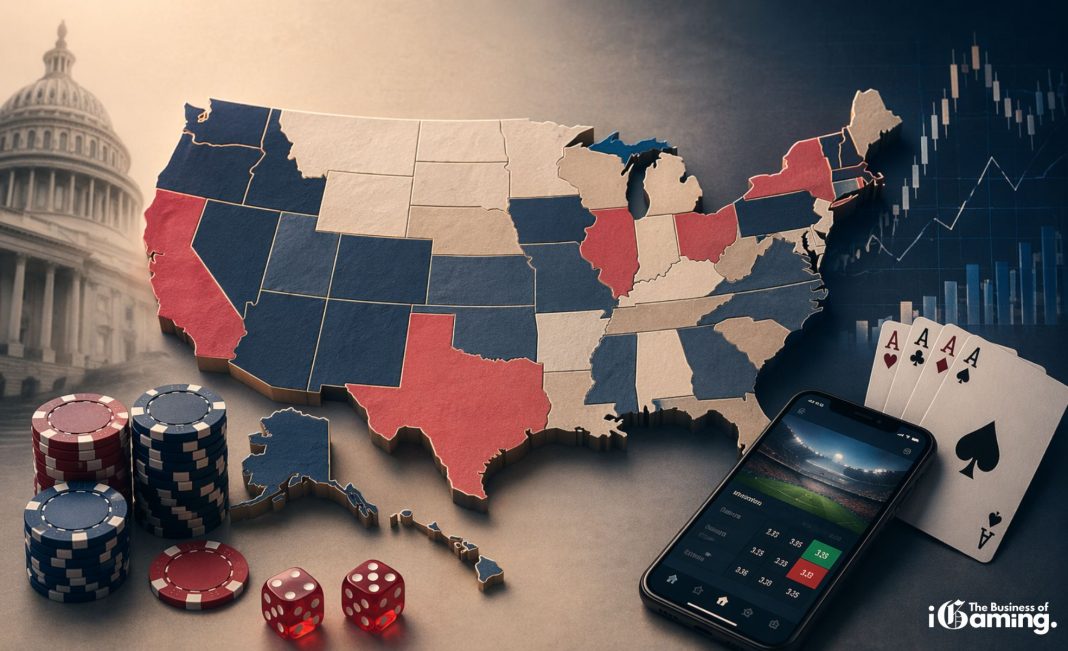

The United States is often described as the largest opportunity in global iGaming. What the data increasingly shows, however, is that this opportunity is not a single market – but a collection of competing, overlapping and structurally inefficient ecosystems operating under one flag.
United States iGaming & Betting at a Glance
| Metric | Value |
|---|---|
| Total Online Gambling Market (CEB) | ~$79.8B |
| Licensed Market Share | ~$25.2B |
| Offshore Market Share | ~70–75% |
| Total Commercial Gambling Revenue (GGR) | $71.9B (2024) |
| Sports Betting Revenue | $16.96B |
| Forecast Online Market Size | ~$40B by 2029 |
| Gambling Participation Rate | 57% of adults |
| States with Legal Sports Betting | 38 |
| States with Full iGaming | 8 |
With an estimated $79.8 billion in Competitive Earning Baseline (CEB) in 2025, the U.S. stands as the world’s largest online gambling economy. Combined with $71.9 billion in commercial gambling revenue in 2024, the scale of the market is not in question.
What is in question is how efficiently that value is captured.
The U.S. is not a market. It is a network of state-level economies
A Market Where Offshore Operators Still Dominate
Despite regulatory expansion, the U.S. market remains structurally offshore. Approximately 80–83% of operators serving U.S. players are unlicensed, with the majority of market value—around three quarters of total CEB—flowing outside the regulated system.
This dynamic mirrors broader industry patterns, where illegal or unregulated gambling continues to account for a meaningful share of total activity across segments.
The Illusion of a Unified Market
The U.S. is not a market. It is a network of state-level economies. Seven U.S. states would rank among the global top 10 markets if treated as standalone countries. New York alone operates at a scale comparable to major international jurisdictions, despite significant offshore leakage.
This creates a structural paradox: scale exists independently of regulation.
State-Level Power: Where Value Is Created (and Lost)
Top U.S. Markets by CEB (Selected States)
| State | CEB (US$) | BAP | YoY | Regulation |
|---|---|---|---|---|
| New York | $6.35B | 5.2% | -0.83% | Betting only |
| California | $5.7B | 13.77% | +10.22% | Unregulated |
| Pennsylvania | $5.77B | 4.06% | -9.07% | Full regulation |
| New Jersey | $5.73B | 3.12% | -12.07% | Full regulation |
| Michigan | $4.9B | 3.21% | -11.72% | Full regulation |
| Texas | $4.4B | 9.31% | +12.95% | Unregulated |
| Ohio | $4.36B | 3.16% | -12.69% | Betting only |
The conclusion is consistent across states: regulation determines capture, not demand.
Seven U.S. states would rank among the global top 10 markets if treated as standalone countries.
The Leading Operators: A Market Split Between Offshore and Regulated Giants
Top Betting & Casino Brands in the U.S.
| Brand | CEB (US$) | BAP | YoY |
|---|---|---|---|
| Bovada | $8.46B | 15.92% | +0.97% |
| BetOnline | $4.8B | 8.52% | +31.8% |
| DraftKings | $6.88B | 6.58% | -8.36% |
| FanDuel | $7.41B | 5.74% | -12.24% |
| Rainbet | $1.73B | 4.89% | +1630% |
| MyBookie | $3.04B | 4.85% | -13.23% |
| BetMGM | $2.54B | 1.84% | -31.27% |
| Bet365 | $751M | 1.39% | -17.24% |
| BitStarz | $735M | 1.00% | +27.58% |
The data highlights a growing divide: offshore and crypto-native operators are gaining momentum, while regulated incumbents face stagnation or decline.
Understanding the Metrics
- CEB → projected earning potential
- BAP → share of demand / visibility
- YoY → demand momentum
These metrics measure market reality—not just reported performance.
Category-Level Demand: What Players Actually Want
One of the most revealing layers of the U.S. market is category demand—independent of operator positioning.
U.S. Gambling Demand by Category (Blask Data)
| Category | Blask Index | YoY | Key Sub-Drivers |
|---|---|---|---|
| Lottery | 226.9M | -4% | Mass market participation |
| Fantasy Sports | 11.06M | +16% | Strong U.S. cultural fit |
| Live Casino | 10.63M | -2% | Blackjack dominant |
| Online Betting | 8.5M | +13% | NFL, NBA driving growth |
| Online Casino | 8.21M | +2% | Slots + general demand |
| Poker | 4.27M | +5% | Stable niche |
| Bingo | 3.63M | -1% | Declining relevance |
| Racing | 533K | -16% | Legacy vertical |
| Prediction Markets | 352.8K | +292% | Emerging segment |
Category Analysis: A Market Misaligned with Its Narrative
The category data challenges several common assumptions about the U.S. betting market.
First, lottery remains the dominant form of gambling by a significant margin, highlighting that mass-market behavior is still driven by accessibility and simplicity rather than complexity or frequency.
Second, while online betting shows solid growth (+13% YoY), it is not the dominant demand driver many assume. Growth is heavily concentrated around American sports such as the NFL and NBA, reinforcing a culturally dependent demand structure rather than a globally diversified one.
Third, online casino and live casino segments remain stable rather than explosive, suggesting that regulatory expansion alone is not sufficient to unlock growth in these verticals.
Most notably, prediction markets are emerging as a high-growth outlier (+292% YoY). While still relatively small, they signal a shift toward new forms of event-based wagering that may sit adjacent to traditional betting.
The Player Behind the Market
The U.S. gambling audience is increasingly mainstream.
- 57% of adults participated in gambling in 2025
- 62% view gambling as acceptable
- Core age group: 25–44
This is a market driven as much by convenience and entertainment as by financial motivation.
The Structural Problem: Regulation vs Reality
Three structural gaps continue to define the market:
- Product limitations (casino vs betting split)
- Geographic gaps (California, Texas)
- UX and payment friction
Together, these factors sustain offshore dominance.
Regulation Does Not Eliminate Offshore – It Redistributes It
The evidence is consistent across datasets. Regulation shifts value toward licensed operators – but does not eliminate offshore competition.
Instead, the U.S. operates as a dual market system, where regulated brands coexist with a structurally embedded offshore ecosystem.
Conclusion: A Market of Scale, Growth—and Structural Inefficiency
The U.S. betting market in 2026 is defined not just by its size, but by its contradictions.
It is the largest gambling economy in the world, yet one where the majority of value escapes the regulated system. It is highly developed in certain states, yet entirely unregulated in others.
And perhaps most importantly: The U.S. is not struggling to create demand. It is struggling to capture it effectively.
Until regulation aligns with actual player behavior—across products, accessibility, and experience—offshore operators will continue to lead.