




For years, the online gambling industry has treated search traffic as a simple volume game. Markets with high search demand were viewed as attractive, while low-volume territories were often ignored. But a new dataset from Blask suggests that the more important question may not be how much people search — but how they search.
According to Blask’s new Maturity Index, some markets are still heavily driven by generic discovery searches such as “online casino” or “sports betting,” while others have already become deeply brand-oriented ecosystems where players search directly for operators like Bet365, Betano, or Stake.
The distinction matters because it changes the economics of acquisition.
In markets dominated by generic searches, SEO, affiliate content, paid search, and category-based advertising can still influence user behavior at scale. In markets where searches are overwhelmingly brand-directed, much of that acquisition battle has already been won by established operators.
That creates two very different competitive landscapes.
What Is the Blask Maturity Index?
Blask defines the Maturity Index as a measurement of how iGaming search demand is split between:
- Generic category searches
- Brand-directed searches
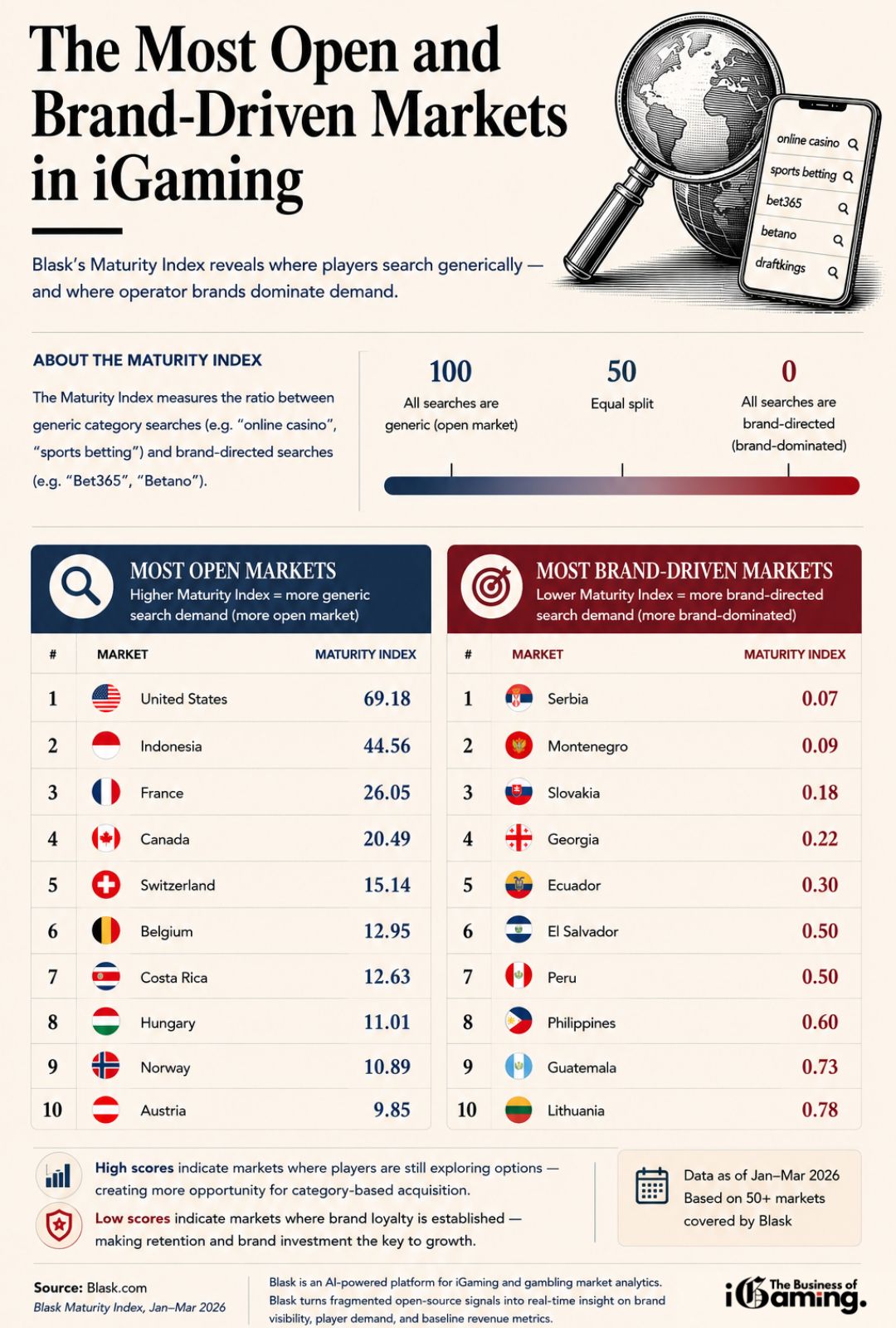
A score of 100 would mean virtually all searches are category-driven, while a score of 0 would indicate a market where nearly all searches are for specific operator brands.
In practical terms:
- Higher score = more open market
- Lower score = more brand-driven market
This is important because the term “maturity” can easily be misunderstood. A lower score does not mean a weaker market. In many cases, it signals the opposite: a market where consumer habits and operator loyalty are already deeply established.
The Most Open iGaming Markets
The United States currently records the highest Maturity Index among the markets covered by Blask, with a score of 69.18.
Blask notes that the US position is partly structural. Lottery-related search traffic contributes heavily to generic search demand, especially in states where online casino regulation remains fragmented. Even so, the broader picture suggests a market where players are still comparing operators rather than navigating directly to established brands.
Indonesia ranks second with 44.56, standing far above most global markets. According to Blask, no single operator has yet developed enough dominance to shift user behavior toward brand-led searching.
France, Canada, Switzerland, Belgium, and Costa Rica also sit in the upper tier — markets where regulation exists, major operators are active, but category-level acquisition still generates meaningful traffic opportunities.
Markets with the Highest Maturity Index (Most Open)
| Rank | Market | Maturity Index |
|---|---|---|
| 1 | United States | 69.18 |
| 2 | Indonesia | 44.56 |
| 3 | France | 26.05 |
| 4 | Canada | 20.49 |
| 5 | Switzerland | 15.14 |
| 6 | Belgium | 12.95 |
| 7 | Costa Rica | 12.63 |
| 8 | Hungary | 11.01 |
| 9 | Norway | 10.89 |
| 10 | Austria | 9.85 |
The Most Brand-Driven Markets
At the opposite end of the scale, Serbia posts an exceptionally low score of 0.07, followed closely by Montenegro at 0.09.
In these markets, the vast majority of iGaming searches already contain operator names. Users are not searching broadly for “online casino” alternatives. They are navigating directly to known brands.
That changes the value equation for affiliates, SEO teams, and performance marketers.
In heavily brand-driven markets, category acquisition becomes increasingly difficult because much of the search demand has already consolidated around established operators. Brand equity, retention, sponsorship visibility, and direct user trust start to matter more than discoverability.
Slovakia, Georgia, Ecuador, El Salvador, and Peru also appear near the bottom of the rankings.
Markets with the Lowest Maturity Index (Most Brand-Driven)
| Rank | Market | Maturity Index |
|---|---|---|
| 1 | Serbia | 0.07 |
| 2 | Montenegro | 0.09 |
| 3 | Slovakia | 0.18 |
| 4 | Georgia | 0.22 |
| 5 | Ecuador | 0.30 |
| 6 | El Salvador | 0.50 |
| 7 | Peru | 0.50 |
| 8 | Philippines | 0.60 |
| 9 | Guatemala | 0.73 |
| 10 | Lithuania | 0.78 |
Brazil Shows What Happens After Regulation
One of the more interesting observations in the report is Brazil.
The country does not appear in either the highest or lowest top 10 lists, but Blask points out that the market has become significantly more brand-driven following the 2024–2025 licensing transition.
As regulation narrowed the field, operators such as Betano and Bet365 strengthened their position in consumer search behavior. That reflects a broader pattern often seen after formal regulation arrives:
- Smaller operators lose visibility
- Compliance costs reduce fragmentation
- Media spend concentrates around larger brands
- Search demand gradually shifts from category discovery to operator loyalty
In many ways, Brazil may represent a preview of how newly regulated markets evolve over time.
Why This Matters for Affiliates and Operators
The Maturity Index highlights something the industry has debated for years: not all search traffic behaves the same way.
A market with strong generic search demand creates opportunities for:
- SEO-driven affiliates
- Content acquisition strategies
- Review and comparison sites
- Generic paid search campaigns
- New market entrants
But markets dominated by brand searches reward a completely different strategy:
- Brand building
- Sponsorships
- CRM and retention
- Direct navigation traffic
- Ecosystem dominance
This also explains why certain affiliate models perform well in one region and struggle in another.
In a market like the United States, category-led search acquisition still has room to scale. In Serbia or Montenegro, the battle has already shifted toward brand recognition and user habit.
A Different Way to Measure Market Opportunity
Traditional market analysis often focuses on gross gaming revenue, licensing frameworks, or traffic volume. Blask’s approach introduces another layer: how competitive demand actually is.
That nuance may become increasingly important as regulation expands globally and operators fight for attention in saturated environments.
Because in mature iGaming ecosystems, visibility alone is not enough anymore. The real advantage belongs to the brands players search for by name.