

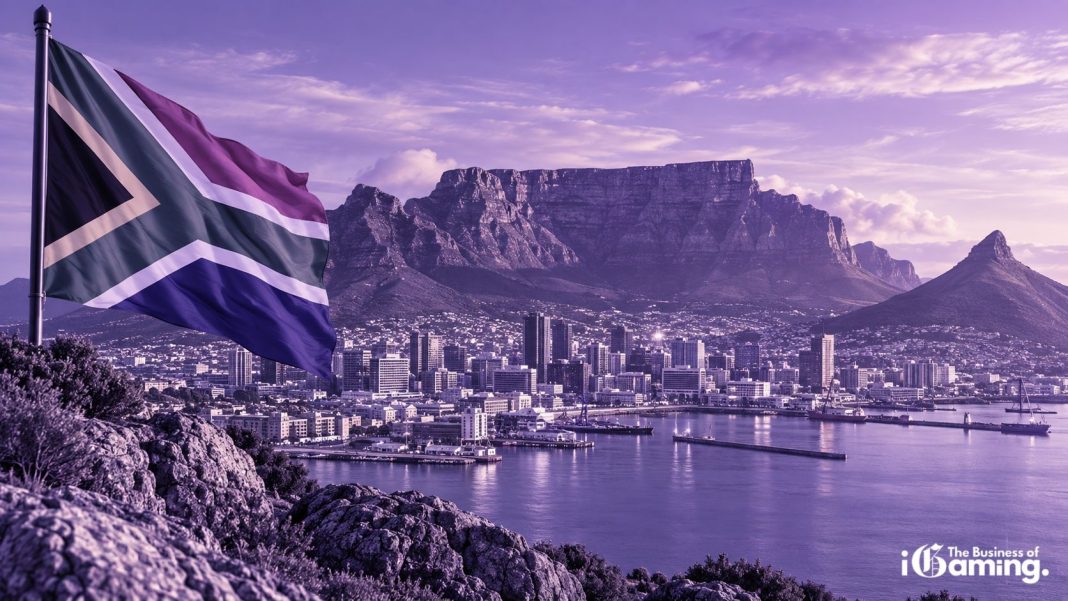

South Africa has developed into one of the most important gambling markets in Africa. A large population, widespread internet access and an increasingly digital betting culture have created an environment where major domestic and international brands compete for attention.
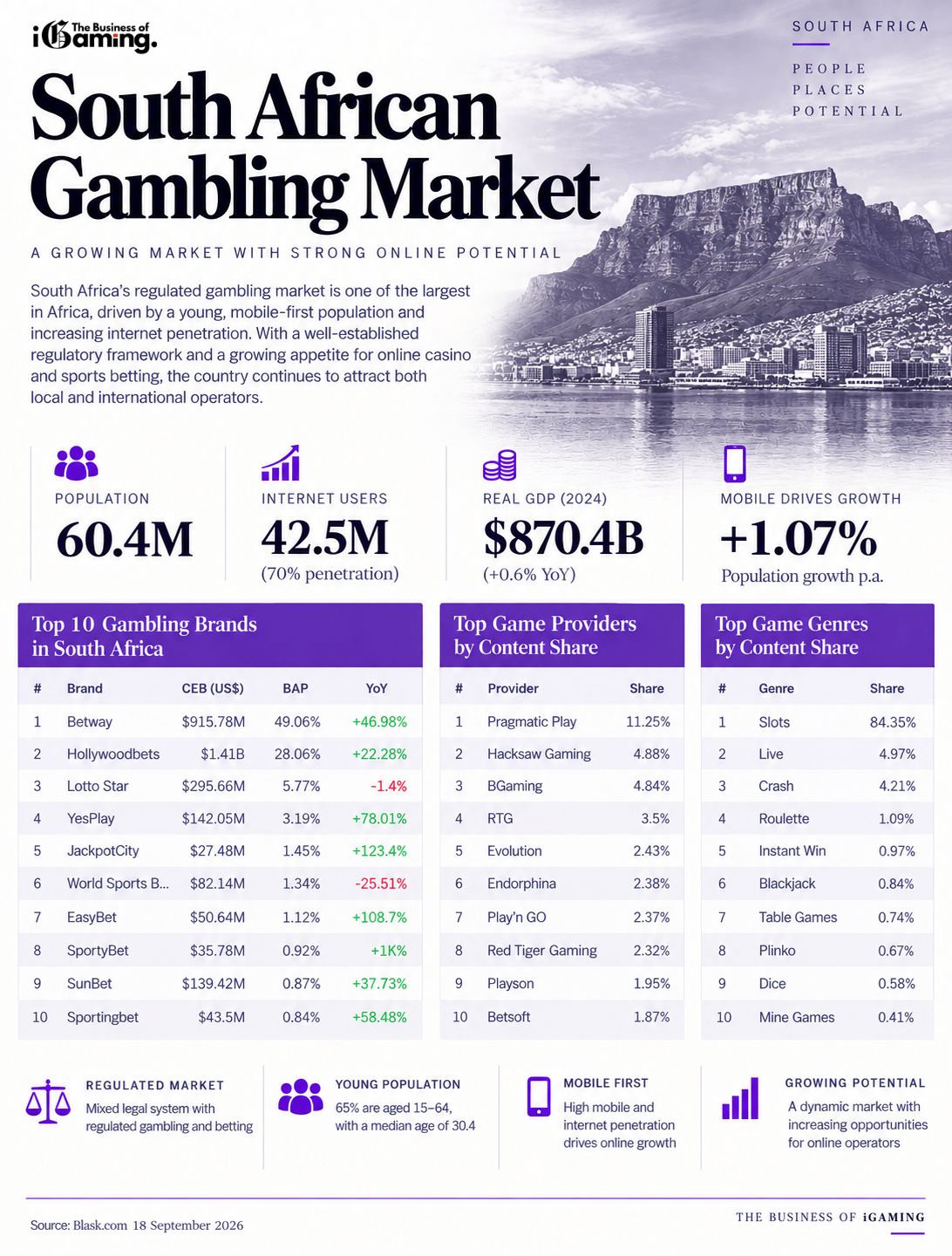
Data from Blask.com, as of 18 September 2026, illustrates just how concentrated the online market has become. Betway and Hollywoodbets sit well ahead of the rest of the brands measured by Blask, while Pragmatic Play has established a similarly commanding position among game providers. At the same time, slots account for more than four-fifths of the gaming content measured across the 140 brands in the dataset.
But South Africa is also an unusual market from a regulatory perspective. While betting with licensed South African bookmakers can be offered online, the National Gambling Board (NGB) states that interactive online gambling remains prohibited. This distinction is important when interpreting online casino and game-content data: visibility and consumer demand do not necessarily mean that every product represented in market-intelligence datasets is locally authorised.
Betway and Hollywoodbets dominate the brand landscape
The clearest observation from the Blask data is the strength of the two largest brands.
| Rank | Brand | CEB | BAP | YoY |
| 1 | Betway | $915.78M | 49.06% | +46.98% |
| 2 | Hollywoodbets | $1.41B | 28.06% | +22.28% |
| 3 | Lotto Star | $295.66M | 5.77% | -1.4% |
| 4 | YesPlay | $142.05M | 3.19% | +78.01% |
| 5 | JackpotCity | $27.48M | 1.45% | +123.4% |
| 6 | World Sports Betting | $82.14M | 1.34% | -25.51% |
| 7 | EasyBet | $50.64M | 1.12% | +108.7% |
| 8 | SportyBet | $35.78M | 0.92% | +1K% |
| 9 | SunBet | $139.42M | 0.87% | +37.73% |
| 10 | Sportingbet | $43.5M | 0.84% | +58.48% |
Source: Blask.com, 18 September 2026.
Betway accounts for a BAP (Brand’s Accumulated Power) of 49.06%, compared with 28.06% for Hollywoodbets. Together, the two brands therefore represent more than three quarters of the accumulated brand power among the operators shown in the dataset.
Hollywoodbets is particularly interesting when CEB, or Competitive Earning Baseline, is considered. Its estimated CEB of $1.41 billion is higher than Betway’s $915.78 million despite Betway having the considerably higher BAP.
There is nevertheless plenty happening further down the ranking. YesPlay has increased 78.01% year-on-year, EasyBet is up 108.7%, JackpotCity 123.4%, while SportyBet records the most dramatic percentage increase in the dataset.
Not every established operator is moving in the same direction. Lotto Star declined 1.4% year-on-year, while World Sports Betting was down 25.51%. The result is a market that appears concentrated at the top but still has considerable movement among its challengers.
South Africa’s gambling boom is increasingly about betting
The digital growth seen in the Blask data fits into a much larger shift in South African gambling. Official National Gambling Board figures show that betting generated R36.5 billion in gross gambling revenue during FY2023/24, representing 61% of GGR across regulated gambling modes at the time. That was an increase of 53.7% from the previous financial year.
More recent NGB reporting puts total gambling GGR at approximately R75 billion in FY2024/25, with online betting responsible for around 60% of total GGR.
The South African Reserve Bank has highlighted the same long-term transformation. Gambling turnover increased from R358 billion in 2015 to approximately R1.5 trillion in 2024, while GGR increased from R26.3 billion to R74.5 billion. The SARB specifically notes that growth accelerated after the pandemic as more consumers moved toward online betting.
That makes South Africa more than simply a large African gambling market. It is increasingly a digital betting market.
Pragmatic Play has a major content advantage
The provider rankings tell another interesting story. Across the 140 brands analysed by Blask, Pragmatic Play accounts for 11.25% of content share, more than twice the share of its nearest competitors.
Hacksaw Gaming follows at 4.88%, narrowly ahead of BGaming at 4.84%. RTG takes 3.5%, followed by Evolution at 2.43%.
| Rank | Game provider | Content share |
| 1 | Pragmatic Play | 11.25% |
| 2 | Hacksaw Gaming | 4.88% |
| 3 | BGaming | 4.84% |
| 4 | RTG | 3.50% |
| 5 | Evolution | 2.43% |
| 6 | Endorphina | 2.38% |
| 7 | Play’n GO | 2.37% |
| 8 | Red Tiger Gaming | 2.32% |
| 9 | Playson | 1.95% |
| 10 | Betsoft | 1.87% |
Source: Blask.com, 18 September 2026.
What stands out here is the diversity below Pragmatic Play. Hacksaw Gaming and BGaming have become substantial parts of the content mix, while established European names including Evolution, Play’n GO, Red Tiger Gaming and Playson all feature in the top ten.
The gap at the top, however, is significant. Pragmatic Play’s share is larger than those of Hacksaw Gaming and BGaming combined.
Slots account for 84% of gaming content
There is even greater concentration when looking at game genres. Slots represent an extraordinary 84.35% of content share across the brands analysed. Nothing else comes remotely close.
Live gaming is second at 4.97%, followed by crash games at 4.21%. Roulette accounts for 1.09%, Instant Win for 0.97% and blackjack for 0.84%.
The prominence of crash games is particularly noteworthy. Their 4.21% content share puts the category relatively close to live casino and well ahead of traditional individual table-game categories such as roulette and blackjack.
This suggests a content landscape divided into two very different areas: an overwhelmingly dominant slots ecosystem and a much smaller group of alternative formats competing for the remaining share.
A young, connected population provides the foundation
The structural characteristics of South Africa help explain why digital gambling has expanded so rapidly. The country has a population of roughly 60.4 million, with approximately 42.5 million internet users, according to the demographic figures used for our infographic. Around 65% of the population is between 15 and 64 years old, while the median age is approximately 30.4.
These characteristics create a substantial addressable digital audience, particularly for mobile-first entertainment.
The change in gambling behaviour has already been significant. NGB research found that gambling participation increased from 30.6% in 2017 to 65.7% in 2023, while betting prevalence increased from 13% to 46% over the same period. Online sports and other contingency betting were among the preferred gambling activities.
Regulation remains the crucial distinction
There is an important caveat when discussing South Africa as an “online gambling market.” South Africa has a regulated gambling industry covering casinos, betting, bingo and limited payout machines, with licensing handled at provincial level. But the regulatory framework treats online betting and interactive gambling differently.
The NGB states that online betting through a licensed South African bookmaker is legal, while interactive online gambling is prohibited. Consumers are also prohibited from gambling with offshore companies from within South Africa.
This creates an interesting tension between regulation, technology and consumer demand. Digital gambling behaviour is clearly expanding, yet the products consumers encounter online extend beyond what the existing legal framework permits.
That issue has become increasingly prominent in 2026. The NGB has warned consumers about growth in illegal online gambling platforms and advised players to verify that operators hold the appropriate provincial licence.
South Africa is becoming a market that cannot be ignored
The combination of Blask’s September 2026 data and official gambling statistics paints a picture of a market undergoing a substantial digital transformation.
At brand level, Betway and Hollywoodbets hold particularly strong positions, but rapidly growing competitors suggest the landscape is far from static. At supplier level, Pragmatic Play has established a significant content lead, while slots remain overwhelmingly dominant and crash games have emerged as a notable secondary category.
Most importantly, the underlying market is expanding. Official statistics show that betting has become the largest contributor to regulated gambling GGR, while digital channels have fundamentally changed how South Africans participate.
For operators, suppliers and other companies following the African gambling industry, South Africa is therefore one of the markets worth watching particularly closely in 2026 – not only because of its size, but because of the interaction between mobile adoption, changing player behaviour, intense brand competition and an evolving regulatory debate.
Infographic data source: Blask.com, 18 September 2026.