

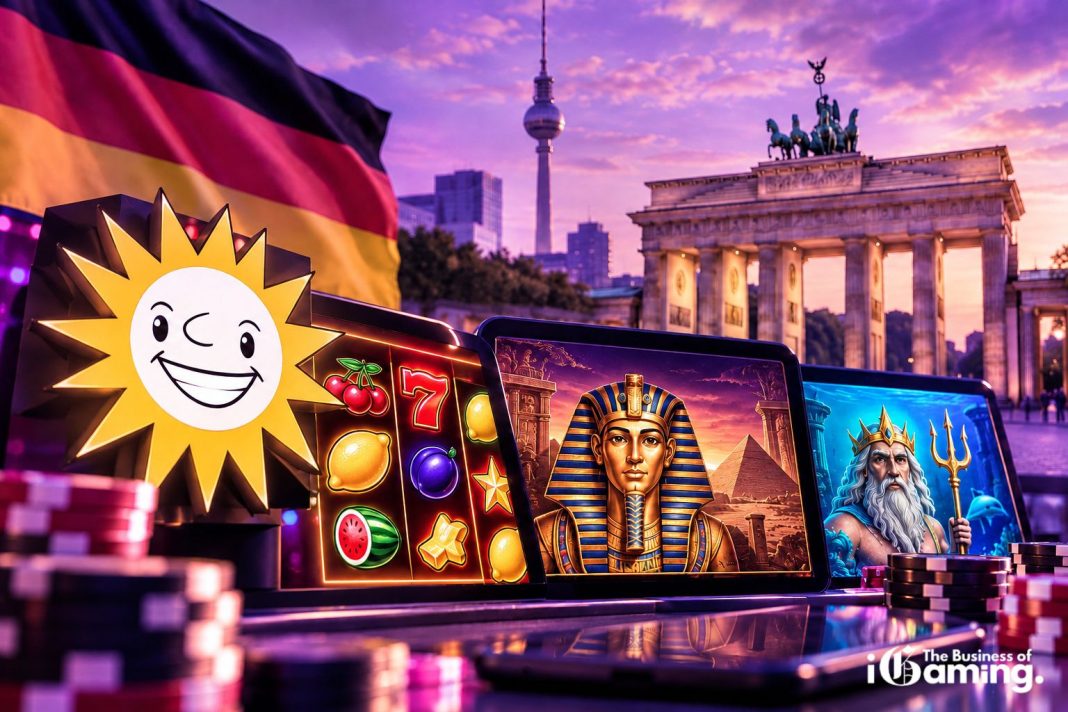

Germany is one of Europe’s most interesting casino markets because some of its strongest player preferences cannot really be understood by looking at online gambling alone. Open the lobby of a German-facing online casino and names such as Book of Ra, Sizzling Hot, Lucky Lady’s Charm and Lord of the Ocean, alongside familiar Merkur titles, continue to carry considerable weight.
Greentube itself has described Book of Ra deluxe as occupying a special position in Germany and points to classics including Lucky Lady’s Charm deluxe and Lord of the Ocean as games with exceptional performance among German players.
At first glance, this can seem surprising. The international slots industry has moved rapidly towards elaborate bonus systems, cinematic graphics, enormous maximum-win claims and increasingly complex mechanics. Yet in Germany, games and brands whose roots stretch back decades remain deeply embedded in player preferences. The explanation is not simply that German players prefer older or simpler games. It is much more closely connected to familiarity, land-based gaming culture, brand recognition and decades of accumulated player experience.
To understand the German online casino player, therefore, we first need to understand what happened before online casino became mainstream.
Germany was a machine-gaming market long before it became an online casino market
Merkur provides perhaps the clearest example. Paul Gauselmann began operating jukeboxes in 1957, opened the company’s first arcade in 1974 and introduced its first internally developed gaming machine in 1977. The Merkur Disc subsequently became an enormous success, with more than 40,000 machines sold. According to the company’s historical account, Gauselmann had become Germany’s market-leading gaming-machine manufacturer by 1985, with a market share exceeding 50%.
This history matters because generations of German consumers encountered Merkur long before they could open a casino website on their phone. The smiling Merkur sun became recognizable, as did the machines, sounds, visual language and style of play associated with the brand. When gambling subsequently moved online, Merkur was therefore not starting from zero. It was taking an established gaming identity and transferring it into a new distribution environment.
That gives the company something a new international provider cannot easily reproduce with a large marketing budget. A new supplier entering Germany has to persuade players to discover its games, understand them and eventually form an association with the brand. Merkur has spent decades building that association.
NOVOMATIC followed a similar path
NOVOMATIC is Austrian rather than German, but its relationship with the German-speaking gambling market is similarly deep. The company was founded in 1980 and began expanding internationally into Germany and other European markets in 1981. Over the following decades, NOVOMATIC developed a substantial land-based presence while also becoming an important gaming-technology supplier.
That history was accompanied by games that became exceptionally recognizable. Book of Ra, Lucky Lady’s Charm, Sizzling Hot, Dolphin’s Pearl and Lord of the Ocean are not simply older titles sitting somewhere in an enormous digital catalogue. For many players, particularly those with experience of Germany’s land-based gaming environment, they form part of the visual vocabulary of casino gaming.
Book of Ra is probably the strongest example. Its basic concept is not especially complicated by modern standards: five reels, ten paylines, an Egyptian theme and a recognizable feature structure. Yet that simplicity is arguably part of its strength. A player who has encountered Book of Ra hundreds or thousands of times does not need a tutorial or an explanation of why the game might be interesting. Recognition does much of the work.
Greentube became the bridge between land-based heritage and online casino
It is also worth distinguishing between NOVOMATIC and Greentube. NOVOMATIC is the wider gaming technology group, while Greentube operates as its digital gaming and entertainment division. That puts Greentube in a particularly interesting position: it can take decades of established land-based intellectual property and familiarity and translate it into online gaming.
This became especially relevant as Germany’s regulated nationwide online slots market developed. Through partnerships such as NOVOLINE, Greentube could bring large portfolios of titles online that German consumers were already familiar with from physical gaming environments. Greentube has explicitly highlighted this familiarity when discussing its German operations, noting that customers already knew NOVOMATIC content from the land-based market.
That creates a very different acquisition proposition. A completely new game provider effectively asks the player, “Would you like to try something you’ve never seen before?” Greentube can often ask, “Would you like to play something you already know?” In an online lobby containing hundreds or even thousands of alternatives, that difference can be surprisingly powerful.
Book of Ra demonstrates the power of casino nostalgia
Greentube has described Book of Ra deluxe as a timeless classic in Germany and connected its longevity to its presence across German arcades, casinos and eventually online platforms. The company has also noted that, for many players, these titles were among their earliest encounters with slot gaming.
This introduces a factor that the casino industry perhaps doesn’t discuss enough: nostalgia. Industry analysis tends to concentrate on mathematics, volatility, RTP, bonus mechanics, maximum wins and new technological features, but games can also accumulate emotional and cultural value simply through repeated exposure. A familiar game can remind someone of a particular period in their life, a local Spielothek or casino, or simply the feeling associated with playing that type of machine years earlier.
We see exactly the same phenomenon throughout entertainment. Nintendo continues to build products around characters created decades ago, Hollywood repeatedly revisits established franchises, fashion houses bring archival designs back into their collections and car manufacturers revive historic model names. The product may change significantly, but familiarity makes it easier to capture attention because the consumer already has a relationship with the underlying identity.
Casino games are not immune to that effect. In fact, the repetitive nature of slots may make visual and audio recognition particularly powerful.
Simplicity is probably another part of the explanation
Many of the classic German favourites also share another characteristic: they are relatively easy to understand. Modern online slots can contain cascading reels, persistent multipliers, collectors, transforming symbols, several bonus modes, progress meters, random modifiers and multiple jackpot systems, sometimes within the same game. These mechanics can create extremely engaging products, but they also introduce complexity.
A traditional Merkur or NOVOMATIC-style game often asks much less of the player. The reels spin, symbols land, a result is determined and an easily recognizable feature may occasionally activate. Someone familiar with the format understands what is happening almost immediately.
That does not mean German players reject innovation. Merkur itself has discussed German player interest in broad game selections and features such as Power Spins and tower games. A more useful interpretation is that innovation can be particularly effective when it is built on top of something players already understand.
This is an important distinction. The German market should not be reduced to the stereotype that players simply want old-fashioned slots. What appears to work is a combination of familiar gaming conventions with enough evolution to keep the experience relevant.
Merkur has been developing that gaming language for decades
Merkur’s influence also extends beyond individual game titles. Certain mechanics became closely associated with German machine gaming over decades. One example is the risk ladder, introduced with Merkur Komet and patented by Paul Gauselmann in 1979.
When players repeatedly encounter particular ways of displaying wins, taking risks and progressing through a game, those conventions eventually become familiar. This is similar to how users learn the interface language of an operating system. Once you understand where everything is and how it behaves, switching to something completely different requires more cognitive effort.
Merkur can therefore modernize its products while retaining enough of that familiar DNA for the player to recognize the experience. That is an extremely valuable form of brand equity because it exists not only in a logo but in the way the product itself behaves.
German regulation may make familiarity even more valuable
Germany’s regulated online gambling environment adds another layer. The country’s rules for virtual slots include restrictions such as a €1 maximum stake per game, a minimum five-second game duration, restrictions on jackpots and a series of player-protection measures. The nationwide regulated virtual-slots framework itself is also relatively young, having taken effect in 2021.
These restrictions inevitably influence how online casino products are designed and presented. Operators cannot simply reproduce every product configuration or engagement mechanism that may be available internationally. In an environment where some conventional excitement and promotional levers are restricted, established game brands can become particularly valuable because they provide another reason for players to choose one title over another.
There is also an interesting contrast here. Germany’s regulated nationwide online slots market is relatively young, while its machine-gaming culture stretches back generations. The digital distribution channel may be new, but the underlying player memories are not.
Online data alone cannot explain the German player
This is perhaps the most important analytical lesson. When studying an online casino market, it is tempting to look exclusively at online information: search volumes, casino traffic, game rankings, lobby positions, provider visibility and digital player demand. In Germany, that risks missing an important part of the story because today’s online preferences can originate in offline experiences from many years earlier.
The customer journey may effectively look like:
Land-based venue → familiar machine → familiar game → familiar provider → online casino.
Greentube’s partnerships demonstrate how commercially relevant that connection remains. Its agreement with German operator Jokerstar, for example, connected Greentube’s online portfolio with a business whose roots included more than 165 physical casino arcades, while Greentube specifically emphasized bringing popular land-based favourites into the online environment.
Rather than treating online and offline gambling as completely separate ecosystems, Germany shows how one can feed directly into the other. The player may change channel without completely changing preferences.
Familiar games can also make an unfamiliar casino feel more familiar
Trust is particularly important in online gambling. When someone encounters an unfamiliar operator, several uncertainties can appear simultaneously: Is the casino legitimate? How do deposits and withdrawals work? Is the platform reliable? What should I play?
Recognizable content can remove at least one part of that uncertainty. Seeing Merkur or a familiar NOVOMATIC title does not automatically make a player trust an operator, of course, but it can make the environment feel less foreign. Familiarity with the games reduces the amount of new information that has to be processed.
This has an important implication for international operators entering Germany. Localization is much more than translating an English casino into German. Proper localization means understanding the games, brands, mechanics, payment expectations, regulatory environment and cultural reference points players already know.
A beautifully translated casino containing the wrong product mix can still feel foreign.
Germany challenges the industry’s obsession with “new”
iGaming is naturally fascinated by novelty. Providers compete to launch new games, new mechanics and new features, while operators constantly promote the latest releases. Yet the German market provides a useful reminder that heritage itself can be a competitive advantage.
Greentube’s more recent German integrations illustrate the strategy well. When its content went live with bet365 in Germany, the portfolio combined newer products with established titles such as Book of Ra deluxe, Lucky Lady’s Charm deluxe and Lord of the Ocean.
This suggests that the strongest strategy does not necessarily involve choosing between old and new. Established intellectual property can provide familiarity while newer mechanics, presentation and technology maintain relevance. In other words, heritage can become a platform for innovation rather than an alternative to it.
But what happens when a new generation of German players arrives?
This is where the story becomes particularly interesting for the future.
The player who spent years encountering Merkur machines in German Spielhallen has a completely different entertainment history from someone who is 25 today. Younger adult consumers have grown up with mobile gaming, YouTube, Twitch, social media, esports and highly personalized digital products. Their first meaningful gaming memories may have nothing to do with a physical gambling machine.
That raises an important strategic question for Merkur, NOVOMATIC and Greentube. Can decades of brand equity be transferred to generations that do not share the same land-based nostalgia?
It is certainly possible. Nintendo has successfully introduced decades-old characters to generations that never played the original games. Adidas repeatedly makes old silhouettes culturally relevant again. Entertainment franchises constantly reinvent themselves while retaining recognizable elements.
The challenge for established German casino brands may therefore be to preserve enough of their DNA to maintain recognition among existing players while creating products that feel contemporary to younger adult audiences.
If they manage that successfully, heritage becomes an extraordinary advantage. If they rely too heavily on nostalgia alone, the advantage could gradually weaken as the demographic composition of the player base changes.
What international providers can learn from Germany
The obvious but incorrect conclusion would be that international suppliers should simply produce games that look like Merkur or NOVOMATIC titles. The much more useful lesson is to understand where local player preferences came from before trying to change them.
A provider entering Germany should investigate which games dominated ten or twenty years ago, which physical gaming brands players recognize, which mechanics require almost no explanation, how tastes differ between generations and which themes or franchises have accumulated genuine cultural familiarity. Similar questions should be asked in every market.
That type of analysis can explain why a technically sophisticated international hit may underperform in Germany while an apparently dated title continues attracting players. The difference may have very little to do with which game is objectively “better”. One arrives as a stranger; the other arrives with decades of accumulated recognition.
The German player isn’t necessarily old-fashioned
The continued strength of Merkur, NOVOMATIC and Greentube should therefore not be interpreted simply as evidence that German players prefer old games. It tells us something more valuable about how brand memory influences digital behaviour.
Merkur’s roots in German machine gaming stretch back to the 1970s, while NOVOMATIC expanded into Germany during the early 1980s. Games such as Book of Ra subsequently became fixtures of the land-based environment before following players into online casino. Decades of exposure created something newer providers cannot manufacture overnight: familiarity.
Familiarity creates recognition, recognition reduces friction, and reduced friction can influence which game receives the first click in a lobby containing thousands of alternatives.
That may ultimately be the most interesting lesson from Germany. The iGaming industry naturally focuses on what comes next, but player behaviour does not begin from zero every time a new technology or distribution channel appears. Players carry their previous experiences with them.
Sometimes the most powerful reason for choosing the next game isn’t that it looks new. It’s that it feels familiar.