



Europe’s regulated gambling industry may be significantly smaller than the market operating outside national licensing systems.
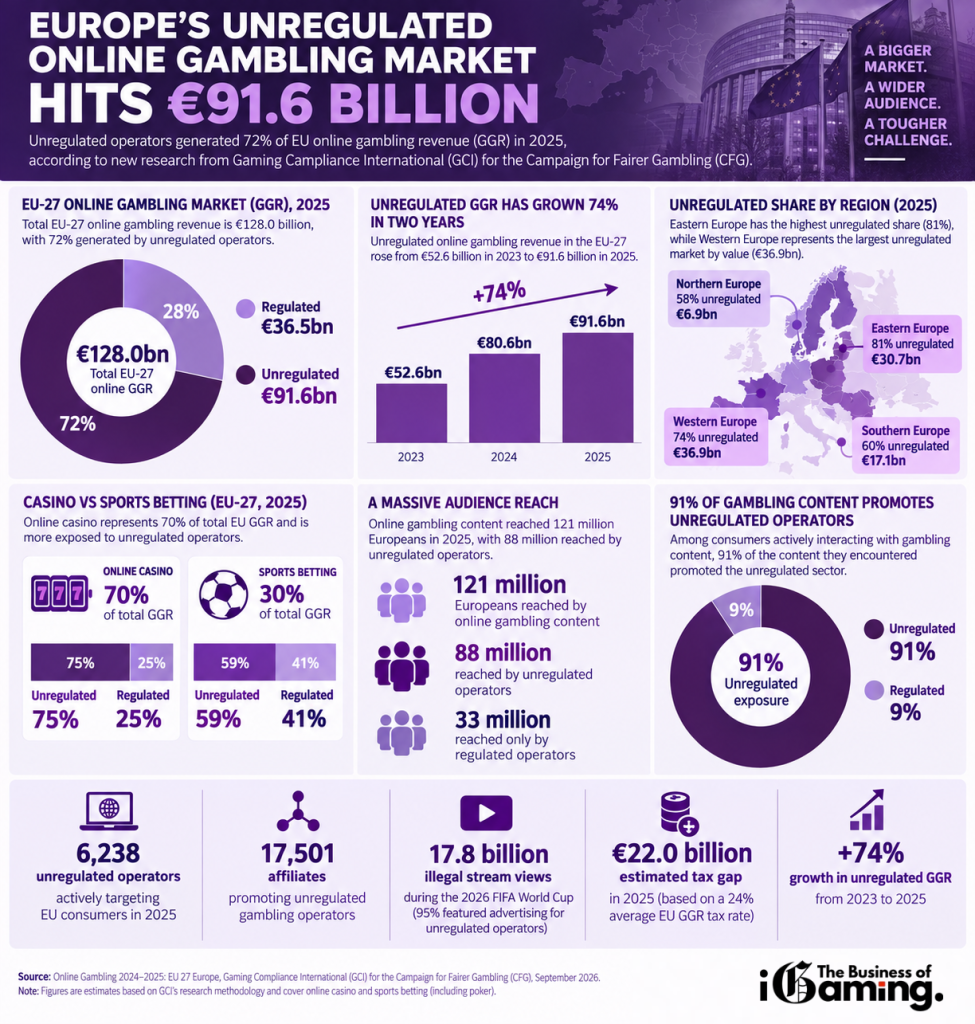
A major new study of the EU’s online gambling market estimates that unregulated operators generated €91.6 billion in gross gambling revenue (GGR) during 2025, representing 72% of the entire €128 billion EU-27 online gambling market.
The findings come from Online Gambling 2024–2025: EU 27 Europe, produced by Gaming Compliance International (GCI) for the Campaign for Fairer Gambling (CFG) and released in September 2026.
The headline number is striking, but the full 48-page report reveals a much broader story than the accompanying press release. GCI estimates that 6,238 unregulated operators were actively targeting EU consumers in 2025, supported by 17,501 affiliates promoting unregulated gambling operators.
More importantly, the study suggests that the competitive battle between regulated and unregulated gambling increasingly takes place before a player ever reaches a casino or sportsbook.
GCI estimates that 91% of the gambling content encountered by consumers actively interacting with gambling-related content in 2025 promoted the unregulated sector.
That puts affiliates, search engines, social media, streaming platforms, payments and other parts of the digital acquisition infrastructure at the centre of the European gambling debate.
Europe’s online gambling market in numbers
According to GCI, the EU-27 online gambling market generated approximately €128.0 billion in GGR in 2025.
Of this:
| Market | 2025 GGR | Share |
| Regulated online gambling | €36.5bn | 28% |
| Unregulated online gambling | €91.6bn | 72% |
| Total online gambling | €128.0bn | 100% |
The imbalance has also increased. GCI estimates unregulated GGR at €52.6 billion in 2023, €80.6 billion in 2024 and €91.6 billion in 2025. Total online GGR increased from €78.4 billion in 2023 to €114.3 billion in 2024 and €128.0 billion in 2025.
That means the unregulated market expanded by approximately 74% between 2023 and 2025.
The regulated market also grew, from €25.8 billion to €36.5 billion over the same period. The issue highlighted by the report is therefore not that regulated gambling is shrinking in absolute terms. Rather, unregulated gambling has expanded considerably faster and continues to account for the majority of the estimated marketplace.
The CFG press release consequently describes the issue as an “enforcement gap”, arguing that gambling activity increasingly takes place outside the regulatory perimeter established by individual European jurisdictions.
The regional numbers reveal an even more fragmented Europe
One of the most useful elements of the underlying GCI report is its regional breakdown. The situation differs considerably between Northern, Southern, Eastern and Western Europe.
| Region | Regulated share | Unregulated share | Regulated GGR | Unregulated GGR | Total GGR |
| Northern Europe | 42% | 58% | €5.0bn | €6.9bn | €11.9bn |
| Southern Europe | 40% | 60% | €11.3bn | €17.1bn | €28.4bn |
| Eastern Europe | 19% | 81% | €7.0bn | €30.7bn | €37.7bn |
| Western Europe | 26% | 74% | €13.2bn | €36.9bn | €50.1bn |
| EU-27 | 28% | 72% | €36.5bn | €91.6bn | €128.0bn |
Eastern Europe has the highest estimated unregulated share at 81%, but Western Europe represents the largest unregulated market by value at approximately €36.9 billion.
Together, Eastern and Western Europe therefore account for roughly €67.6 billion of the €91.6 billion in estimated unregulated GGR.
Northern Europe performs comparatively better from a channelisation perspective, although even there GCI estimates that 58% of GGR occurs outside the regulated sector.
Western Europe has undergone the biggest structural change
Looking only at the 2025 snapshot misses another interesting part of the data. GCI estimates Western Europe’s unregulated GGR at:
2023: €15.6bn
2024: €31.9bn
2025: €36.9bn
That represents growth of 104.5% between 2023 and 2024, followed by another 15.7% increase in 2025.
Southern Europe’s unregulated GGR rose from €10.1 billion in 2023 to €14.0 billion in 2024 and €17.1 billion in 2025. Northern Europe moved from €5.2 billion to €5.7 billion and then €6.9 billion, while Eastern Europe increased from €21.8 billion to €29.0 billion and €30.7 billion.
This matters because the €91.6 billion headline can otherwise give the impression of a uniformly distributed European problem. The report instead describes four substantially different regional markets with different levels and trajectories of channelisation.
Online casino appears to be the bigger challenge
The report also separates casino and sports betting. Approximately 70% of total EU online GGR is attributed to casino and 30% to sports betting in GCI’s 2025 analysis.
But the regulated/unregulated split is particularly notable. For sports betting, GCI estimates: 41% regulated / 59% unregulated
For online casino: 25% regulated / 75% unregulated.
In other words, only around one quarter of estimated EU online casino GGR sits within the locally regulated sector under GCI’s methodology.
There are significant regional differences as well. Western Europe’s online casino market is estimated at 80% unregulated, compared with 78% in Northern Europe, 70% in Eastern Europe and 69% in Southern Europe.
Sports betting appears better channelised, although unregulated activity still represents the majority in every region.
The direction of travel is also noteworthy. In 2024, GCI estimated the EU-wide split at 43% regulated versus 57% unregulated for sports betting and 27% versus 73% for casino.
Both product categories therefore moved slightly further towards the unregulated side in 2025 according to the study.
121 million Europeans were reached by online gambling content
Revenue, however, is only one side of the report. GCI introduces a metric it calls Population Impact, measuring the share of the wider population reached by online gambling and related content.
The company estimates that online gambling content reached 121 million Europeans in 2025. Of these – 88 million were reached by content from unregulated operators, compared with 33 million reached only by regulated operators.
GCI calculates total Population Impact at 23.03% of the population, with 16.76% attributable to unregulated gambling.
The regional differences are again substantial. Eastern Europe recorded the highest estimated total Population Impact at 29.26%, with 26.51% attributed to the unregulated sector.
This introduces an important distinction between market share today and potential customer acquisition tomorrow.
The 91% figure may be even more important than €91.6 billion
Perhaps the most consequential number in the report for operators, affiliates and marketers is not €91.6 billion. It is 91%.
GCI’s separate Audience Exposure metric attempts to measure what consumers already interested in gambling encounter when actively interacting with gambling-related content.
For 2025, the estimated split is:
| Region | Regulated exposure | Unregulated exposure |
| Northern Europe | 19% | 81% |
| Southern Europe | 11% | 89% |
| Eastern Europe | 4% | 96% |
| Western Europe | 9% | 91% |
| EU-27 | 9% | 91% |
This is not the same thing as saying 91% of all gambling advertising in Europe is illegal or unregulated. GCI defines Audience Exposure as a blended measure covering consumers interested in gambling across areas including affiliates, gambling sites, payments, social media, advertising, streaming, peer-to-peer communications, supply chains, search and LLMs, products and apps.
The company describes it as an “early warning indicator” of where future GGR market share could move.
That distinction is important when interpreting the number. Nevertheless, if the measurement proves directionally accurate, it raises a serious commercial problem for regulated operators: licensed companies may be competing for customers in a discovery environment where unregulated brands have significantly greater visibility.
17,501 affiliates are part of the equation
GCI counted 17,501 affiliates promoting unregulated online gambling operators in 2025 alongside the 6,238 operators themselves.
That illustrates why blocking individual casino domains alone may have limited impact. Modern gambling acquisition does not start on an operator homepage.
A player might discover a brand through Google, an affiliate ranking, Telegram, an influencer, a streaming platform, an app or social media. Domains can subsequently disappear or change while the acquisition network remains intact.
This is one of the report’s most important themes: the gambling market should increasingly be understood as an acquisition and distribution ecosystem, rather than simply a collection of casino and sportsbook websites.
Illegal sports streaming is becoming a gambling acquisition channel
The relationship between illegal sports streaming and gambling is another area where the full report goes substantially beyond the press announcement.
GCI estimates 17.8 billion qualifying illegal stream views across Europe during the 2026 FIFA World Cup.
Crucially, the report says 95% of qualifying streams viewed in Europe featured advertising for unregulated gambling operators that were not licensed in the relevant jurisdictions.
For the 2026 UEFA Champions League Final, GCI records 51.3 million qualifying illegal stream views, with 93% featuring such advertising.
There is an important methodological qualification: these are stream views, not unique viewers. GCI defines a qualifying or “committed” view as at least 90 seconds of streaming and says its methodology accounts for interruptions, refreshes, mirror switching and channel resets.
Even with that caveat, the numbers illustrate how piracy and gambling acquisition can intersect.
An illegal stream provides an unusually valuable audience for betting advertisers: people already demonstrating real-time interest in a sporting event.
That effectively turns piracy sites into top-of-funnel gambling marketing channels.
Kick provides another example of the ecosystem problem
The report devotes several pages to the relationship between gambling and streaming platform Kick. GCI says slots content was officially blocked by Kick in six EU jurisdictions at the time of its review – Belgium, France, Greece, Italy, Malta and Slovakia – but concluded that the block worked effectively in only Greece.
It reports that affiliate advertising for unregulated gambling was present on Kick in 26 of 27 EU jurisdictions.
The report also cites Similarweb traffic data indicating that during peak periods of the 2026 FIFA World Cup, 19% of outgoing global traffic from Kick went to Stake, while approximately 1% of outgoing Stake traffic went in the opposite direction.
GCI interprets this as an example of how audience platforms can feed gambling acquisition.
That interpretation is the report authors’ analysis rather than proof that every user following that traffic subsequently gambled, but the traffic relationship itself helps demonstrate why streaming platforms increasingly matter to gambling regulators.
Cloaked advertising adds another layer
Another phenomenon examined by GCI is cloaked advertising — advertising designed to disguise prohibited content or its destination in order to bypass platform controls.
The report says brokers reviewed by GCI offered campaigns targeting all 27 EU jurisdictions.
Among the brokers studied, the report cites an 85% average campaign approval rate, more than 1,100 promised monthly first-time depositors and advertised returns of approximately 3x the advertising investment. More than half of the reviewed brokers were reportedly based within the EU-27.
If mainstream advertising platforms close one acquisition route, the implication is that sophisticated marketers can attempt to create another.
This makes gambling enforcement increasingly similar to other forms of digital platform enforcement: the destination is only one component of the distribution system.
Why blocking gambling websites alone may no longer work
The report ultimately describes an interconnected system involving: search → affiliates → social media → advertising → streaming → P2P communications → apps → payments → gambling sites.
For example, an operator might acquire somebody through social media, move the relationship to email or mobile messaging, send the user through an affiliate or search result, process deposits through a payment provider and ultimately move the player between different domains.
GCI therefore argues that unregulated gambling is sustained by an ecosystem rather than an individual website. That is arguably the central strategic insight behind the entire 48-page study. Domain blocking attacks the final destination.
The report argues that effective enforcement increasingly needs to address the infrastructure that allows customers to discover, access and transact with that destination.
An estimated €22 billion tax gap
The economic consequences extend beyond operator revenue. Using an average EU-27 GGR tax rate of 24%, the report estimates approximately €22.0 billion in taxation associated with GGR generated by unregulated operators in 2025.
The European Casino Association separately described the 2025 figure as approximately €22.9 billion when discussing GCI research at a European Parliament roundtable in July.
The slight difference reinforces the importance of treating these numbers as estimates based on modelling rather than audited tax losses.
Not every euro theoretically generated in a regulated environment would necessarily produce an identical amount of taxable GGR. Player behaviour, market structure, tax rates and channelisation could change if the regulatory environment changed.
The number is therefore better understood as an indication of the potential fiscal scale of activity outside local licensing systems, rather than money governments could automatically recover in full.
What exactly counts as “unregulated” in the study?
This is particularly important when interpreting the €91.6 billion headline. GCI does not simply count every offshore gambling website that can technically be opened from an EU country.
To be classified as an unregulated operator within a jurisdiction, GCI says an operator must actively target and transact within that market without holding the relevant local licence.
Indicators include audience targeting, advertising, affiliate agreements, accessibility with or without VPNs and verified payment capabilities for local residents.
Sites that are merely accessible but lack an active commercial ability to accept bets or transactions are excluded. There is another methodological detail worth noting: active mirrors and redirects can be counted as separate unregulated operator results within a jurisdiction.
That means the 6,238 figure should not automatically be interpreted as 6,238 completely separate corporate gambling companies. It measures active unregulated gambling destinations according to GCI’s methodology.
How GCI estimates the market
The €91.6 billion figure is an estimate, not a sum of financial statements submitted by offshore operators. GCI describes a methodology involving site-versus-site and app-versus-app analysis, combined with what it calls Value per Visit (VPV).
VPV considers factors that can affect player value and behaviour, including KYC, products, pricing, promotions, payment methods, deposit thresholds and bonus conditions. GCI then combines audience activity and these value estimates to size the overall market.
The company says identification, qualification and quantification are performed using human analysis, machine learning and AI.
The report also states that its analysis uses data obtained through GCI’s online surveillance and third-party licensors. That methodological context matters.
€91.6 billion should therefore be described as GCI’s estimate of unregulated GGR, rather than an independently audited measurement of every unlicensed operator’s revenue.
What isn’t included?
Another potentially important point is what the report does not count. Its core market estimates cover – online sports betting and online casino, including poker.
Crypto gambling products are included where they fall within those categories. However, the report says its GGR figures do not cover prediction markets, daily fantasy sports, sweepstakes, social casinos, prize-draw contests or lotteries.
Land-based gambling is also excluded. This is particularly relevant as the boundaries between gambling, gaming, trading and prediction products continue to blur.
The €128 billion total therefore represents GCI’s estimate of the covered EU-27 online casino and sports betting marketplace, rather than every conceivable form of gambling-like digital activity.
The bigger question for European gambling regulation
For years, gambling regulation has largely focused on what licensed operators are allowed to do: advertising restrictions, bonus limits, affordability measures, deposit controls, KYC, self-exclusion and responsible gambling requirements.
The GCI report asks a somewhat different question: How much of the actual gambling marketplace does the regulated system control?
Under its estimates, regulated operators account for just 28% of EU-27 online GGR. The imbalance becomes even more pronounced at the customer-acquisition level, where GCI estimates that unregulated operators account for 91% of Audience Exposure among consumers actively interacting with gambling content.
The report’s argument is therefore not simply that Europe has thousands of illegal or unregulated gambling websites.
It is that the digital infrastructure surrounding gambling — search, affiliates, influencers, streaming, advertising, apps, communications and payments — increasingly determines whether national gambling regulation can achieve its intended outcomes at all.
That is a substantially bigger issue than website blocking.
And if GCI’s estimates are broadly accurate, Europe’s central gambling-policy question may increasingly shift from “How should licensed operators be regulated?” to “How can regulators increase the proportion of the total online gambling market that actually operates within their rules?”
That may be the most consequential finding hidden behind the headline €91.6 billion figure.
Source: Online Gambling 2024–2025: EU 27 Europe, Gaming Compliance International (GCI), commissioned for the Campaign for Fairer Gambling (CFG), September 2026. The accompanying CFG release was published on 23 September 2026.