


There are plenty of examples of successful marketing in iGaming, but there are far fewer examples of an iGaming company effectively helping create an entirely new distribution ecosystem.
That is what makes Kick such an interesting case.
Launched in late 2022, Kick entered a livestreaming market dominated by Twitch and YouTube. On the surface, the proposition looked relatively straightforward: build a creator-friendly alternative to Twitch, offer streamers better economics, loosen some of the restrictions that frustrated creators, and use aggressive talent acquisition to attract audiences.
Viewed through an iGaming lens, however, the strategy looks considerably more sophisticated.
Kick’s founders, Ed Craven and Bijan Tehrani, are also the entrepreneurs behind Stake and the wider Easygo ecosystem. Stake had already demonstrated the power of livestreaming as an acquisition channel for crypto gambling when Twitch changed the rules and restricted certain forms of gambling content.
Instead of simply accepting the loss of an important distribution channel and shifting its marketing elsewhere, the ecosystem around Stake went in a radically different direction: it helped build another one.
That is why Kick may ultimately be remembered as one of the smartest distribution plays to come out of the modern iGaming industry.
What Is Kick?
Kick is a livestreaming platform launched in December 2022 as a direct competitor to Twitch. The basic experience is familiar: creators broadcast live content, viewers follow channels, participate in chat and subscribe to their favourite streamers.
Gaming remains important to the platform, but Kick has expanded well beyond gaming into categories including IRL streams, sports, entertainment and gambling.
What differentiated Kick from the beginning was its approach to creators. Rather than trying to beat Twitch purely through technology, Kick attacked one of the biggest frustrations in the creator economy: how much of the money generated by creators actually reaches the creators themselves.
Kick offers a 95/5 revenue split, meaning creators receive 95% of applicable subscription revenue. Kick’s current documentation says the same 95/5 structure applies to its KICKs and Gifts revenue as well.
It was an extraordinarily aggressive proposition, effectively telling creators that if they brought their audiences to Kick, they could keep almost all of the subscription revenue those audiences generated. For streamers deciding where to invest their time and build their communities, that was a compelling argument.
And it was only one part of the strategy.
The Founders Behind Kick
Kick is closely associated with Ed Craven and Bijan Tehrani, the entrepreneurs who built Stake.com and Easygo.
The pair established Easygo in 2016 before launching Stake in 2017. Stake subsequently became one of the most recognisable crypto gambling brands globally, combining casino, sportsbook, sponsorships and creator marketing in a way few traditional operators had attempted at comparable scale.
Their businesses also illustrate the scale that can be created around this ecosystem. Australian reporting previously showed Easygo Solutions recording hundreds of millions of dollars in profit while providing technology supporting businesses including Stake and Kick.
Kick therefore did not emerge in isolation. It came from founders who had already seen first-hand just how powerful livestreaming could be for customer acquisition, particularly within crypto gambling.
Then something happened that potentially threatened that model.
Twitch Changed the Rules
In September 2022, Twitch announced an important change to its gambling policies. From October 18 that year, the platform prohibited streaming slots, roulette and dice from gambling websites that were not licensed in the United States or other jurisdictions Twitch considered to provide sufficient consumer protection. Stake was among the websites affected by the restrictions.
For Stake, this mattered because streaming had become an unusually effective way of marketing crypto casinos. Instead of a banner advertisement or an affiliate review being the primary point of contact, viewers could spend hours watching their favourite personalities playing casino games.
The streamer was simultaneously entertainment, endorsement, community and distribution, which made the relationship far deeper than a conventional advertising placement. Twitch’s decision nevertheless demonstrated one of the fundamental weaknesses of the model: Stake didn’t control the platform, and a third party could change the rules at any time.
Twitch did exactly that.
Kick launched shortly afterwards.
Why Kick Was Such a Genius Move
Calling Kick “genius” does not mean every decision the company has made has been perfect, nor does it remove the regulatory and responsible-gambling questions surrounding gambling streams. The brilliance lies primarily in the strategic response to a distribution problem.
Consider what normally happens when a company loses access to an important marketing channel. If Google reduces an affiliate site’s rankings, the affiliate tries to recover them. If Meta restricts an advertiser, the advertiser searches for another advertising network. If a streaming platform limits a casino’s exposure, the conventional response would be to find other streamers, other platforms or another form of advertising.
In all of those cases, the underlying question remains roughly the same: where else can we buy or acquire distribution?
Kick represents a fundamentally different answer: what if we help create the distribution ourselves?
Instead of Stake remaining entirely dependent on Twitch to provide access to streamers and audiences, the wider ecosystem gained a platform capable of building its own creator economy. The strategic difference is enormous because it moves the business from simply competing for attention inside somebody else’s infrastructure toward participating in the infrastructure through which that attention is distributed.
Don’t Just Sponsor Creators – Build Somewhere for Them to Go
This is perhaps the most important part of the Kick story.
Stake had already understood something that many traditional gambling companies were slower to recognise: online personalities can function as distribution networks. A major streamer isn’t simply an influencer who delivers a sponsored message. They have an audience, a community and an ability to expose large numbers of people repeatedly to the same brands and products.
Kick added another layer to that strategy. Rather than merely sponsoring creators, it created an environment designed to make creators want to participate, with the 95/5 revenue model forming an important part of the proposition.
Kick’s own creator site currently promotes both its 95/5 split and additional payouts available through its partner programme.
The model can therefore be viewed as a relatively simple chain: creator-friendly economics attract creators, creators bring audiences, audiences create attention, and that attention creates opportunities for brand exposure and customer acquisition.
The casino does not necessarily need to be the starting point. The entertainment is.
Kick Turned Distribution Into a Product
This is where Kick becomes particularly relevant to the wider iGaming industry.
Most operators spend enormous amounts acquiring traffic from infrastructure they don’t own. Google owns the search engine, Meta owns Facebook and Instagram, affiliates own their websites, influencers own their audiences, sports organisations own their sponsorship inventory and broadcasters control access to their viewers.
In almost every case, the operator is effectively renting access to somebody else’s distribution.
Kick flips that concept around by placing the wider Stake/Easygo ecosystem much closer to the infrastructure through which attention itself is distributed. In strategic terms, it resembles the difference between buying advertising on a television network and owning the television network.
Obviously, Kick is not simply a Stake advertising platform. It has developed into a much broader streaming service containing enormous amounts of non-gambling content, but strategically, the relationship between the businesses remains fascinating.
From Casino Streaming to a Mainstream Creator Platform
Another clever aspect of the strategy was that Kick did not restrict itself to casino streaming, which would have severely limited its potential audience and probably its long-term relevance.
Instead, the company aggressively pursued mainstream creators and expanded into a much wider range of content categories. Someone can now discover Kick without having any interest in gambling whatsoever, whether they arrive to watch gaming, an IRL streamer, sports or general entertainment.
That gives Kick something considerably more valuable than a gambling-specific streaming portal: a general consumer audience.
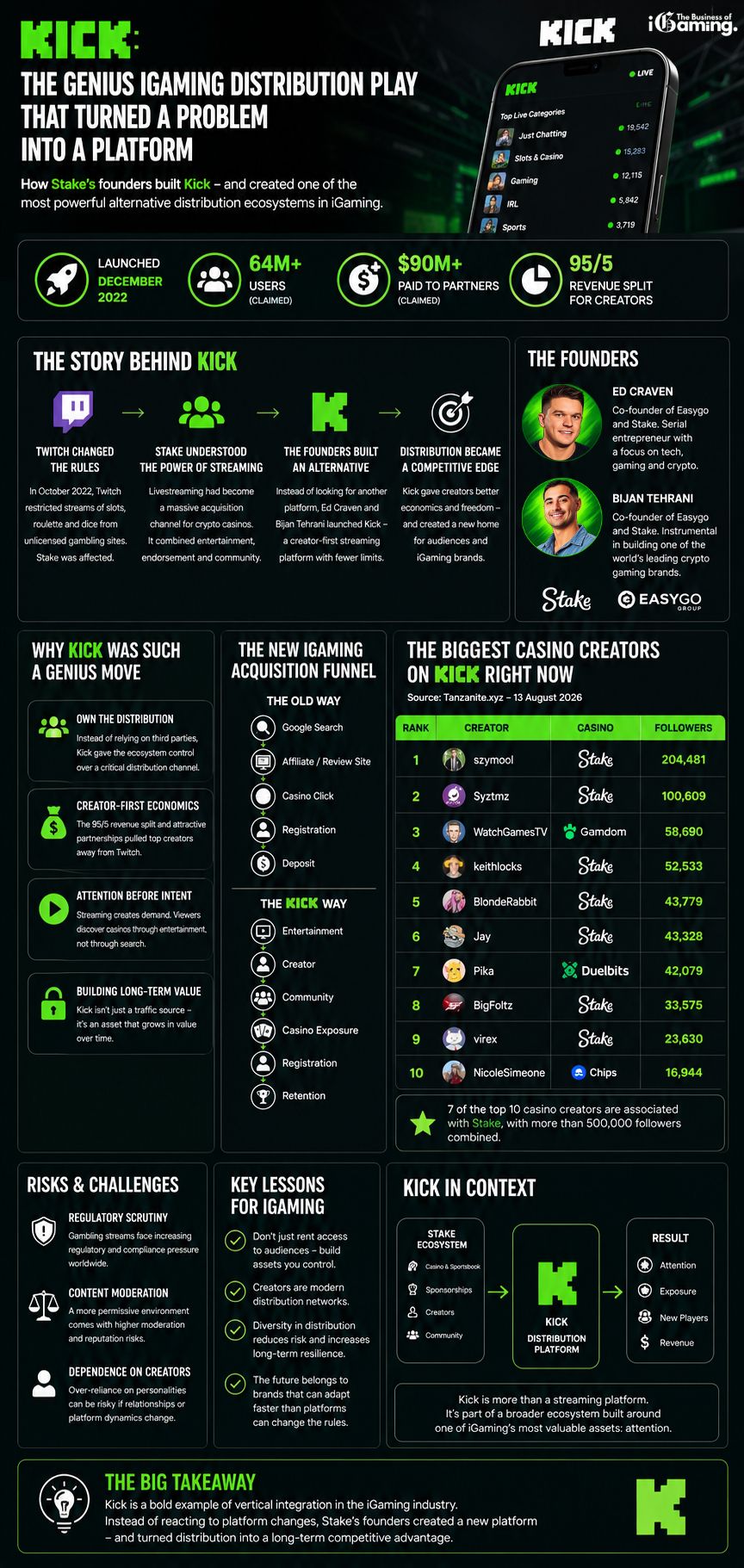
The platform itself currently claims more than 64 million users and more than $90 million paid to partners on its creator-facing website.
Kick has therefore evolved far beyond the idea of simply providing another home for casino streams.
The Biggest Casino Creators on Kick Right Now
The connection between Kick and iGaming remains particularly visible when looking at the largest casino-focused creators on the platform.
According to data from Tanzanite.xyz on 13 August 2026, Stake is associated with seven of the ten largest casino creators on Kick by followers.
| Rank | Creator | Casino | Followers |
| 1 | szymool | Stake | 204,481 |
| 2 | Syztmz | Stake | 100,609 |
| 3 | WatchGamesTV | Gamdom | 58,690 |
| 4 | keithlocks | Stake | 52,533 |
| 5 | BlondeRabbit | Stake | 43,779 |
| 6 | Jay | Stake | 43,328 |
| 7 | Pika | Duelbits | 42,079 |
| 8 | BigFoltz | Stake | 33,575 |
| 9 | virex | Stake | 23,630 |
| 10 | NicoleSimeone | Chips | 16,944 |
Source: Tanzanite.xyz, 13 August 2026
The concentration is striking. Seven of the top ten casino creators are associated with Stake, and collectively those seven accounts have more than 500,000 followers based on the Tanzanite snapshot.
That does not prove that Kick exists primarily to acquire Stake customers—the platform today is substantially broader than gambling—but it demonstrates how powerful the ecosystem can become. Stake is not simply buying conventional advertising inventory on Kick; it is embedded within a creator economy where some of the largest gambling-focused personalities on the platform are already associated with the brand.
The New Casino Acquisition Funnel
The traditional affiliate funnel is relatively simple:
Google search → Affiliate → Casino review → Click → Registration → Deposit
It has worked extraordinarily well for more than two decades, but the Kick model illustrates a very different route to the customer:
Entertainment → Creator → Community → Casino exposure → Registration → Retention
There is one particularly important distinction between the two. The traditional funnel generally captures existing intent, because someone searching Google for “best online casino” already has an interest in finding somewhere to play.
Streaming can instead create intent.
A viewer might initially have no intention of finding a new casino and may simply be watching because they enjoy a particular creator. Over time, however, the casino becomes part of the entertainment, repeated exposure builds familiarity and the streamer can provide a form of social proof. Eventually, a proportion of those viewers may convert.
This makes streaming fundamentally different from traditional performance marketing because the channel can influence demand before the conventional search-and-click journey has even started.
Stake Understood Attention Before Many Traditional Operators
This may be the larger lesson from the story.
Many traditional operators historically approached marketing through clearly defined channels such as SEO, PPC, affiliates, TV advertising, sports sponsorship and CRM. Stake approached growth more like a modern internet company, where creators, celebrities, sports sponsorships, crypto communities and streaming could all become interconnected parts of the same brand-building machine.
Kick takes that philosophy one step further. Instead of merely participating in the creator economy, the founders helped build infrastructure for it, which is a significantly more ambitious strategy than simply allocating a larger budget to influencer marketing.
The Economics Don’t Have to Look Like Twitch
There is also an important point about Kick’s business model. Looking at the 95/5 split in isolation can make the economics seem strange: if creators receive 95% of applicable subscription revenue, where is the platform’s margin?
But that question assumes Kick must operate according to exactly the same economic logic as Twitch, and it doesn’t necessarily have to.
A platform can have strategic value beyond maximising subscription margins. Building audiences, creating an ecosystem, attracting creators and establishing distribution can themselves be enormously valuable, especially when the people behind the platform have interests elsewhere in the digital entertainment economy.
Seen from that perspective, the 95/5 split looks less like generosity for generosity’s sake and more like an extremely aggressive customer-acquisition strategy. Creators are effectively the supply side of a livestreaming marketplace, and if you give them a compelling enough reason to move, their audiences may follow.
Kick Still Faces Significant Risks
None of this means Kick’s strategy is without problems.
Its more permissive positioning has repeatedly created moderation controversies, while the combination of livestreaming and gambling attracts obvious regulatory and responsible-gambling scrutiny. Kick’s current community guidelines require creators to comply with applicable gambling laws, restrict minors from gambling-related activities, require appropriate age labelling and state that sponsored gambling must involve platforms holding valid licences in the relevant jurisdiction. Affiliate relationships must also be disclosed.
There is also a broader reputational challenge. Offering creators more freedom can differentiate a platform from competitors, but the same freedom can create problems when creators cross boundaries.
Kick therefore has to balance two competing objectives: being different enough from Twitch to attract creators while avoiding becoming so permissive that advertisers, regulators or mainstream audiences become uncomfortable with the platform.
How successfully it manages that balance may ultimately be one of the biggest tests of the business model.
The Real Lesson for iGaming
The biggest takeaway from Kick isn’t that every casino company should launch a social network. Almost none should.
The lesson is about distribution ownership.
The iGaming industry spent much of the past two decades building businesses on platforms controlled by somebody else. Affiliates built around Google, operators built around affiliates, brands accumulated enormous social audiences on Meta, and streamers built careers on Twitch.
The problem is that algorithms change, advertising policies change, search results change and streaming policies change. When the underlying platform belongs to somebody else, a business can never completely control its access to the audience.
Kick represents an unusually aggressive response to that problem. Instead of asking “How do we get our distribution back?”, the founders effectively asked “Why don’t we build another distribution channel?”
That is what makes the strategy so interesting.
From Stake to Kick: Building an Ecosystem Around Attention
Stake started as a crypto casino, but the ecosystem around it increasingly resembles something broader.
Casino and sportsbook products generate revenue, sponsorships generate awareness, creators generate attention and communities, while Kick provides distribution. Rather than operating as completely separate components, each part of the ecosystem has the potential to reinforce the others.
That may explain why the Kick strategy deserves more attention from the iGaming industry than it often receives. The smartest part wasn’t simply launching another Twitch competitor; it was recognising that distribution itself had become one of the most valuable assets in online gambling.
When Twitch changed its rules, Stake could have simply moved its marketing budget somewhere else. Instead, the founders behind the ecosystem helped create somewhere else.
For an industry currently worried about Google updates, declining organic traffic, advertising restrictions and increasingly expensive acquisition, that is a case study worth paying attention to.