


The global gambling industry is enormous, but the latest data also shows just how unevenly that activity is distributed.
According to data from Blask dated 29 September 2026, the United States sits far ahead of every other country when markets are compared using Competitive Earning Baseline (CEB). Behind the US, however, the picture becomes much more competitive. The United Kingdom, Turkey, Canada, Brazil and Russia all appear among the six largest markets, while rapidly developing markets such as the Philippines, South Africa and Mexico are recording some of the strongest year-on-year growth.
The data is particularly interesting because it does more than rank countries. It also provides an indication of how many gambling brands are competing for players, how interest has changed over the previous 12 months, the maturity of each market, and whether online casino and betting are regulated or unregulated.
This gives us a useful snapshot of where global gambling demand is concentrated in 2026 — and where the industry may be changing fastest.
Important methodology note: The figures below should not be interpreted as reported gambling revenue. Blask defines CEB, or Competitive Earning Baseline, as an estimated revenue range for a brand based on projected APS and market-level assumptions around retention and average revenue per user. It is therefore a modelled benchmark rather than directly observed operator revenue.
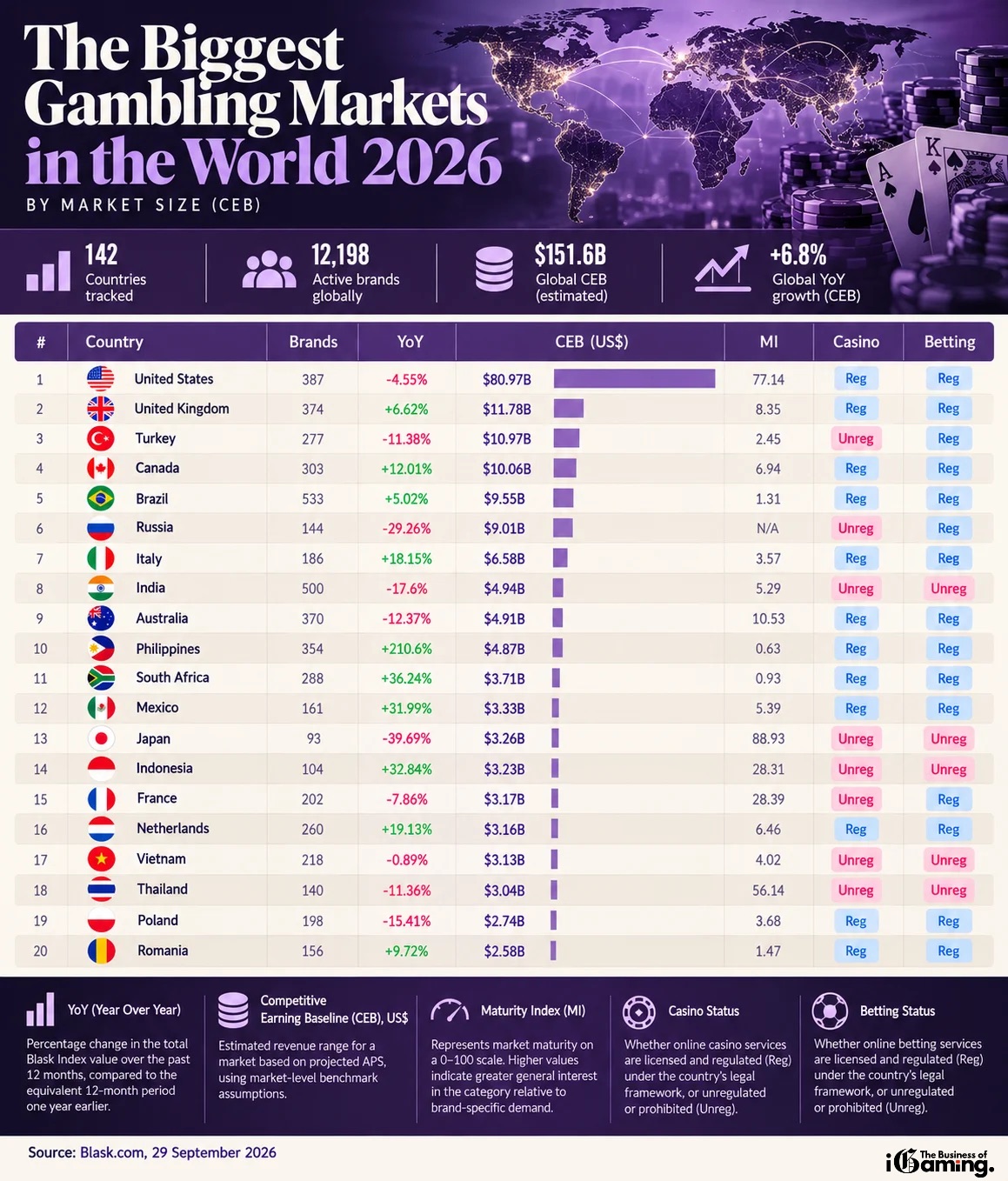
The 20 Biggest Gambling Markets in the World 2026
| Rank | Country | Brands | YoY | CEB (US$) | MI | Casino | Betting |
| 1 | 🇺🇸 United States | 387 | -4.55% | $80.97B | 77.14 | Reg | Reg |
| 2 | 🇬🇧 United Kingdom | 374 | +6.62% | $11.78B | 8.35 | Reg | Reg |
| 3 | 🇹🇷 Turkey | 277 | -11.38% | $10.97B | 2.45 | Unreg | Reg |
| 4 | 🇨🇦 Canada | 303 | +12.01% | $10.06B | 6.94 | Reg | Reg |
| 5 | 🇧🇷 Brazil | 533 | +5.02% | $9.55B | 1.31 | Reg | Reg |
| 6 | 🇷🇺 Russia | 144 | -29.26% | $9.01B | N/A | Unreg | Reg |
| 7 | 🇮🇹 Italy | 186 | +18.15% | $6.58B | 3.57 | Reg | Reg |
| 8 | 🇮🇳 India | 500 | -17.60% | $4.94B | 5.29 | Unreg | Unreg |
| 9 | 🇦🇺 Australia | 370 | -12.37% | $4.91B | 10.53 | Reg | Reg |
| 10 | 🇵🇭 Philippines | 354 | +210.60% | $4.87B | 0.63 | Reg | Reg |
| 11 | 🇿🇦 South Africa | 288 | +36.24% | $3.71B | 0.93 | Reg | Reg |
| 12 | 🇲🇽 Mexico | 161 | +31.99% | $3.33B | 5.39 | Reg | Reg |
| 13 | 🇯🇵 Japan | 93 | -39.69% | $3.26B | 88.93 | Unreg | Unreg |
| 14 | 🇮🇩 Indonesia | 104 | +32.84% | $3.23B | 28.31 | Unreg | Unreg |
| 15 | 🇫🇷 France | 202 | -7.86% | $3.17B | 28.39 | Unreg | Reg |
| 16 | 🇳🇱 Netherlands | 260 | +19.13% | $3.16B | 6.46 | Reg | Reg |
| 17 | 🇻🇳 Vietnam | 218 | -0.89% | $3.13B | 4.02 | Unreg | Unreg |
| 18 | 🇹🇭 Thailand | 140 | -11.36% | $3.04B | 56.14 | Unreg | Unreg |
| 19 | 🇵🇱 Poland | 198 | -15.41% | $2.74B | 3.68 | Reg | Reg |
| 20 | 🇷🇴 Romania | 156 | +9.72% | $2.58B | 1.47 | Reg | Reg |
Source: Blask.com, 29 September 2026. Regulation labels reproduce the status shown in the supplied Blask dataset.
The United States is in a league of its own
The first thing that stands out is the extraordinary gap between the United States and everyone else. Blask places the US at a CEB of $80.97 billion. The United Kingdom, in second place, stands at $11.78 billion. On this metric, the US is therefore almost seven times the size of the UK.
Yet the American figure needs context. The United States is not a single homogeneous gambling market. Regulation differs substantially between states, and the relative importance of sports betting, online casino, lotteries and land-based gambling varies geographically.
What the Blask data does demonstrate is the sheer scale of gambling-related digital demand in the country. Interestingly, that scale is not currently translating into growth according to the company’s index: the US recorded a 4.55% year-on-year decline.
This illustrates an important distinction throughout the ranking. The biggest markets are not necessarily the fastest-growing markets.
The UK remains Europe’s heavyweight
The United Kingdom ranks second at $11.78 billion CEB, accompanied by 374 active brands and 6.62% year-on-year growth.
Its position is particularly notable because the UK is one of the world’s most established online gambling jurisdictions. Rather than representing a new market experiencing an initial explosion of operator activity, Britain has had a mature online betting and casino industry for many years.
Italy provides another interesting European comparison. It ranks seventh at $6.58 billion but is growing considerably faster, with its Blask Index up 18.15% year on year.
The Netherlands is another European market showing substantial growth at 19.13%, although its $3.16 billion CEB leaves it much further down the overall ranking.
Europe therefore remains extremely important, but there is no single European growth story. Different markets are moving in markedly different directions.
Turkey is one of the world’s largest gambling markets
Perhaps one of the more surprising results is Turkey. Turkey ranks third globally with a CEB of $10.97 billion, ahead of Canada and Brazil. Blask tracks 277 brands in the country.
At the same time, the dataset classifies casino as unregulated while betting is classified as regulated. The country’s Blask Index has fallen 11.38% year on year.
This combination highlights why regulation alone does not necessarily explain the scale of gambling demand. Large digital gambling ecosystems can exist even when substantial parts of the product landscape sit outside a locally regulated framework.
Canada quietly reaches the global top four
Canada receives considerably less international industry attention than some other markets, yet Blask places it fourth with a $10.06 billion CEB. It is also moving in the opposite direction from Turkey, recording 12.01% year-on-year growth.
The data tracks 303 active brands, while both casino and betting are shown as regulated. Canada’s combination of scale and positive growth makes it one of the most significant markets in the dataset.
Brazil had become a global top-five market
Then comes Brazil. With 533 active brands, Brazil has more tracked brands than any other country in the top 20. Its CEB of $9.55 billionplaces it fifth globally in the September snapshot, while its Blask Index was still 5.02% higher year on year.
That makes Brazil’s current regulatory situation particularly consequential for the wider industry.
Brazil was not a small emerging jurisdiction waiting to develop into an important gambling market. By Blask’s measurements, it had already become one of the world’s largest.
The number of competing brands also demonstrates the scale of commercial interest the country had attracted. Operators, game studios, affiliates, media companies, payment providers and sports organisations had increasingly built businesses around Brazilian gambling demand.
The question now is not simply what happens to regulated operators. It is what happens to the underlying demand if the legal framework changes substantially.
The Philippines is the extraordinary growth story
No country in the top 20 comes close to the Philippines in terms of year-on-year growth. Its Blask Index has increased by an extraordinary 210.6%, putting the Philippines at $4.87 billion CEB and tenth overall.
That places it almost alongside Australia, which has a CEB of $4.91 billion but is moving in the opposite direction with a 12.37% YoY decline. It is a striking example of how quickly the geography of online gambling can change.
A country does not necessarily need decades to become commercially important to international operators. Changes in smartphone penetration, payment infrastructure, regulation, marketing, local operator competition and consumer behaviour can transform a market remarkably quickly.
South Africa and Mexico are markets to watch
Immediately below the Philippines are two other markets showing strong growth. South Africa is up 36.24%, reaching $3.71 billion CEB, while Mexico is up 31.99% at $3.33 billion.
South Africa also has 288 active brands tracked by Blask, suggesting significant competitive intensity. Mexico has fewer — 161 — but still records one of the strongest growth rates among the world’s 20 largest markets.
Taken together, these figures point toward a broader geographic diversification of the gambling industry. Europe remains crucial and the US remains dominant, but some of the strongest expansion is occurring elsewhere.
India shows the scale of gambling outside regulated markets
India provides another revealing example. Blask tracks 500 active brands, second only to Brazil among the countries shown here, while estimating CEB at $4.94 billion.
Yet both casino and betting are marked as unregulated in the dataset. The Blask Index is also down 17.6% year on year.
India therefore demonstrates an important reality of global online gambling: regulatory status and consumer demand are two separate variables.
Prohibiting or restricting an activity does not automatically mean that measurable online interest disappears. That distinction becomes especially important when governments consider whether to regulate existing demand or attempt to suppress it.
Some large Asian markets exist almost entirely outside regulated gambling
Japan, Indonesia, Vietnam and Thailand are all among the world’s 20 largest markets by Blask’s CEB metric despite casino and betting being classified as unregulated in the dataset. The figures are substantial:
Japan sits at $3.26 billion, Indonesia at $3.23 billion, Vietnam at $3.13 billion, and Thailand at $3.04 billion.
Their trajectories are very different. Japan is down 39.69%, Thailand is down 11.36% and Vietnam is almost flat at -0.89%. Indonesia, meanwhile, has grown 32.84%.
This is another reason why global gambling cannot be understood purely by looking at regulated operator revenue. Consumer interest can extend far beyond formally licensed ecosystems.
The fastest-growing markets aren’t necessarily the biggest
Looking across the table, several different groups emerge. The United States represents extraordinary scale but negative YoY movement. Britain combines scale with moderate growth. Canada and Italy combine large CEB figures with double-digit expansion.
Then there is another group consisting of the Philippines, South Africa, Mexico and Indonesia, where growth is considerably stronger.
At the other extreme are markets such as Japan (-39.69%), Russia (-29.26%), India (-17.60%) and Poland (-15.41%).
These movements shouldn’t automatically be interpreted as equivalent changes in gambling revenue. The YoY column measures the percentage change in the Blask Index over the previous 12 complete months compared with the equivalent earlier period.
It is therefore primarily a measure of changing gambling-related demand within Blask’s methodology.
What does the Maturity Index tell us?
Another interesting element is Blask’s Maturity Index (MI). Unlike a conventional market-size metric, MI attempts to show how broad gambling interest is relative to interest in individual brands. According to Blask’s definition, a higher score indicates that general category demand is stronger relative to brand-specific demand, suggesting broader user awareness and a more competitive environment.
The differences are enormous. Japan has an MI of 88.93, the United States 77.14 and Thailand 56.14. Brazil, by comparison, sits at only 1.31, while the Philippines is at 0.63 and South Africa at 0.93.
This creates a useful second dimension to the ranking. Two countries with similar CEB figures can have very different competitive structures and patterns of consumer interest.
Regulation does not neatly divide large and small markets
Perhaps the most interesting conclusion from the entire dataset is that there is no simple relationship between regulation and market scale.
Some of the world’s largest markets have regulated casino and betting. Others contain major unregulated components. Some unregulated markets are growing rapidly, while others are contracting. The same variation exists among regulated markets.
That matters because online gambling is fundamentally digital and cross-border.
A government’s regulatory framework determines which companies can legally serve consumers and under what conditions, but regulation alone does not necessarily determine whether the underlying consumer demand exists.
For regulators, operators and investors, the more important questions therefore concern channelisation: where players actually gamble, how much activity remains inside the licensed system, and how effectively a regulatory framework can attract existing demand.
The global gambling map is becoming more diverse
For years, discussions about the global iGaming industry tended to revolve around a relatively predictable collection of mature European markets. That picture is becoming increasingly outdated.
The United States is now overwhelmingly large by Blask’s CEB metric. Brazil has reached the global top five. The Philippines is experiencing extraordinary growth. South Africa and Mexico are expanding rapidly, while huge levels of gambling interest can also be observed across markets where online gambling remains restricted.
The result is a much more geographically diverse industry. And that may be the most important takeaway from the 2026 ranking of the world’s biggest gambling markets.
The future of iGaming is unlikely to be defined by one region. It will be shaped by the interaction between consumer demand, regulation, technology, payments and local competition across dozens of very different markets.
For operators and suppliers, understanding those differences may increasingly matter more than simply asking which country is biggest.
Source: Blask.com, 29 September 2026.