



The 2026/27 Premier League season marks one of the biggest changes to football sponsorship in recent years. After years in which betting companies became a familiar sight on Premier League shirts, gambling brands can no longer appear as front-of-shirt sponsors on matchday kits.
The change comes from a voluntary agreement reached collectively by Premier League clubs in 2023. It took effect following the conclusion of the 2025/26 season. The Premier League described itself as the first UK sports league to collectively introduce such a measure voluntarily.
But there is an important distinction: Gambling sponsorship in the Premier League has not been banned altogether.
Betting companies can still have commercial relationships with clubs and, subject to the applicable rules, appear on shirt sleeves, training kits and other club assets.
And that is exactly what we’re seeing in 2026/27.
2025/26 was the final season for gambling front-of-shirt sponsors
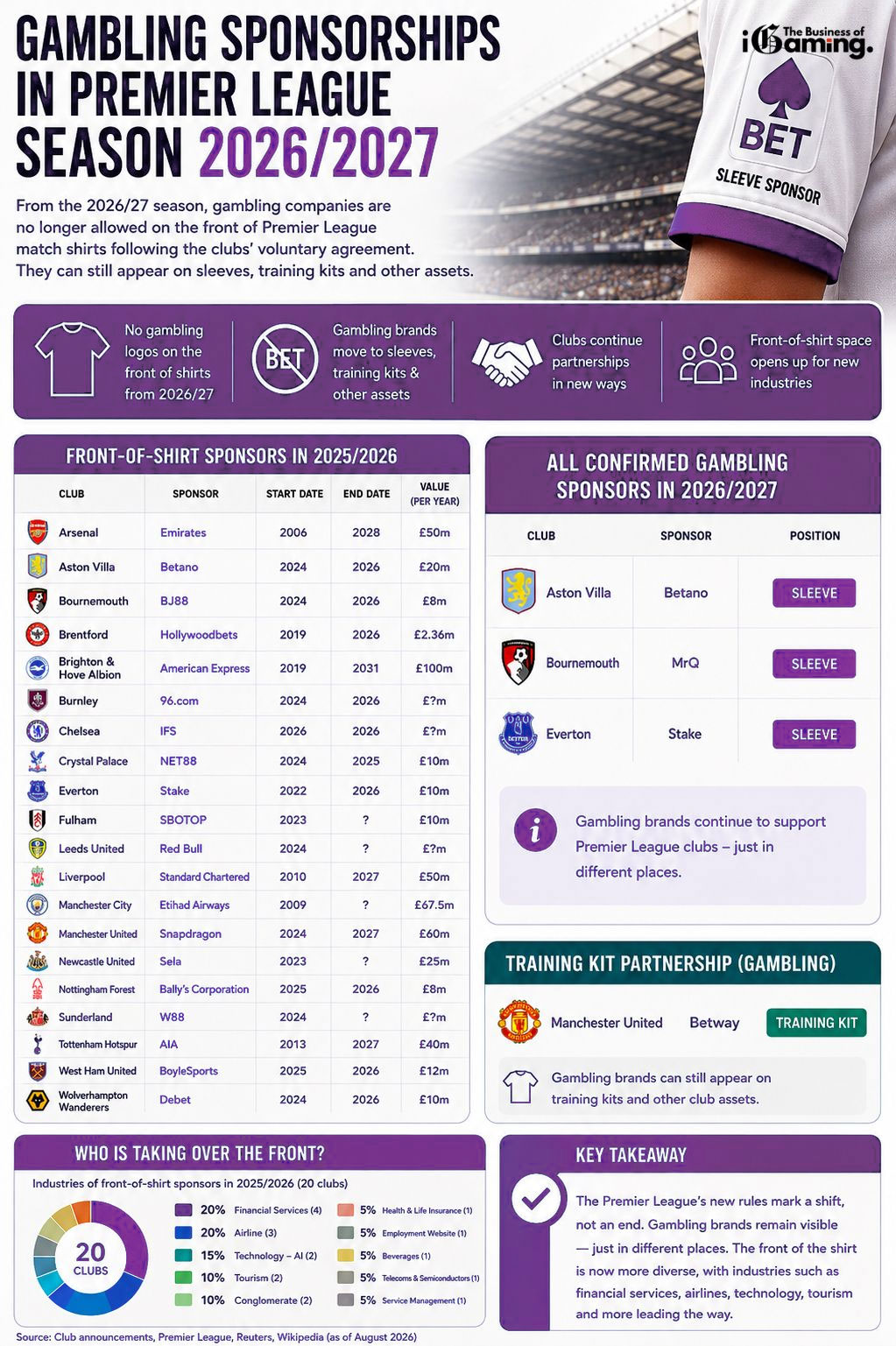
The scale of the change becomes obvious when looking back just one season. In 2025/26, gambling companies remained prominent among Premier League front-of-shirt sponsors.
They included Betano at Aston Villa, BJ88 at Bournemouth, Hollywoodbets at Brentford, Stake at Everton, SBOTOP at Fulham, W88 at Sunderland, BoyleSports at West Ham United and Debet at Wolverhampton Wanderers.
Other clubs had major non-gambling agreements, including Emirates at Arsenal, American Express at Brighton & Hove Albion, Standard Chartered at Liverpool, Etihad Airways at Manchester City, Snapdragon at Manchester United and AIA at Tottenham Hotspur.
The gambling deals were commercially important, too.
Aston Villa’s Betano agreement was reported at approximately £20 million per year, while several other gambling partnerships were worth millions annually. For clubs accustomed to receiving substantial payments from betting companies, replacing that revenue was always going to be one of the biggest questions surrounding the new rules.
What happened to the gambling sponsors in 2026/27?
They haven’t all disappeared. Some have simply moved. The clearest examples can be seen on Premier League shirt sleeves.
Confirmed gambling sleeve sponsors for 2026/27
| Club | Gambling sponsor | Position |
| Aston Villa | Betano | Sleeve |
| Bournemouth | MrQ | Sleeve |
| Everton | Stake | Sleeve |
This creates an interesting situation.
Aston Villa had Betano on the front of its shirt in 2025/26. In 2026/27, Betano remains associated with the club but occupies the sleeve instead.
Everton provides another clear example. Stake’s front-of-shirt deal ended with the 2025/26 season, but the gambling company has retained Premier League exposure through Everton’s sleeve.
The overall result is therefore better described as a redistribution of gambling sponsorship rather than its disappearance from Premier League football.
Manchester United and Betway show another route
Sleeves aren’t the only alternative. Training kits could become an increasingly valuable commercial asset for gambling companies.
Manchester United’s new partnership with Betway is particularly significant. The multi-year agreement makes Betway Manchester United’s exclusive global betting partner and puts the brand on the training kits of the men’s and women’s teams.
The Times reported the deal at approximately £20 million, with Manchester United describing it as the largest standalone training-kit or sleeve sponsorship agreement of its kind.
It demonstrates just how valuable non-match-shirt-front inventory can become. For gambling companies, the question is increasingly shifting from:
“Can we sponsor a Premier League club?”
to:
“Where can our brand appear?”
Who is taking over the front of Premier League shirts?
This is arguably the more interesting commercial story. Removing betting companies from the front hasn’t resulted in one particular industry replacing them.
Instead, the 2026/27 market is considerably more diverse. Among the announced front-of-shirt partnerships are:
| Club | 2026/27 shirt sponsor | Industry |
| Arsenal | Emirates | Airline |
| Aston Villa | Visit Rwanda | Tourism |
| Bournemouth | Vitality | Health & life insurance |
| Brentford | Indeed | Employment/recruitment |
| Brighton & Hove Albion | American Express | Financial services |
| Coventry City | Monzo | Financial services |
| Crystal Palace | Temporal | AI/technology |
| Everton | CMC Markets | Financial services |
| Fulham | ClickHouse | Technology |
| Leeds United | Red Bull | Conglomerate |
| Liverpool | Standard Chartered | Banking/financial services |
| Manchester City | Etihad Airways | Airline |
| Manchester United | Snapdragon | Semiconductors/technology |
| Newcastle United | Knowx Hydrate | Beverages |
| Tottenham Hotspur | AIA | Insurance/financial services |
Some clubs entered the period without a confirmed front-of-shirt partner, so the picture remains capable of changing as additional agreements are announced.
The important point is that there is no single replacement for gambling.
Financial services, technology, AI, tourism, airlines, insurance, recruitment and consumer businesses are all competing for Premier League exposure.
Financial services and technology are emerging as major winners
The shift toward finance and technology is particularly noticeable. Everton has moved from Stake to CMC Markets, while Coventry City has Monzo and Liverpool continues its long-standing relationship with Standard Chartered.
Technology is another increasingly important category.
Manchester United has Snapdragon, Crystal Palace has AI company Temporal and Fulham has database technology company ClickHouse. Reuters reported on August 7 that Nielsen sees the disappearance of gambling companies from shirt fronts creating opportunities for fintech, sovereign investment and major software businesses.
That could be an indication of where Premier League sponsorship is heading over the next several seasons.
Aston Villa illustrates the transformation perfectly
Aston Villa is perhaps the best example of the new commercial structure.
In 2025/26:
Front of shirt: Betano
In 2026/27:
Front of shirt: Visit Rwanda
Sleeve: Betano
Visit Rwanda was announced as Aston Villa’s Principal Partner in July 2026, with its branding appearing on the front of the men’s, women’s and academy shirts. The Premier League described it as the most important sponsorship agreement in Aston Villa’s history.
Betano hasn’t necessarily been pushed out of the commercial ecosystem. It has simply moved to another piece of sponsorship inventory.
That distinction is central to understanding the 2026/27 changes.
Why were gambling companies so attracted to Premier League shirts?
The relationship made commercial sense. Premier League football provides enormous international exposure to an audience already strongly interested in sport.
A shirt sponsor receives visibility far beyond the 90 minutes of a match. The logo can appear in match broadcasts, highlights, press photography, social media, interviews, merchandise, news coverage and other media around the club.
For an online sportsbook or casino attempting to establish itself internationally, Premier League sponsorship offered an unusually powerful way of building brand recognition.
Clubs benefited because gambling operators were often willing to pay significant amounts for that exposure. The rapid expansion of online gambling therefore coincided with betting companies becoming increasingly prominent Premier League sponsors.
The new rule is not a complete gambling sponsorship ban
This remains the most important distinction. Premier League clubs agreed to withdraw gambling sponsorship specifically from the front of matchday shirts.
The agreement took effect at the end of the 2025/26 season. Football authorities have also introduced a Code of Conduct for Gambling Related Agreements in Football, covering principles including protection, social responsibility, reinvestment and integrity.
Gambling companies can therefore still potentially gain exposure through areas such as shirt sleeves, training apparel, stadium advertising, official betting partnerships and other commercial activations, provided those arrangements comply with the relevant rules.
Could sleeve and training-kit sponsorship become more valuable?
That is one of the most interesting questions for the gambling industry. Previously, an operator looking for maximum visibility could bid for the centre of a Premier League shirt.
That option has now disappeared. But the desire to reach Premier League audiences hasn’t. Operators may consequently redirect sponsorship budgets toward the most valuable remaining assets.
The Manchester United–Betway agreement is particularly significant in this respect. A reported £20 million for a training-kit partnership demonstrates that these secondary sponsorship positions can command substantial amounts.
Sleeves could become increasingly competitive for the same reason.
The Premier League sponsorship market is becoming more diverse
There is also a broader structural change underway. Different industries have dominated football sponsorship during different eras. Electronics and consumer brands were once particularly prominent. Airlines became major sponsors as the Premier League’s international audience expanded. Online betting companies then emerged as aggressive buyers of football sponsorship inventory.
The next era may be considerably more fragmented.
Financial services are already strongly represented, technology businesses are growing, AI companies have begun appearing, and tourism remains significant.
Airlines continue to occupy some of the league’s most established partnerships, while insurance, recruitment and consumer businesses add further diversity.
Reuters’ report on Nielsen’s analysis suggests software infrastructure companies could become especially important by 2028, with technology businesses increasingly competing for the visibility previously purchased by gambling operators.
Gambling sponsorship isn’t leaving Premier League football
The 2026/27 season shouldn’t therefore be interpreted as the end of the relationship between gambling and Premier League football.
It’s a change in where that relationship is visible.
2025/26 represented the end of the gambling front-of-shirt era. 2026/27 represents the beginning of a new sponsorship structure.
Betano remains visible with Aston Villa, but on the sleeve. Stake has moved from Everton’s shirt front to its sleeve. Betway has entered into a major Manchester United training-kit partnership.
Meanwhile, the most valuable position — the front of the matchday shirt – is becoming home to a much broader range of industries.
Key takeaway
The Premier League’s new rules have changed the sponsorship hierarchy rather than eliminated gambling companies from football. The front of the shirt is becoming more diverse, with financial services, technology, tourism, airlines, insurance and other sectors filling the space.
At the same time, gambling companies are migrating to sleeves, training kits and other commercial assets.
That makes 2026/27 an important test of what Premier League sponsorship will look like in the post-gambling-front-of-shirt era. And if the current trend continues, the biggest long-term beneficiary may be technology.
The betting brands haven’t disappeared.