



What provably fair means
Provably fair is a cryptographic method that lets a player check, after a round, that the outcome was fixed before the bet and was not changed by the casino. Instead of trusting a black box, the player can verify the result with a few inputs. It is most often seen on crypto casinos and on the in-house games those casinos produce.
The core idea is trust through maths. A casino cannot prove that every game is honest simply by pointing to a certificate. Provably fair gives players a way to check each outcome for themselves.
How the system works
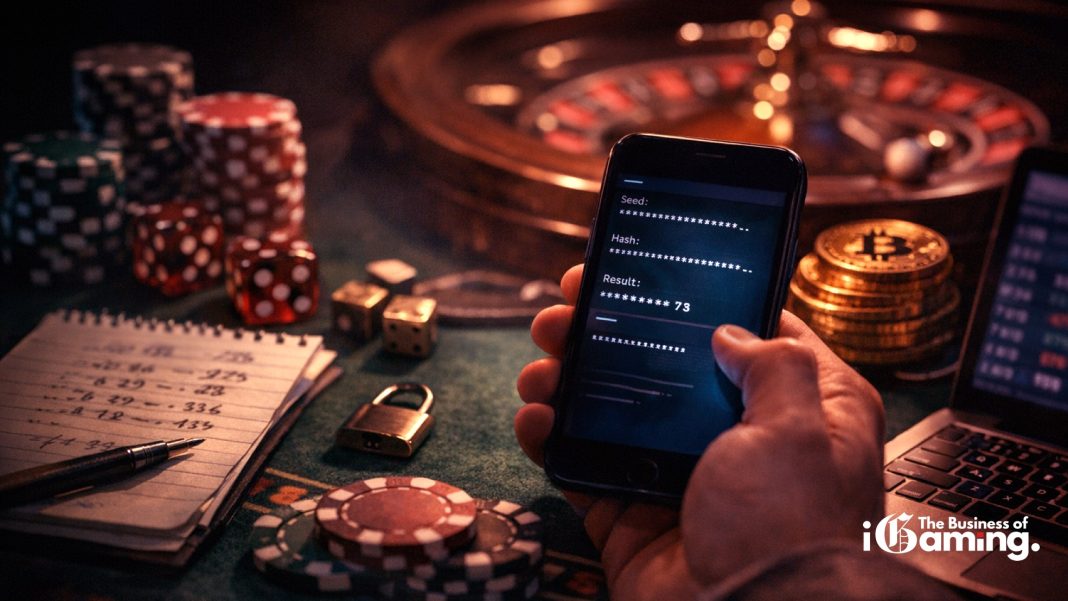
Most provably fair games rely on seeds and hashing. In broad terms, the casino commits to a secret server seed by publishing its hash before play begins. The player contributes a client seed of their own. Implementations typically also use a counter, often called a nonce, that tracks the bets made under that seed pair. The combined inputs are run through a hash function, and the output determines the result.
After the round, the casino reveals the original server seed. The player can hash it, confirm that it matches the published commitment, and recalculate the outcome using the same inputs. If the numbers match, the result was fixed in advance. Guides describe this as the key difference from a standard random number generator, which the player cannot inspect.
Which games use it
Provably fair suits certain game formats best. Dice, crash, coin flips, mines, plinko and limbo are typical examples, and several industry guides list them as casino originals. Blackjack, roulette and poker variants can be built on the same approach, although they are less common.
Third-party slots and live dealer tables work differently. Their results usually come from the game provider, and their fairness is tested through audited random number generators from independent testing labs. Players who assume every game on a crypto casino is provably fair may be caught out by this distinction.
How players can check a result
Most casinos that offer provably fair games include a verifier tool. The player enters the server seed, client seed, nonce and result, and the tool shows whether they match. The process is less intimidating than it sounds, because the tool does the hashing. The key habits are to note your client seed and to check the published hash before the round starts.
A simple way to start
- Open a provably fair dice or crash game at a platform you already trust.
- Copy the hashed server seed before you place a bet.
- After the round, reveal the seed and run it through the verifier.
- Repeat over a few rounds to see how the process works.
What provably fair does not guarantee
This is where many explanations go wrong. Provably fair proves that a single result followed the published formula. It does not prove that the house edge is fair, that the game is well designed, or that the platform pays out withdrawals promptly. A provably fair dice game can still carry a built-in margin, and verifying fairness is not the same as improving your odds.
Provably fair also says nothing about how an operator treats players outside the game. Deposits, bonus wallets, withdrawal rules and KYC checks are separate processes that need their own review. Testing and certification of the wider platform matter just as much as any single verifier tool.
Wrong networks, phishing links and copied deposit addresses are risks that the maths does not solve. Anyone using crypto should double-check every address and network before sending funds.
Why operators use it
For crypto casinos, provably fair is mainly about credibility. It gives players a visible reason to trust in-house games, which matters on platforms where the operator’s reputation is a main selling point. One industry write-up notes that provably fair games are popular with operators because they help build consumer trust. That is a commercial argument as much as a technical one.
Judge the platform, not just the game
A provably fair badge is a useful signal, but it should not be the only one. Check the licence, any published RTP information, responsible gambling tools and withdrawal terms. Ask whether the operator is open about its licensing and payment rules. A verifiable game on an unclear platform still leaves the player exposed.
The bottom line
Provably fair games are a real transparency improvement. They let players check individual results without trusting a black box. They do not change the house edge, they do not vet the whole operator, and they are no reason to play beyond your budget. Use the verifier, understand its limits, and judge the platform as a whole.