

Finland is one of the most interesting gambling markets in Europe. Its long-established state-controlled gambling system, strong domestic brands and growing online casino competition make it a particularly important market to follow.
The latest Blask data provides an opportunity to look beyond regulation and examine what Finnish players are searching for, which gambling brands dominate attention, which game providers have the strongest visibility and how the market is evolving.
Several findings stand out:
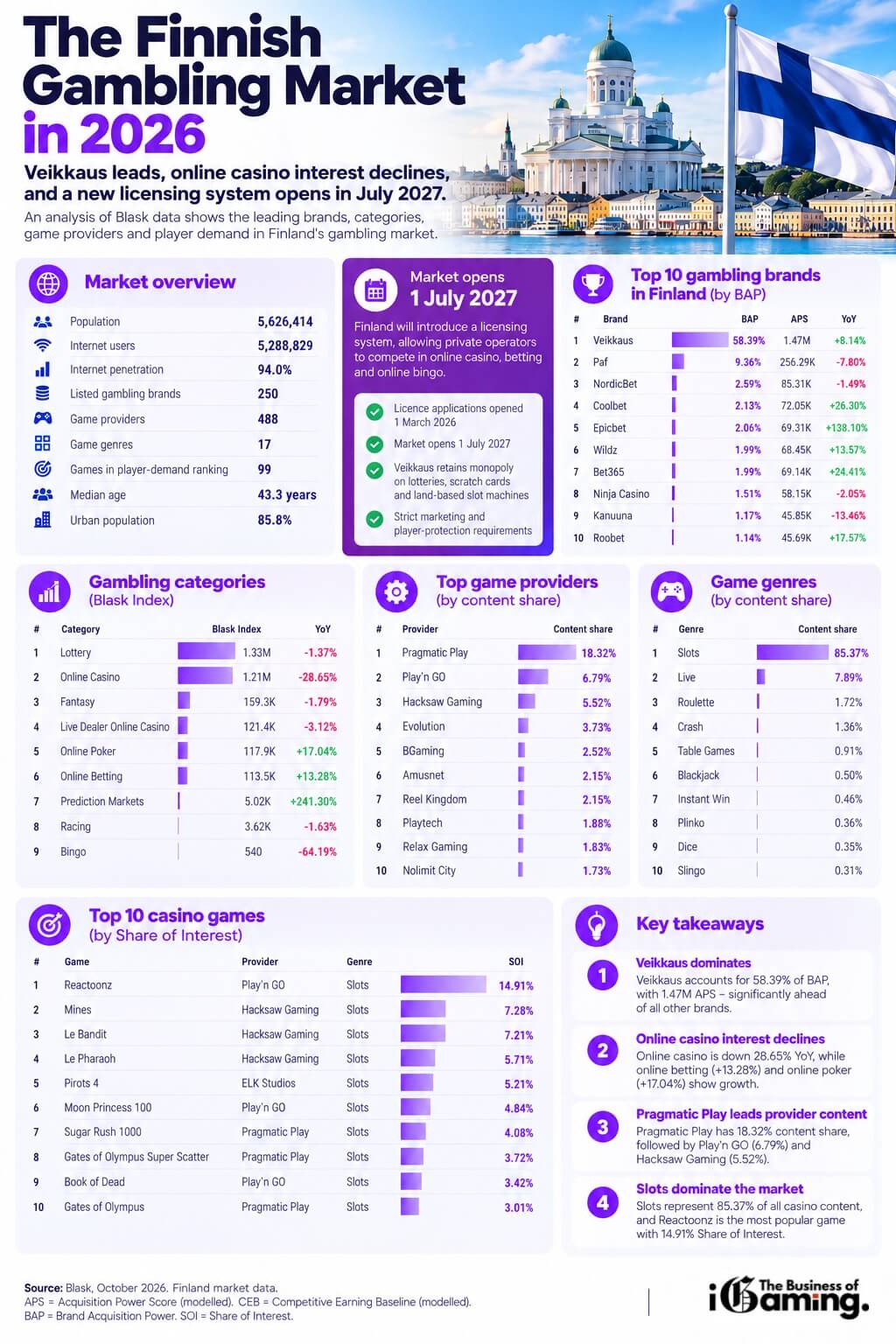
- Veikkaus accounts for 58.39% of Brand Acquisition Power (BAP) among the 250 brands in the supplied ranking.
- Online casino interest is down 28.65% year-on-year, while online betting and poker show positive growth.
- Pragmatic Play leads game-provider content share at 18.32%, ahead of Play’n GO and Hacksaw Gaming.
- Slots account for 85.37% of game-genre content share across the observed casino lobbies.
- Reactoonz is the most popular game by Share of Interest (SOI) in the supplied player-demand ranking.
These findings provide a snapshot of a market where an established domestic leader coexists with international casino brands, changing player preferences and a complex regulatory environment.
The following article separates the figures supplied by Blask from broader market interpretation, rather than treating modelled acquisition or earning metrics as observed financial results.
1. Finland’s gambling market at a glance
Finland has a population of approximately 5.63 million and one of Europe’s most digitally connected societies. According to the demographic data available through Blask, approximately 5.29 million people use the internet, equivalent to around 94% of the population.
This high level of digital adoption makes Finland a particularly interesting market for online gambling operators, game providers and affiliates.
Finnish gambling market statistics 2026
| Indicator | Finland |
| Population | 5,626,414 |
| Internet users | 5,288,829 |
| Internet penetration | 94.0% |
| Listed gambling brands | 250 |
| Game providers tracked | 488 |
| Game genres | 17 |
| Games in player-demand ranking | 99 |
| Brands in game-provider analysis | 221 |
| Median age | 43.3 years |
| Urban population | 85.8% |
Source: Blask, October 2026. The counts represent the coverage of the respective Blask datasets, not necessarily the number of licensed businesses or products commercially available in Finland.
The country’s relatively small population means that competition for Finnish gambling customers can be intense, particularly in online casino.
However, the most important development for the industry is the transition away from Veikkaus’ exclusive control of much of the market.
2. Finland’s gambling reform: The market opens in July 2027
Finland is preparing for one of the most significant changes to its gambling industry in decades. The new Gambling Act was approved in January 2026, establishing a framework that will open online casino games, online slots, betting and online bingo to licensed private competition.
The new competitive gambling market is scheduled to launch on 1 July 2027.
Applications for gambling licences opened on 1 March 2026, allowing operators to begin preparing for the transition.
Until the new framework takes effect, Veikkaus retains its exclusive position in the domestic gambling system. Other companies cannot begin offering or marketing gambling services under the future Finnish licences before July 2027.
The reform will not eliminate every aspect of Veikkaus’ monopoly. The state-controlled operator will retain exclusivity over lottery-type games, scratch cards and physical slot machines and casino games.
This creates a hybrid model combining a state monopoly in selected gambling categories with licensed private competition in online casino and betting.
The Finnish government’s stated objectives include reducing gambling harm, improving regulatory oversight and directing more gambling activity into the nationally regulated system.
The reform also introduces player-protection requirements, including mandatory identification, self-exclusion tools, financial limits and restrictions on gambling marketing.
For operators and affiliates, this means that Finland’s future commercial opportunity will depend not only on consumer demand but also on licensing, advertising restrictions and compliance requirements.
The opening of the market creates opportunities for international operators, but it does not mean that every existing offshore gambling brand will automatically be permitted to operate.
3. Finland’s biggest gambling brands in 2026
One of the most striking findings from Blask is the continued dominance of Veikkaus. Despite the presence of hundreds of international gambling brands in the dataset, Veikkaus accounts for 58.39% of the Brand Acquisition Power (BAP) shown in the supplied ranking.
This is considerably higher than any other individual brand.
Top 10 gambling brands in Finland
| Rank | Brand | APS | CEB (USD) | BAP | YoY |
| 1 | Veikkaus | 1.47M | $356.16M | 58.39% | +8.14% |
| 2 | Paf | 256.29K | $61.47M | 9.36% | −7.80% |
| 3 | NordicBet | 85.31K | $20.56M | 2.59% | −1.49% |
| 4 | Coolbet | 72.05K | $16.17M | 2.13% | +26.30% |
| 5 | Epicbet | 69.31K | $12.87M | 2.06% | +138.10% |
| 6 | Wildz | 68.45K | $14.88M | 1.99% | +13.57% |
| 7 | Bet365 | 69.14K | $15.40M | 1.99% | +24.41% |
| 8 | Ninja Casino | 58.15K | $13.57M | 1.51% | −2.05% |
| 9 | Kanuuna | 45.85K | $11.07M | 1.17% | −13.46% |
| 10 | Roobet | 45.69K | $9.46M | 1.14% | +17.57% |
Source: Blask, October 2026. Ranked by BAP as displayed in the supplied dataset. APS and CEB are modelled estimates, not observed acquisitions or revenue. The YoY column represents Blask’s reported brand growth indicator.
Veikkaus remains the dominant brand
Veikkaus’ 58.39% BAP is more than six times the share of second-placed Paf. Its modelled APS of 1.47 million is also substantially higher than that of the other leading brands.
This illustrates the strength of Veikkaus’ existing market position, which has been built through its historical monopoly, domestic recognition and extensive gambling product portfolio. However, its current position does not guarantee equivalent dominance after the licensing reform.
Once international operators can compete under Finnish licences, customer acquisition, brand positioning and product differentiation may become increasingly important.
Paf holds a strong second position
Paf, the Åland-based gambling operator, ranks second with 9.36% BAP and modelled CEB of $61.47 million. Its established Nordic identity and responsible gambling positioning make it a particularly interesting competitor as Finland prepares for a more open market.
Although Blask reports a 7.8% year-on-year decline for Paf, the brand remains substantially ahead of most international competitors in the ranking.
Epicbet and Coolbet show strong momentum
Among the other leading brands, Epicbet stands out with reported YoY growth of 138.1%. Coolbet records growth of 26.3%, while Bet365 shows an increase of 24.41%.
These figures suggest that competitive momentum varies significantly between brands. However, rapid percentage growth should be interpreted alongside the starting level of brand activity.
A smaller brand can achieve exceptionally high percentage growth without approaching the overall scale of an established market leader.
4. What gambling categories are growing in Finland?
The category-level Blask data reveals an interesting divergence between online casino and other forms of gambling. Online casino remains one of the largest categories by Blask Index, but its year-on-year momentum is considerably weaker than that of betting and poker.
Gambling categories in Finland – Blask Index and YoY
| Category | Blask Index | YoY |
| Lottery | 1.33M | −1.37% |
| Online Casino | 1.21M | −28.65% |
| Fantasy | 159.3K | −1.79% |
| Live Dealer Online Casino | 121.4K | −3.12% |
| Online Poker | 117.9K | +17.04% |
| Online Betting | 113.5K | +13.28% |
| Prediction Markets | 5.02K | +241.30% |
| Racing | 3.62K | −1.63% |
| Bingo | 540 | −64.19% |
Source: Blask, one-year view, October 2026. Blask Index measures modelled market attention; it is not gambling revenue or the number of active players.
Online casino interest declines sharply
The most notable finding is the 28.65% year-on-year decline in the online casino category. Online casino still has a substantial Blask Index of 1.21 million, making it one of the largest categories in the Finnish gambling landscape.
Nevertheless, the decline raises important questions.
Is consumer attention shifting towards other gambling formats? Are established online casino brands facing stronger competition for visibility? Or are broader changes in gambling-related search and digital behaviour influencing the data?
The figures alone cannot determine the cause. They do, however, suggest that operators preparing for the 2027 licensing system should avoid assuming that online casino demand will automatically grow as the market opens.
Online poker and betting show positive momentum
Online poker records growth of 17.04%, while online betting increases by 13.28%. This contrasts with the negative figures for online casino and live dealer online casino.
For operators planning their Finnish product portfolios, the divergence could be relevant. Sports betting and poker may warrant additional investigation into player demographics, brand preferences and acquisition channels.
Prediction markets record exceptional percentage growth
Prediction markets show growth of 241.3%, the strongest percentage increase among the nine categories. However, the category’s Blask Index is only 5.02K.
This illustrates the difference between growth rate and market scale. A rapidly growing category can remain very small compared with established products such as lotteries and online casinos.
Prediction markets therefore represent an interesting emerging area of consumer attention, rather than an established major gambling category in Finland.
Their regulatory classification also requires separate consideration.
5. The most popular casino game providers in Finland
The Blask game-provider dataset provides insight into which software companies have the strongest presence across the casino lobbies included in its analysis.
The dataset covers 488 providers, with content-share figures calculated across 221 brands.
Top 10 game providers by content share
| Rank | Game provider | Content share |
| 1 | Pragmatic Play | 18.32% |
| 2 | Play’n GO | 6.79% |
| 3 | Hacksaw Gaming | 5.52% |
| 4 | Evolution | 3.73% |
| 5 | BGaming | 2.52% |
| 6 | Amusnet | 2.15% |
| 7 | Reel Kingdom | 2.15% |
| 8 | Playtech | 1.88% |
| 9 | Relax Gaming | 1.83% |
| 10 | Nolimit City | 1.73% |
Source: Blask, 18 October 2026. Content share across 221 observed brands. This is not market share by revenue, player activity or operator earnings.
Pragmatic Play dominates casino content distribution
Pragmatic Play accounts for 18.32% of the observed game-provider content share. That is approximately 2.7 times Play’n GO’s share and more than three times Hacksaw Gaming’s.
The gap demonstrates the scale of Pragmatic Play’s content presence in the casino lobbies covered by Blask. However, content share is not equivalent to player preference.
A provider may have a large number of games distributed across operators without necessarily generating the highest player engagement or revenue.
This distinction becomes particularly important when comparing game-provider content share with individual game demand.
Play’n GO and Hacksaw Gaming hold strong positions
Play’n GO ranks second with 6.79% content share. The company also performs strongly in Blask’s player-demand ranking, with several games appearing among Finland’s most popular titles.
Hacksaw Gaming ranks third with 5.52% content share. Its position is particularly interesting because two Hacksaw titles, Mines and Le Bandit, appear among the three leading games by Share of Interest.
This suggests that content presence and player interest should be analysed together when assessing provider performance.
Evolution leads the live casino specialist segment
Evolution ranks fourth overall with 3.73% content share. Its position reflects the presence of live casino products within the observed operator portfolios.
However, comparing Evolution directly with slot-focused providers can be misleading because their product portfolios differ. A more detailed analysis would compare providers within specific game genres rather than relying solely on overall content share.
6. Slots dominate Finland’s online casino content
The game-genre distribution shows an overwhelming concentration of slot games.
Casino game genres by content share
| Rank | Genre | Content share |
| 1 | Slots | 85.37% |
| 2 | Live | 7.89% |
| 3 | Roulette | 1.72% |
| 4 | Crash | 1.36% |
| 5 | Table Games | 0.91% |
| 6 | Blackjack | 0.50% |
| 7 | Instant Win | 0.46% |
| 8 | Plinko | 0.36% |
| 9 | Dice | 0.35% |
| 10 | Slingo | 0.31% |
Source: Blask, 18 October 2026. Genre content share across 221 brands.
Slots account for more than 85% of the observed casino content. This means that slot games represent the overwhelming majority of the content classified in Blask’s analysed casino lobbies.
Live casino products account for 7.89%, while roulette and crash games have considerably smaller shares. These figures do not mean that 85% of Finnish gambling revenue comes from slots.
Nor do they establish that 85% of Finnish casino players prefer slot games. Instead, they show the composition of the available content within the observed sample.
Nevertheless, the dominance of slots helps explain why game providers specialising in slot content occupy so many of the leading positions.
7. Finland’s most popular casino games in 2026
Game-provider distribution tells us which companies have the strongest content presence. Player-demand data provides another perspective by identifying individual games attracting the greatest share of measured interest.
According to Blask’s Share of Interest (SOI) ranking, Reactoonz leads the Finnish market.
Top 10 casino games in Finland by Share of Interest
| Rank | Game | Provider | SOI |
| 1 | Reactoonz | Play’n GO | 14.91% |
| 2 | Mines | Hacksaw Gaming | 7.28% |
| 3 | Le Bandit | Hacksaw Gaming | 7.21% |
| 4 | Le Pharaoh | Hacksaw Gaming | 5.71% |
| 5 | Pirots 4 | ELK Studios | 5.21% |
| 6 | Moon Princess 100 | Play’n GO | 4.84% |
| 7 | Sugar Rush 1000 | Pragmatic Play | 4.08% |
| 8 | Gates of Olympus Super Scatter | Pragmatic Play | 3.72% |
| 9 | Book of Dead | Play’n GO | 3.42% |
| 10 | Gates of Olympus | Pragmatic Play | 3.01% |
Source: Blask, October 2026. SOI represents Blask’s measured share of interest within the tracked game dataset, not a share of wagers, revenue or active players.
Reactoonz is Finland’s leading game by measured interest
Reactoonz accounts for 14.91% of the measured Share of Interest. That is more than twice the share of second-placed Mines.
The strong performance of Reactoonz is notable because the game has been available for several years.
Its continued presence at the top of the ranking suggests that established titles can retain substantial consumer attention even as newer games enter the market. This is an important consideration for game providers and operators.
New releases may generate short-term attention, but recognisable games with established audiences can remain commercially relevant for much longer.
Hacksaw Gaming has three games in the top four
Hacksaw Gaming is particularly prominent in the player-demand ranking. Mines ranks second, Le Bandit third and Le Pharaoh fourth.
Together, these three games account for 20.20% of the displayed SOI values. This is particularly interesting given that Hacksaw Gaming ranks third by overall provider content share.
The company therefore has several individual titles attracting substantial measured interest relative to its overall content presence.
However, this does not establish higher revenue efficiency or profitability. It does suggest that Hacksaw Gaming deserves closer attention in any analysis of Finnish game preferences.
Play’n GO demonstrates the value of established game franchises
Play’n GO has three titles in the top 10: Reactoonz, Moon Princess 100 and Book of Dead.
Their combined displayed SOI is 23.17%. This gives Play’n GO a particularly strong presence among the leading individual games.
The contrast with Pragmatic Play is revealing. Pragmatic Play dominates overall provider content share, while Play’n GO leads the individual game ranking through Reactoonz.
The provider with the most content is not necessarily the provider with the most popular individual game. This is one of the most useful distinctions in the dataset.
8. What does the data tell us about Finnish gambling players?
Several broader observations emerge when combining the brand, category, provider and player-demand datasets.
Established brands remain powerful
Veikkaus dominates Brand Acquisition Power despite the presence of numerous international brands in the dataset. This suggests that domestic brand recognition remains a significant factor in the Finnish gambling landscape.
Slots remain central to casino content
The overwhelming slot content share demonstrates the importance of slot portfolios to online casino operators targeting Finnish audiences. However, operators should not assume that content volume alone determines customer satisfaction or engagement.
Player interest is concentrated around recognisable titles
Reactoonz, Mines, Le Bandit and Le Pharaoh account for substantial portions of the measured game-interest ranking. This suggests that individual titles can attract significant attention even in an environment with hundreds of available game providers.
Gambling categories are developing at different speeds
Online casino’s negative YoY figure contrasts with positive momentum in poker, betting and prediction markets.
Operators entering Finland in 2027 may therefore benefit from examining demand at the product-category level rather than treating the gambling market as one homogeneous audience.
9. The opportunities and challenges for operators entering Finland in 2027
Finland’s new licensing framework creates the prospect of a substantially different competitive environment. For the first time under the new system, licensed private operators will be able to compete directly with Veikkaus in online casino and betting.
However, the transition will introduce both opportunities and challenges.
Opportunity 1: Competing for an established online audience
Finland already has substantial online gambling-related attention, as demonstrated by the Blask category data. Operators entering the market will not be introducing consumers to an entirely new product category.
Instead, they will compete for attention in a market where consumers already recognise domestic and international gambling brands.
Opportunity 2: Differentiation through game portfolios
The provider and game-demand rankings suggest that certain games and software suppliers have particularly strong visibility.
Operators could use this information to evaluate their game portfolios and identify areas where customer interest may not be fully reflected in content availability.
However, the commercial value of specific games would still need to be validated using actual player engagement and revenue data.
Opportunity 3: Brand positioning and customer trust
Veikkaus’ dominant BAP indicates that established brand recognition is likely to be an important competitive factor. International operators will need to build credibility in a market where a domestic state-controlled brand has historically occupied a central position.
Finnish-language customer service, transparent terms, secure payments and responsible gambling practices may all influence customer trust.
Challenge 1: Strict marketing restrictions
The new Gambling Act permits certain forms of marketing but imposes significant limitations. These include restrictions on influencer marketing, direct marketing, sponsorship and advertising aimed at vulnerable groups.
Operators and affiliates will need to adapt their acquisition strategies to the permitted channels.
Challenge 2: Regulatory compliance
The new licensing framework introduces requirements covering player identification, responsible gambling, self-exclusion and financial limits.
These obligations will affect operational costs and the economics of acquiring and retaining customers.
Challenge 3: Competition from established brands
Veikkaus will enter the competitive market with substantial domestic recognition. Paf and other established international brands also have existing awareness among Finnish consumers.
New entrants will therefore need to compete against businesses that already attract measurable attention.
10. What should game providers learn from the Finnish market?
For game providers, the data reveals an interesting distinction between content distribution and consumer demand. Pragmatic Play leads overall content share by a considerable margin.
However, Play’n GO and Hacksaw Gaming occupy many of the leading positions in the individual game-interest ranking.
This creates several questions worth investigating. Does a larger game catalogue lead to stronger overall player engagement?
Can a provider with fewer distributed games outperform competitors through a small number of highly recognisable titles?
And will Finland’s licensing reform change the balance between established game providers and newer studios? The current Blask data cannot answer all these questions.
Nevertheless, it provides a useful foundation for future research into provider visibility, game demand and operator portfolio strategies.
11. What happens next for the Finnish gambling market?
The next major milestone is 1 July 2027, when the competitive licensing framework is scheduled to take effect. The transition will create a new environment for gambling operators, suppliers and other industry stakeholders.
However, the eventual structure of the market remains uncertain.
It is not yet clear how many of the brands currently attracting Finnish consumer attention will obtain licences, how quickly they will launch, or how their market positions will change.
Nor is it possible to determine whether the new framework will reverse the negative online casino momentum recorded in the latest Blask category data.
Several indicators will be particularly important to monitor after the market opens:
- Changes in Veikkaus’ Brand Acquisition Power.
- The number of operators entering the licensed market.
- Changes in online casino and betting interest.
- The competitive positions of Paf, NordicBet, Coolbet and other established brands.
- Changes in game-provider content share and player demand.
- The extent to which gambling activity shifts towards nationally licensed operators.
Together, these indicators could provide valuable insight into how the Finnish market evolves under the new framework.
Conclusion: Finland is entering a new era of gambling competition
Finland’s gambling market is approaching a historic transition. The country’s move towards licensed private competition will fundamentally change the relationship between Veikkaus, international operators and Finnish gambling consumers.
The latest Blask data shows a market characterised by strong domestic brand dominance, substantial online casino interest, an extensive international brand presence and significant differences in performance across gambling categories.
Veikkaus remains the clear leader in Brand Acquisition Power, while Paf holds a strong second position.
Pragmatic Play dominates game-provider content share, but Play’n GO and Hacksaw Gaming have some of the most prominent individual titles in the player-demand ranking.
Meanwhile, online casino interest has declined considerably year-on-year, even as poker and betting show positive momentum.
The central question is no longer simply whether international operators can attract Finnish gambling customers. It is how the introduction of a regulated competitive market will reshape brand visibility, player demand and commercial opportunity.
For operators, affiliates and game providers preparing for July 2027, understanding the existing market structure may provide an important advantage.
And for market intelligence professionals, Finland represents a valuable opportunity to observe how a long-established gambling monopoly evolves into a more competitive licensing system.
Research methodology
This analysis is based primarily on Blask’s Finland market data on 19 October 2026.
The research includes:
- Brand rankings: 250 brands, including APS, CEB, BAP and YoY.
- Gambling categories: Nine categories, with Blask Index and YoY.
- Game providers: Content-share rankings covering 488 providers and 221 observed brands.
- Game genres: Content-share distribution across 17 genres.
- Player demand: Share of Interest rankings covering 99 games.
- Country statistics: Demographic, internet penetration and regulatory indicators.
APS and CEB are modelled estimates based on benchmark assumptions. They should not be interpreted as actual acquisitions, operator revenue or observed player spending.
Brand Acquisition Power, Blask Index, content share and Share of Interest represent different indicators and should not be treated as interchangeable.
The screenshots provide rankings and snapshots rather than complete historical datasets. Consequently, the analysis identifies patterns and research questions without claiming to establish the causes of changes in player behaviour.
Primary data source: Blask.com, October 2026.
Research and analysis: The Business of iGaming.
Sources
- Blask.com – Finland market intelligence dashboard, October 2026.
- Finnish Government, Ministry of the Interior – Finland to Open Some Gambling Services to Competition, 15 January 2026.
- Finnish National Police Board – Gambling and Licences Under the Gambling Act, 2026.
- Finlex – Gambling Act 10/2026.
- Finnish Government – Gambling System Reform: Licensing Introduced to Open Betting and Online Casino Games Market to Competition, March 2025.