




Recent regional data points to strong iGaming momentum in Malaysia.
The Business of iGaming’s Asia in Focus analysis placed Malaysia among the region’s faster-growing markets, with Blask data showing year-on-year growth of 35.09%.
The same analysis also classifies Malaysia as an unregulated market, which matters when interpreting the growth figure. Demand and market accessibility are separate issues, particularly in Asia, where regulatory conditions vary considerably between jurisdictions.
Malaysia’s Department of Statistics reported individual internet usage of 98.3% in 2025, while mobile-phone usage reached 99.6%.
For iGaming businesses looking at the market, those figures point to a fairly clear product requirement: a Malaysia-facing platform needs to work for a highly connected, heavily mobile and multilingual audience.
WCC Malaysia provides one example of how that can be reflected in the product itself.
WCC serves the Malaysian market through WCC96.com, with English, Bahasa Malaysia and Chinese versions of the platform. Looking at the way the site is organised shows that localisation extends well beyond translating the front page.
Language Is Only the Starting Point
English and Bahasa Malaysia are widely used online, while Chinese remains important for a substantial part of Malaysia’s digital audience.
Supporting those users properly involves more than changing menu labels.
Account information, promotions, deposits, withdrawals, support pages, platform rules and responsible gaming material all form part of the same user journey. A translated lobby paired with single-language account information still leaves gaps in the local experience.
WCC maintains separate English, Bahasa Malaysia and Chinese paths for its Malaysia platform.
The core product remains recognisably WCC across all three, while WCC96.com functions as the website address rather than a separate consumer-facing identity.
That consistency is useful for a short brand name such as WCC. A user changing language should still feel that they are on the same platform.
Product Mix Shapes Local Relevance
What users expect to find on an iGaming platform also differs by market.
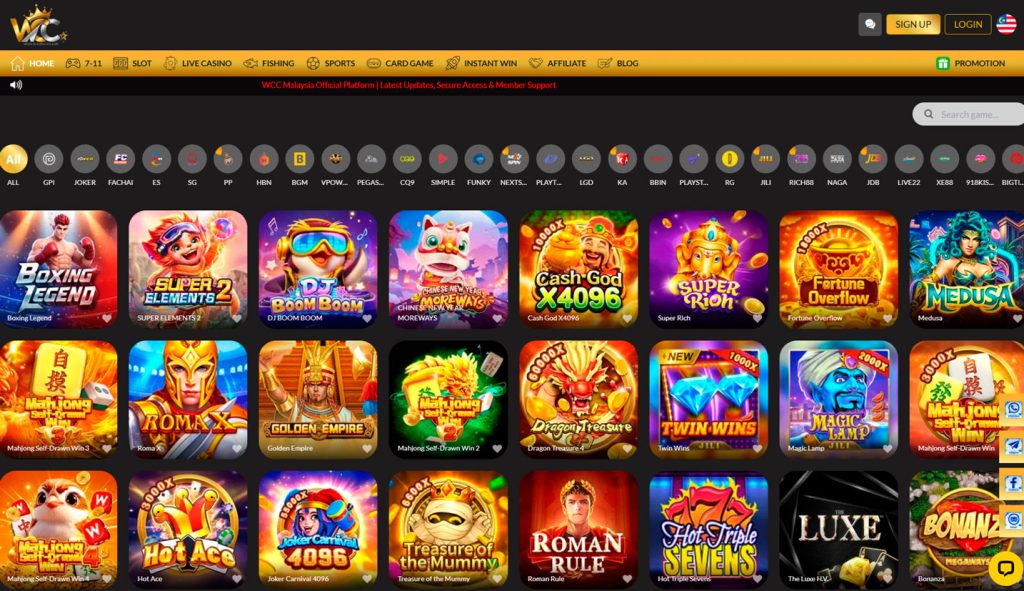
WCC’s Malaysia platform separates its main content into slots, live casino, sports, fishing games, card games, e-games and instant win. Its 7-11 app products are presented separately from the main browser-based categories.
Someone arriving for sports can go directly to sports. A slot player does not need to work through a general casino lobby first. Fishing and card games are visible as categories in their own right, while instant-win titles are separated from conventional slots.
This matters more as the supplier catalogue grows.
Adding more titles increases choice, but it can also make discovery worse. If users have to search through hundreds of games before finding the type of product they wanted, catalogue size stops being much of an advantage.
WCC handles the first stage of discovery through category-led navigation: vertical first, provider or individual title second.
It is not usually described as localisation, but it directly affects how local users find and move through the product.
Mobile Tests the Product Structure
Almost every modern gaming platform can open on a phone. That alone says very little about the quality of the mobile experience.
The more useful test is what happens when menus, promotions, account functions, providers and game categories all have to share a smaller screen.
Malaysia’s usage figures make this particularly relevant. With individual mobile-phone usage at 99.6% in DOSM’s latest survey, mobile is difficult to treat as a secondary interface.
WCC retains its main gaming verticals in the mobile experience rather than reducing the platform to one continuous game feed.
Users can move towards slots, live casino, sports, fishing, card games or instant win before they begin looking at individual titles.
As the catalogue grows, that first layer of navigation becomes more important. Every provider adds content, while promotions and account functions compete for the same limited screen space.
Desktop has more room to absorb that complexity. Mobile does not.
For a platform carrying several gaming verticals, the order in which information appears becomes part of the product design.
Supporting Content Still Matters
The game lobby gets most of the attention, but users eventually need information that has nothing to do with choosing a game.
Registration, deposits, withdrawals, account access and responsible gaming all sit outside the supplier catalogue.
WCC publishes supporting content around these parts of the platform alongside its gaming sections.
That reduces the need for customer support to handle every routine question. It also gives WCC control over how its own platform is explained.
Most games on an iGaming site come from third-party studios. Account guides, platform information and operational content are areas where the operator speaks in its own voice.
For a multilingual platform, this material matters. Localising the lobby while leaving practical account information behind creates an obvious break in the experience.
It is less visible than adding another provider, but it is part of maintaining a usable local version of the platform.
What WCC Malaysia Shows About Local Product Strategy
WCC should not be treated as a universal blueprint. Malaysia has its own audience, product mix and regulatory context.
Its platform does, however, illustrate several product decisions that sit underneath localisation.
| Local requirement | How it appears on WCC Malaysia |
|---|---|
| Multiple commonly used languages | English, Bahasa Malaysia and Chinese platform versions |
| Different gaming preferences | Separate gaming verticals rather than one generic lobby |
| High mobile usage | Core categories retained in the mobile experience |
| Large supplier catalogue | Category-first discovery before provider or title selection |
| Consistent identity | WCC remains the brand across language versions |
| Practical user information | Account guides and responsible gaming content alongside the gaming product |
Taken together, these choices create a more coherent local product.
A platform can translate its interface and still organise games in a way that does not suit the market. It can build a good mobile interface while making basic account information difficult to find.
Language, product structure, mobile design and supporting content work better when they are treated as parts of the same market strategy.
Scale Creates a Maintenance Problem
WCC already covers several distinct gaming categories. If the catalogue continues to expand, keeping the first layer of navigation simple will become more important, particularly on mobile.
The three-language structure creates a similar operational burden.
Launching English, Bahasa Malaysia and Chinese versions is one task. Keeping navigation, account information and supporting content aligned as the platform changes is another.
This is where localisation becomes ongoing product work.
New providers, promotions, interface changes and account updates all have to be reflected consistently across the different versions of the platform.
It is not the most visible part of entering a market, but it is one of the easier areas to neglect after launch.
What Operators Can Take From Malaysia
Malaysia shows why iGaming localisation is no longer just a translation exercise.
The market combines very high internet and mobile usage with a multilingual audience and demand spread across several gaming verticals. Growth indicators also need to be considered separately from regulatory accessibility.
WCC Malaysia offers one example of how those conditions can shape the product.
Its three language versions operate under the same WCC identity. Major gaming verticals are separated before users reach individual providers and titles. Mobile retains that structure, while supporting pages extend the local experience beyond the game lobby.
For operators evaluating Malaysia, localisation does not end at launch. Language, information architecture, mobile navigation, supporting content and brand consistency all require ongoing product management as the platform evolves.