




For more than two decades, the affiliate model has been one of the greatest commercial success stories in online gambling.
Few industries have benefited from organic search quite like iGaming. Entire businesses were built around ranking for terms such as best online casino, casino bonus, crypto casino and thousands of game-specific searches. A well-ranked review page could generate players for years, creating predictable recurring revenue with relatively modest operating costs. In many respects, Google became the industry’s largest acquisition partner.
That relationship, however, is changing.
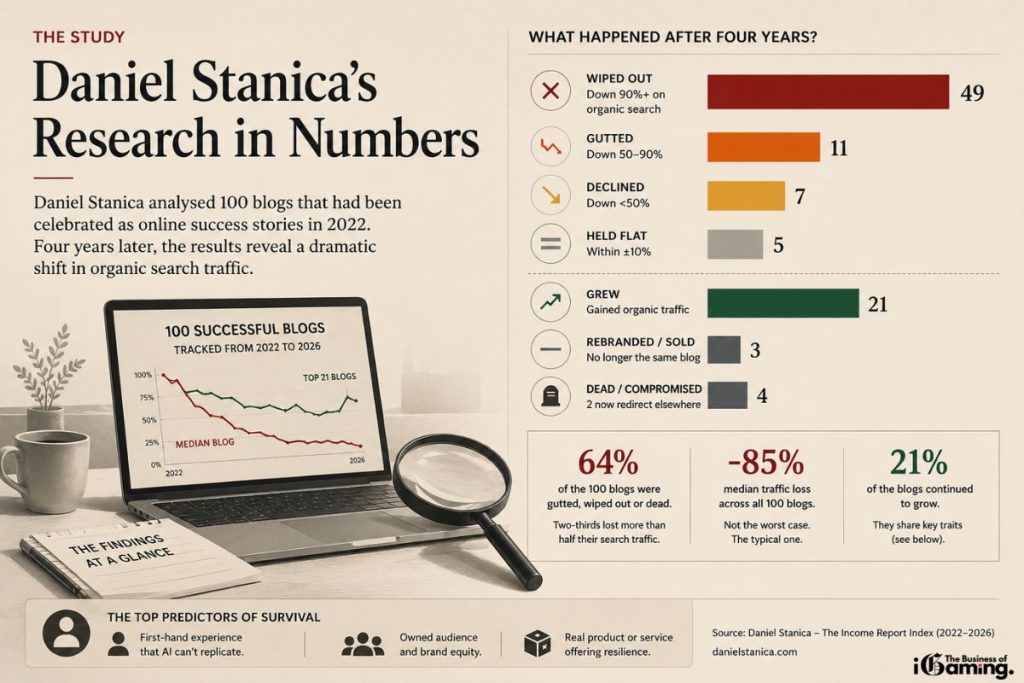
A recent study by digital entrepreneur Daniel Stanica, later highlighted by Rand Fishkin, examined what happened to 100 blogs that had been celebrated as online success stories only a few years ago. Four years later, the median blog had lost 85 percent of its organic traffic, while only a small minority continued to grow.
The study was not conducted on gambling affiliates, and its conclusions should not automatically be transferred to iGaming. Nevertheless, it raises important questions for an industry that has historically depended more heavily on Google than almost any other affiliate vertical. If businesses built around organic search are becoming increasingly vulnerable elsewhere, what does that mean for one of the world’s most competitive SEO industries?
The answer is unlikely to be comfortable.
The Study Every Affiliate Should Read
Daniel Stanica’s research follows one hundred blogs that were widely recognised for their success in 2022 and compares their performance four years later. Rather than focusing on isolated examples, the study attempts to identify broader patterns that explain why some publishers continued growing while others experienced dramatic declines.
The headline numbers are striking. Nearly half of the analysed blogs lost more than 90 percent of their organic search traffic, while the median decline reached 85 percent. Only around one fifth of the sites managed to grow during the period.
More interesting than the decline itself, however, are the characteristics shared by those businesses that remained resilient. Stanica argues that publishers with genuine first-hand experience, an owned audience and a real product or service consistently outperformed businesses that relied primarily on search rankings. His conclusion is simple but powerful: search should be viewed as a customer acquisition channel rather than the business itself.
That distinction may prove increasingly relevant as AI transforms the way people discover information online.
iGaming Built an Industry Around Google
Unlike many other affiliate sectors, online gambling evolved alongside Google’s rapid rise as the dominant search engine.
For years, ranking well was often enough to build a highly profitable business. Review sites expanded into media companies, affiliate networks consolidated across multiple markets and publicly listed businesses emerged almost entirely from organic search success. The model rewarded scale, technical SEO and content production, and for a long time there were few reasons to question it.
The economics were compelling. A single player acquired through an organic search could generate recurring commissions for months or even years, making customer lifetime value significantly more important than page views. That dynamic encouraged publishers to invest heavily in SEO while continuously expanding into new keywords, payment methods, game reviews and regulated markets.
It was a model that worked remarkably well—until several independent trends began to converge.
A Structural Shift Rather Than a Temporary Downturn
It is tempting to explain today’s challenges by pointing to a single event, whether it is Google’s Helpful Content updates, AI Overviews or tighter regulation. In reality, the industry’s current situation is the result of multiple structural changes taking place simultaneously.
Google itself is evolving from a search engine into what increasingly resembles an answer engine. AI-generated summaries, featured snippets and richer search results mean that users often receive the information they need without clicking through to external websites. The phenomenon commonly referred to as “zero-click search” reduces the value of rankings even when publishers retain their positions.
At the same time, artificial intelligence has dramatically lowered the cost of producing content. The competitive advantage once associated with publishing thousands of articles has largely disappeared because almost everyone now has access to similar production capabilities. As generic content becomes abundant, originality becomes significantly more valuable.
The competitive landscape has also broadened. Gambling affiliates no longer compete solely against each other. They increasingly share search results with Reddit discussions, YouTube videos, community forums, operator-owned editorial content and AI-generated answers. Simply reaching the first page of Google is no longer the guarantee of traffic that it once was.
Layered on top of these developments is a steadily more demanding regulatory environment. Markets such as Sweden, the Netherlands, Germany and the United Kingdom have tightened compliance requirements, while emerging regulated jurisdictions introduce additional complexity for both operators and affiliates. The result is an industry where acquiring new customers has become more expensive while maintaining visibility has become more difficult.
The Economics of Affiliate Marketing Are Changing
These developments are already influencing the commercial realities of the industry.
Several publicly listed affiliate companies have shifted their strategies in recent years, placing greater emphasis on acquisitions, proprietary technology, data capabilities and diversification rather than relying exclusively on organic growth. At the same time, many independent affiliates report declining margins, increasing acquisition costs and a significantly more competitive hiring environment.
The employment market reflects these changes. Positions that were once plentiful – particularly within editorial content and SEO—have become noticeably more difficult to secure. Employers have become more selective, salary growth has slowed and many companies are reorganising their teams around fewer, more specialised roles.
None of this necessarily signals a crisis for iGaming. The industry continues to grow globally, particularly in newly regulated markets. However, it does suggest that the economics underpinning affiliate businesses are evolving in ways that many publishers are only beginning to recognise.
Experience Has Become the Competitive Advantage
One of the most valuable observations emerging from Stanica’s research is that the businesses which survived tended to offer something that competitors could not easily replicate.
For iGaming affiliates, this represents an important shift in thinking.
A generic casino review assembled from publicly available information offers limited long-term value in a world where AI can generate similar content within seconds. By contrast, content built around genuine testing, proprietary research and original analysis remains considerably more difficult to reproduce.
Withdrawal speed comparisons, payment verification, customer support testing, exclusive interviews with operators, traffic intelligence, player surveys and market reports all represent forms of content that derive their value from original work rather than summarising existing information.
Ironically, artificial intelligence may increase the commercial value of authentic human expertise rather than diminish it. As the volume of generated content expands, scarcity shifts from information itself to the credibility of its source.
Brand Is Becoming More Valuable Than Rankings
Perhaps the most significant implication of the current transition is that successful affiliates are increasingly building audiences that exist independently of Google.
Newsletters, LinkedIn, Telegram, YouTube, podcasts, events and industry reports all serve a common purpose: they create direct relationships with readers rather than relying entirely on search algorithms.
This is a subtle but important change. A publisher whose audience actively searches for its brand enjoys a fundamentally different competitive position from one that depends exclusively on ranking for generic keywords.
The objective is no longer simply to rank for best casino. Increasingly, it is to become the publication readers seek out by name.
That distinction may prove decisive over the coming decade.
Future-Proofing an Affiliate Business
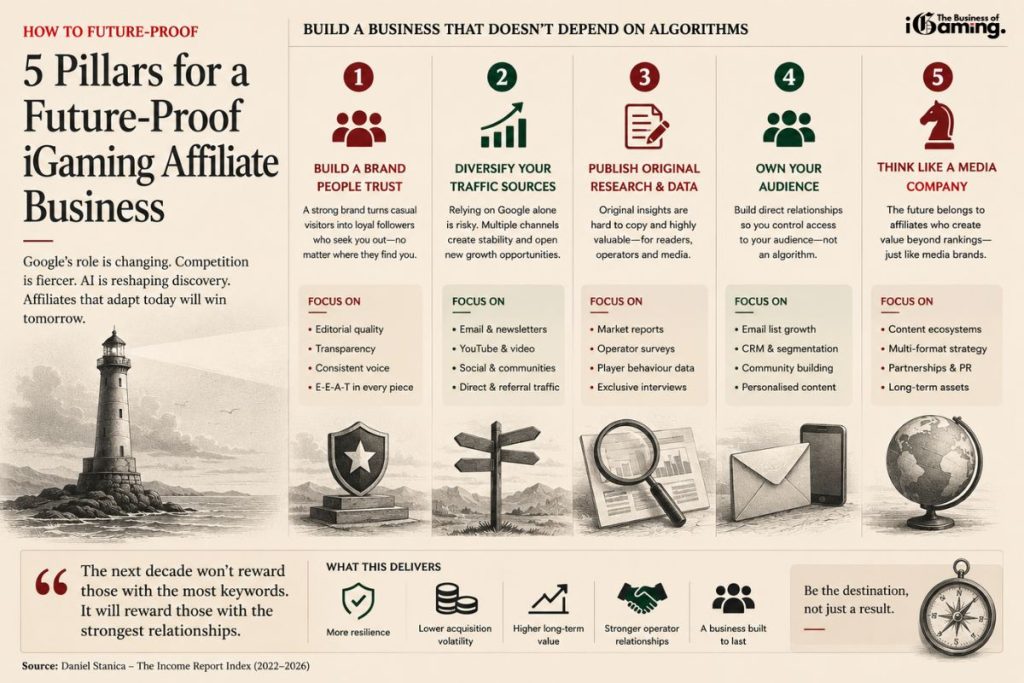
If the traditional SEO playbook is becoming less reliable, the obvious question is what should replace it. The answer is unlikely to involve abandoning search altogether. Organic visibility will remain one of the industry’s most valuable acquisition channels for years to come. What is changing is the degree to which businesses should depend on it.
Affiliates that are likely to thrive over the next decade will probably share several characteristics. They will invest in recognisable brands rather than anonymous websites, diversify their traffic sources instead of relying almost exclusively on Google, publish proprietary research that competitors cannot easily imitate and cultivate direct relationships with their audiences across multiple channels.
In other words, they will increasingly resemble modern media companies rather than traditional SEO businesses.
The Next Decade Will Reward Originality
It would be easy to interpret Daniel Stanica’s research as evidence that blogging has reached its end. That conclusion misses the broader point.
The study is not really about blogs. Nor is it solely about Google. It is about the risks of building a business on an audience that ultimately belongs to someone else.
The iGaming affiliate sector remains one of the most innovative and commercially successful corners of digital publishing, but its competitive advantages are changing. The companies that emerge strongest from this transition are unlikely to be those with the largest keyword portfolios or the highest article counts. Instead, they will be the organisations that combine trusted brands, proprietary data, original journalism and genuine expertise into something that neither search engines nor AI can easily replace.
Search is not disappearing. But its role is changing. For iGaming affiliates, adapting to that reality may become the defining challenge of the next decade.