

The global gambling industry is often analysed through traffic rankings, player activity, or regulatory expansion. However, one of the clearest indicators of long-term power and market confidence remains market capitalization – the total value investors assign to publicly listed companies.
The latest data paints a nuanced picture of the industry in 2026. While online gambling continues to grow rapidly, the largest companies by market cap are not exclusively digital-first operators. Instead, the rankings are shaped by a combination of land-based giants, technology suppliers, and hybrid operators with diversified revenue streams.
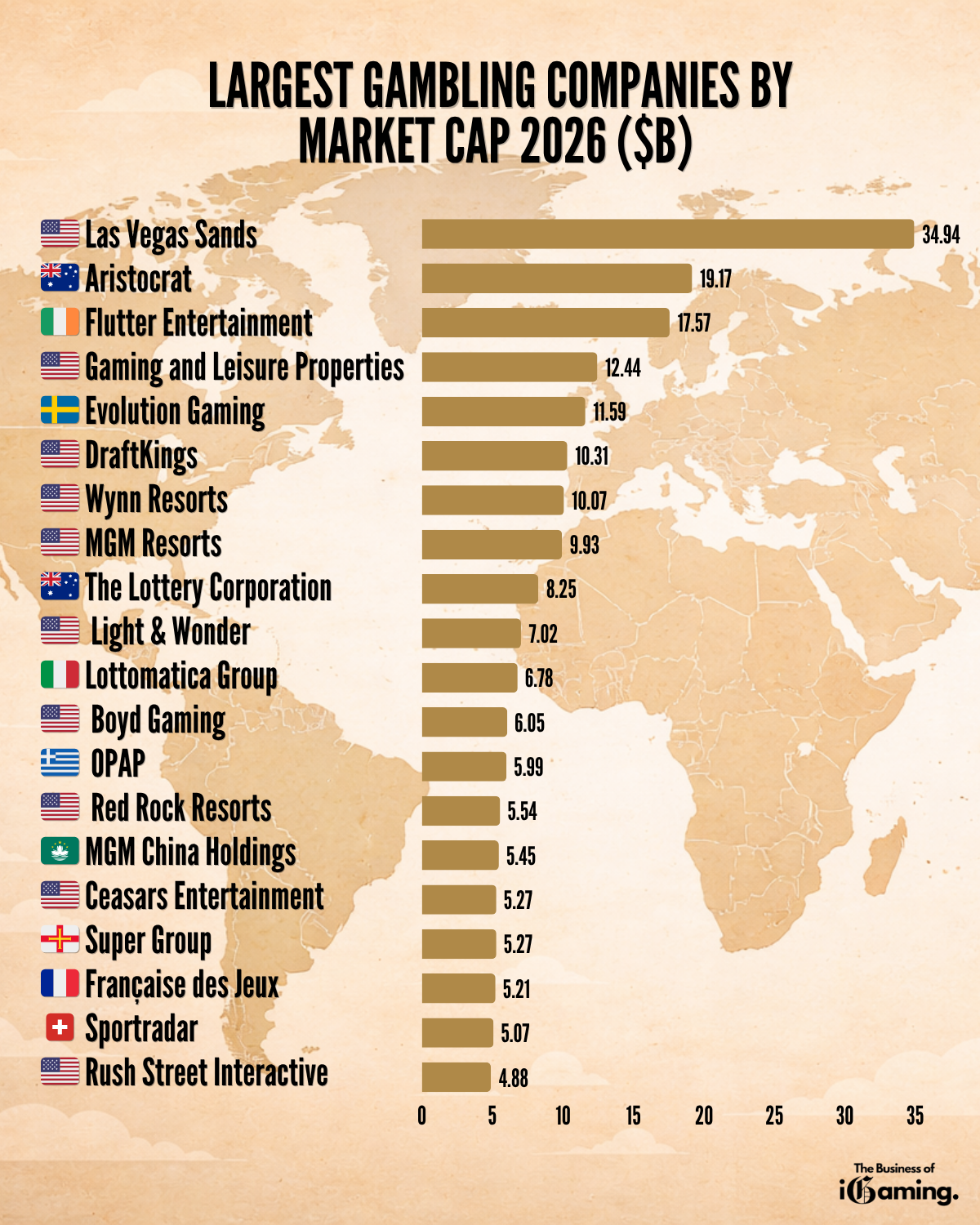
At the top sits Las Vegas Sands, followed by Australia’s Aristocrat and Ireland-based Flutter Entertainment, highlighting how scale in gambling is still closely tied to infrastructure, global reach, and long-term financial stability.
Top Gambling Companies by Market Cap (2026)
| Position | Company | Market Cap | Country |
|---|---|---|---|
| 1 | Las Vegas Sands | 34.94B | USA |
| 2 | Aristocrat | 19.17B | Australia |
| 3 | Flutter Entertainment | 17.57B | Ireland |
| 4 | Gaming and Leisure Properties | 12.44B | USA |
| 5 | Evolution Gaming | 11.59B | Sweden |
| 6 | DraftKings | 10.31B | USA |
| 7 | Wynn Resorts | 10.07B | USA |
| 8 | MGM Resorts | 9.93B | USA |
| 9 | The Lottery Corporation | 8.25B | Australia |
| 10 | Light & Wonder | 7.02B | USA |
| 11 | Lottomatica Group | 6.78B | Italy |
| 12 | Boyd Gaming | 6.05B | USA |
| 13 | OPAP | 5.99B | Greece |
| 14 | Red Rock Resorts | 5.54B | USA |
| 15 | MGM China Holdings | 5.45B | Macau |
| 16 | Caesars Entertainment | 5.27B | USA |
| 17 | Super Group | 5.27B | Guernsey |
| 18 | Française des Jeux (FDJ) | 5.21B | France |
| 19 | Sportradar | 5.07B | Switzerland |
| 20 | Rush Street Interactive | 4.88B | USA |
Source: CompaniesMarketCap.com
Key Insights & Industry Analysis
1. Land-based giants still set the benchmark
Despite the strong narrative around digital disruption, the top of the ranking remains dominated by companies with deep roots in land-based gambling.
Operators such as Las Vegas Sands, Wynn Resorts, and MGM Resorts continue to command the highest valuations due to their ownership of large-scale integrated resorts, premium hospitality offerings, and high-margin VIP segments.
These businesses are not just casinos — they are global entertainment ecosystems. Their valuations reflect asset-backed stability and predictable revenue streams, something purely online operators often struggle to match at the same scale.
Read more: The Richest People in Gambling and Casinos 2026
Flutter Entertainment leads the online-first operators
Among companies with a strong online footprint, Flutter Entertainment stands out as the clear market leader with a valuation of $17.57 billion.
Through brands such as FanDuel, Betfair, and Paddy Power, Flutter has built a diversified portfolio that spans both mature European markets and the rapidly expanding US betting ecosystem.
It represents perhaps the closest example of a truly global, scaled online gambling operator, combining product breadth with geographic reach.
3. Evolution Gaming highlights the power of B2B dominance
With a market cap of $11.59 billion, Evolution Gaming is one of the most important companies in the modern iGaming ecosystem — despite not operating a consumer-facing casino.
Its strength lies in supplying the industry itself. Evolution’s live casino infrastructure is used by operators worldwide, allowing it to scale globally without the need to acquire players directly.
What further strengthens Evolution’s position is its growing portfolio of owned studios, including:
- Nolimit City
- NetEnt
- Red Tiger Gaming
- Big Time Gaming
This combination of live casino dominance and premium slot content has positioned Evolution as a vertically integrated supplier powerhouse.
The key takeaway is clear:
In iGaming, owning the infrastructure can be just as valuable — if not more — than owning the customer.
4. The rise of US-listed challengers
Companies such as DraftKings ($10.31B) and Rush Street Interactive ($4.88B) reflect the ongoing expansion of the US online gambling market.
However, their valuations are not purely based on current profitability. Instead, they are driven by expectations around:
- market expansion
- regulatory developments
- long-term customer value
This makes them fundamentally different from traditional operators, as they are priced on future potential rather than established margins.
5. Light & Wonder and the hybrid supplier model
Light & Wonder ($7.02B) represents another important segment of the industry — the hybrid supplier.
The company operates across:
- land-based gaming machines
- digital content
- platform technology
In addition, its acquisition of ELK Studios strengthens its position within premium slot development, adding a layer of creative, high-performance content to its broader distribution network.
This hybrid approach allows Light & Wonder to benefit from both B2B scalability and diversified revenue streams, making it a key player in the evolving ecosystem.
6. Lottery and monopoly operators remain highly valuable
Lottery-focused companies such as:
- The Lottery Corporation ($8.25B)
- FDJ ($5.21B)
- OPAP ($5.99B)
continue to command strong valuations.
Their advantage lies in:
- regulatory protection
- limited competition
- highly predictable revenue
These characteristics make them particularly attractive from an investor perspective, as they offer stable, cash-generating business models in an otherwise volatile industry.
7. Europe’s continued structural strength
While the narrative often shifts toward emerging markets, Europe remains a cornerstone of the global gambling industry.
Companies such as:
- Evolution (Sweden)
- Flutter (Ireland)
- Lottomatica (Italy)
- OPAP (Greece)
demonstrate the region’s strength in:
- technology development
- regulatory maturity
- operational scalability
Europe continues to function as the backbone of global iGaming infrastructure.
8. Asia exposure still carries significant weight
The presence of MGM China Holdings ($5.45B) highlights the ongoing importance of Asia, particularly Macau, in the global gambling landscape.
Despite periods of regulatory uncertainty, Macau remains one of the most valuable gambling markets in the world, offering:
- high-value players
- strong margins
- long-term growth potential
For companies with exposure to the region, Asia continues to represent a critical strategic asset.
Read more: The World’s Largest Online Gambling Websites by Traffic 2026
The Big Picture
The gambling industry in 2026 is not dominated by a single business model. Instead, it is defined by a combination of different verticals:
Asset-heavy operators
Las Vegas Sands, MGM, Wynn
Online-first platforms
Flutter, DraftKings, Super Group
B2B suppliers
Evolution, Light & Wonder
Lottery and monopoly models
FDJ, OPAP, The Lottery Corporation
Final Thoughts
If traffic rankings show where players are spending their time, market capitalization reveals something deeper:
Where long-term value is being created
The most important insight from this ranking is that the future of gambling is not about one dominant segment. Instead, it lies in convergence – between land-based and digital, between B2C and B2B, and between regulated and emerging markets.
The companies that succeed are those that can operate across multiple layers of the ecosystem, combining scale, technology, and distribution.
And in 2026, that balance of power has never been more evident.