

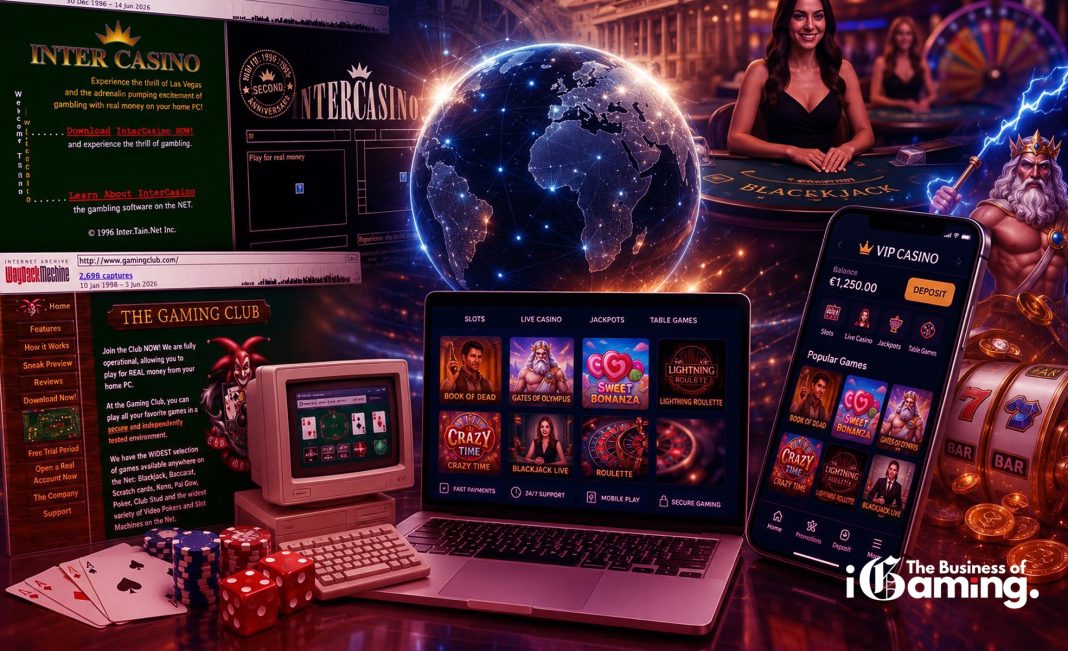

Thirty years ago, playing roulette or blackjack for real money over the internet was still an extraordinary idea. There were no smartphones, no live game shows, no thousands-strong slot lobbies and certainly no instant casino experience in your pocket. In 1996, InterCasino accepted what it described as its first real-money wager online. Three decades later, the experiment has become a global industry – and many of the companies that shaped it are still shaping online casino today.
In November 1996, someone sat down at a computer and gambled real money at InterCasino. It is difficult to make that sentence sound particularly dramatic in 2026.
Today, a player can open a casino on a phone, make a deposit in seconds and choose between thousands of slots, live blackjack tables, crash games, game shows and instant-win titles.
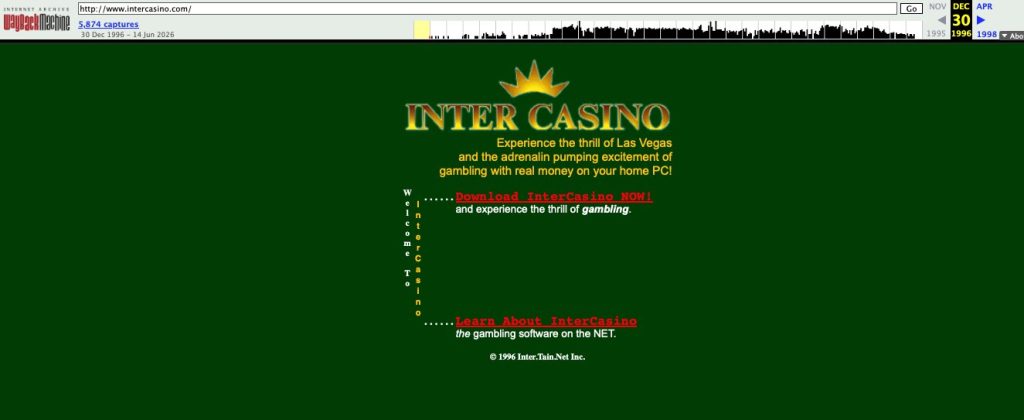
In 1996, simply making the wager was the innovation. InterCasino’s archived website offers a remarkable snapshot of how new the concept still was. The operator said it had been licensed by Antigua in July 1996 and accepted its first real-money wager that November. Yet by the end of the year, it claimed to have already hosted thousands of players. Within its first three years, more than 230,000 players had visited the casino and over 200 million games had been played.
Thirty years later, those numbers almost feel quaint. But the more interesting story isn’t simply how much online casino grew. It is how completely the product changed.
So what actually was the first online casino?
The answer isn’t quite as straightforward as online casino histories sometimes suggest.
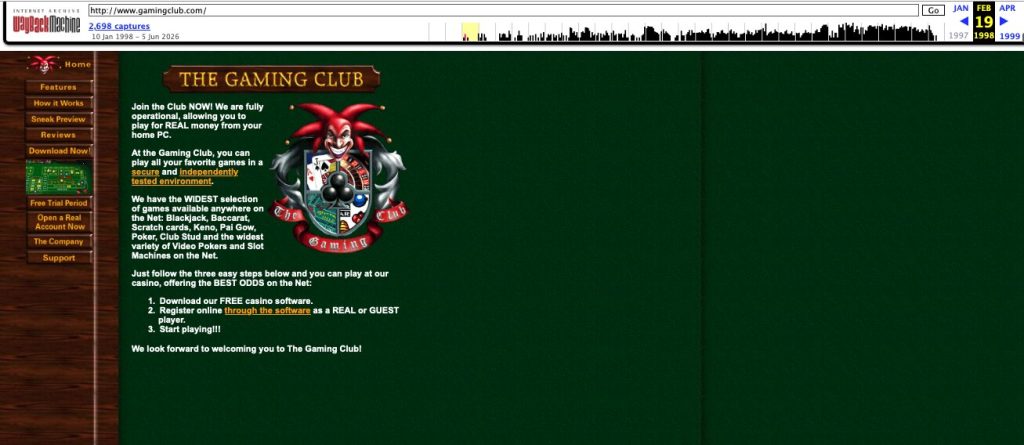
The foundations were laid in 1994, when Antigua and Barbuda began licensing companies wishing to offer gambling over the internet. Around the same period, Microgaming emerged as one of the industry’s earliest casino software companies. The Gaming Club was another of the pioneering casino brands, although full real-money operations followed later.
Then came InterCasino. The brand is widely associated with the first genuine real-money online casino wager in 1996, although even the Wikipedia material supplied for this article flags that some of the historical claims require stronger independent sourcing.
That caveat matters. The birth of online casino wasn’t really a single launch on a single day. It was a short period in the mid-1990s when regulation, internet access, payment technology and casino software finally came together.
InterCasino’s November 1996 wager is nevertheless a useful line in the sand. And that makes 2026 the perfect year to look back.
1996: When downloading a casino was revolutionary
Forget opening Chrome or Safari and tapping “Play”. Early online casino was software. Players generally downloaded a casino program onto a desktop computer, registered an account and connected to the internet to gamble. Slow connections, basic graphics and limited processing power imposed obvious restrictions.
Yet the fundamental proposition was revolutionary: The casino had escaped the casino.
A player no longer needed to travel to Las Vegas, Atlantic City, Monte Carlo or a local gambling venue. Roulette, blackjack, video poker and slots could be accessed from home.
Look at the surviving Gaming Club advertisement reproduced in the attached historical material and you can see how operators marketed that breakthrough. Players were instructed to download free casino software, register as a real-money or guest player and start playing from their home PC.
What sounds cumbersome today was the selling point then.
The first revolution wasn’t the casino. It was the software provider
There is another reason the 1990s deserve attention. They created the supplier-driven structure that still defines iGaming. Casinos needed technology companies to build their platforms and games. The result was the emergence of specialist B2B businesses whose influence eventually became enormous.
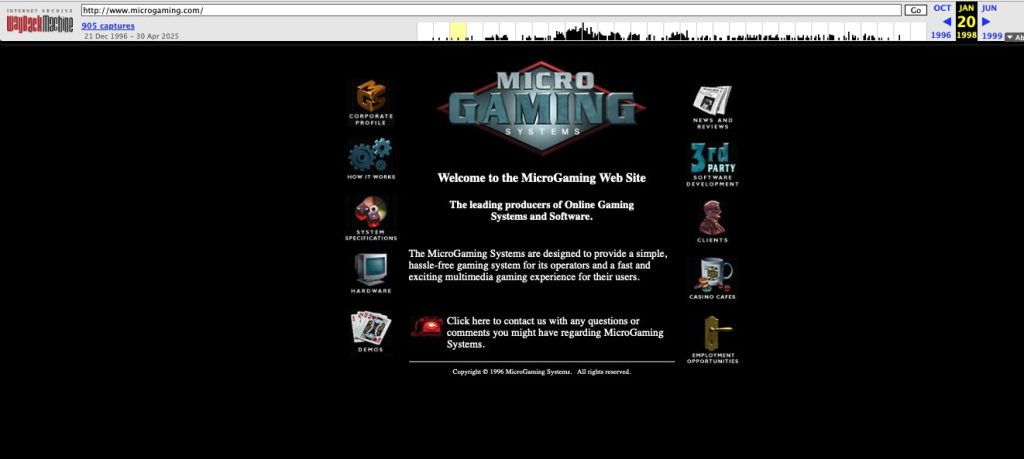
Microgaming was among the pioneers.
NetEnt dates its history to 1996 – meaning that 2026 isn’t only the 30th anniversary of InterCasino’s early real-money wagering. It is also NetEnt’s 30th anniversary. Evolution now describes NetEnt as one of the industry’s longest-established online slot developers.

Then came another company that would become deeply influential: Playtech, founded in 1999. Three decades later, Playtech operates across more than 50 regulated jurisdictions and provides platforms, content and services to more than 200 clients.
The modern supplier ecosystem had begun to form. And that changed the economics of online casino forever. Operators did not have to invent every game themselves. A successful game could be distributed across dozens, eventually hundreds, of casino brands.
That model remains one of the defining characteristics of iGaming in 2026.
The 2000s: Online casino starts growing up
The first casinos proved that internet gambling could work. The next decade was about making it good.
Graphics improved. Game libraries became larger. Progressive jackpots became more sophisticated. Payment methods expanded. Loyalty programmes and bonuses became central acquisition tools.
Competition between operators intensified. But one development would ultimately matter more than almost anything else: the casino started moving away from the desktop.
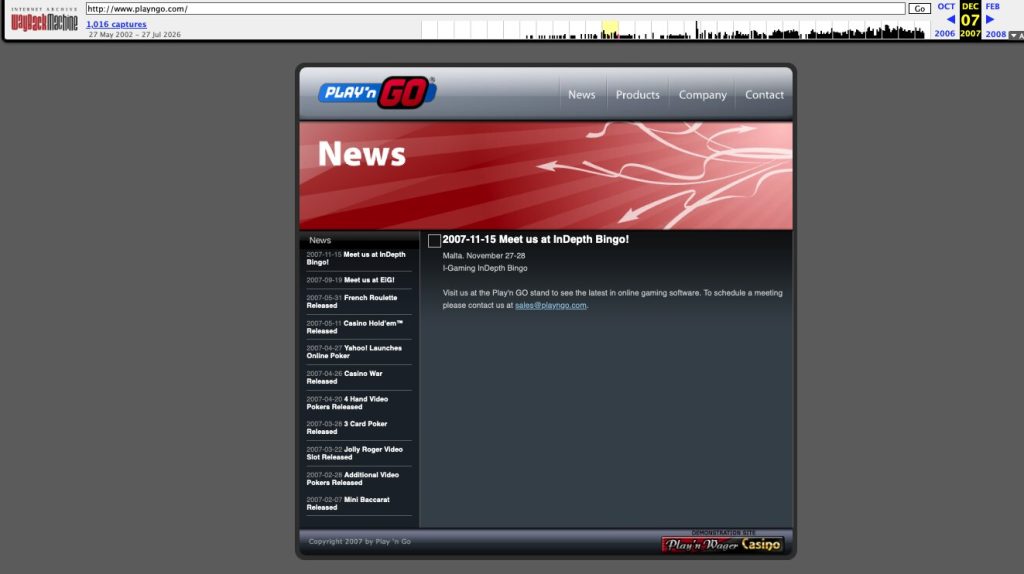
Play’n GO was founded in Sweden in 2005 and became one of the early suppliers to place a major bet on mobile casino. The company says that in its early years it deliberately focused on creating mobile-first titles at a time when player adoption remained relatively limited.
That decision looks obvious with hindsight. It wasn’t at the time. The iPhone didn’t arrive until 2007.
Mobile casino would eventually transform not just where people played, but the games themselves. Interfaces had to become cleaner. Loading times mattered more. Portrait orientation became important. Sessions could be shorter. Games had to work across screen sizes and increasingly across browsers rather than downloaded clients.
The casino was slowly becoming something you carried around.
2006: Evolution puts a real dealer behind the screen
Then another Swedish-founded company tried something different. Evolution was established in 2006 and opened its first studio in Riga. Its proposition seems familiar now: stream real roulette, blackjack and baccarat tables over the internet. At the time, it wasn’t familiar at all.
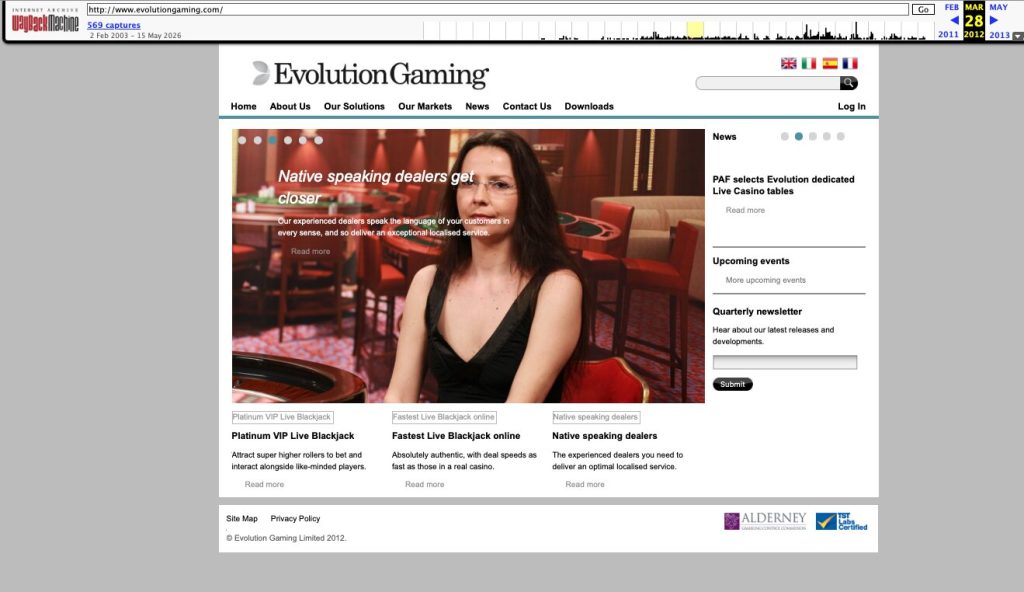
Evolution has described its original setup as a handful of tables, a roulette wheel, a host and a basic webcam. Internet speeds were slow and some players were sceptical that what they were seeing was actually happening live.
That is worth remembering because live casino eventually became one of online gambling’s major product categories. Evolution spent the following years improving video, interfaces, tables, dealing technology, localisation and mobile usability. By 2026, its network had grown to 24 studios across six continents and the company employed more than 22,000 people.
But Evolution’s biggest contribution may have come later. It stopped trying merely to reproduce the physical casino.
The smartphone changed everything
If the first phase of online casino was about putting a land-based casino onto a computer, the smartphone forced the industry to rethink the product. Mobile wasn’t simply desktop casino on a smaller screen.
Players could now gamble on the sofa, during a commute or wherever regulations permitted. Casino sessions competed directly with social media, streaming, mobile games and every other app fighting for attention.
Suppliers adapted.
HTML5 gradually replaced older technologies. Touch controls became standard. Interfaces became faster and more visual. Game discovery changed. Portrait-first design became increasingly important. Play’n GO’s early mobile bet suddenly looked prescient. The supplier has subsequently grown from a small Swedish operation into an international studio with hundreds of titles.
Online casino was no longer a destination. It was becoming an always-available entertainment product.
The slot became entertainment IP
Something else happened along the way. Slots became brands. NetEnt’s Starburst is perhaps one of the clearest examples of the transition. Play’n GO built enduring franchises around titles such as Book of Dead and Reactoonz. Providers increasingly developed recognisable characters, mechanics, sequels and visual identities.
The casino lobby started behaving less like a collection of digital machines and more like Netflix. Hundreds – sometimes thousands – of titles competed for visibility.
The consequences were significant. Game providers increasingly needed marketing, distribution and brand recognition, not simply good mathematics and graphics.
Operators, meanwhile, needed recommendation systems, categories, personalised lobbies and increasingly sophisticated ways of helping players discover games.
The battle for the player was becoming a battle for the lobby.
Live casino becomes a game show
Perhaps nothing illustrates the distance between 1996 and 2026 better than live casino. The early ambition was authenticity:
Can we make online roulette feel like casino roulette?
The later ambition became entertainment:
What can we create online that doesn’t need to exist in a physical casino at all?
Evolution’s Dream Catcher helped establish the live game-show format. MONOPOLY Live followed, as did Crazy Time and an expanding generation of games built around presenters, multipliers, bonus rounds and television-style production.
Evolution itself describes this progression as live casino moving from a webcam feed into an interactive entertainment category. That is a fundamental change.
Online casino had spent years imitating the physical casino. Now the physical casino was no longer the limit.
A new generation of studios arrives
The supplier market also became considerably more diverse. The giants of the first two decades were joined by a new generation of studios that approached game design differently.
Hacksaw Gaming, for example, was founded in 2018. It initially built its identity around scratchcards and instant-win content before becoming particularly well known for mobile-friendly slots and a distinctive visual and mathematical style.
Studios such as Nolimit City, Big Time Gaming and Red Tiger also helped push mechanics, volatility and presentation in different directions. Many of those businesses ultimately became part of Evolution, whose portfolio today stretches across Evolution, Ezugi, NetEnt, Nolimit City, Red Tiger, Big Time Gaming and other studios.
Meanwhile, suppliers including Pragmatic Play grew around a multi-product model spanning slots, live casino and other verticals. The result is an industry where the game creator can sometimes be as recognisable to players as the casino carrying the game.
That would have been difficult to imagine in 1996.
Regulation became part of the product
The industry’s development wasn’t driven by games alone. Regulation fundamentally reshaped online casino.
Antigua and Barbuda was an early licensing jurisdiction. Others followed. The Malta regulatory framework became important to European iGaming, while nationally regulated markets increasingly emerged across Europe and elsewhere.
The UK’s regulated remote gambling market, Sweden’s re-regulated system and similar frameworks changed how operators approached licensing, advertising, player verification and responsible gambling.
Testing and certification became increasingly formalised as well. eCOGRA was established in the early 2000s, while suppliers and operators became accustomed to meeting technical requirements across multiple jurisdictions.
The industry that started with a simple question – can people gamble over the internet? – eventually had to answer much more difficult questions about consumer protection, AML, affordability, marketing and responsible gambling.
In many markets, compliance technology is now as fundamental to an online casino as the games themselves.
The industry also consolidated
Another striking feature of the last 30 years has been consolidation. Some pioneering brands disappeared. Others were acquired. Suppliers followed the same pattern.
One particularly significant example came in 2020 when Evolution acquired NetEnt, bringing together a company that helped define modern live casino with one whose roots went back to the first generation of online slots. Red Tiger came with NetEnt, while Evolution later expanded its RNG portfolio further through acquisitions including Big Time Gaming and Nolimit City.
In one corporate group, you can now see several different chapters of online casino history. NetEnt represents the early internet casino generation.
Evolution represents live casino. Big Time Gaming represents the mechanics-led slot era. Nolimit City represents a more recent generation of distinctive, high-volatility content.
It is almost a miniature history of the industry’s product evolution.
From downloaded software to an entertainment ecosystem
Put an online casino from 1996 next to one from 2026 and the family resemblance is surprisingly small. The basic games remain. Roulette is still roulette. Blackjack is still blackjack.
Almost everything surrounding them has changed.
| Era | What defined online casino |
| 1994–1999 | Downloadable software, early regulation and first real-money casinos |
| 2000–2005 | Bigger slot libraries, jackpots, bonuses and payment innovation |
| 2005–2010 | Mobile experimentation and the emergence of live casino |
| 2010–2015 | Smartphones, HTML5 and mobile-first gaming |
| 2015–2020 | Branded slots, new mechanics and live game shows |
| 2020–2026 | Personalisation, instant games, crash, content consolidation and entertainment-led casino |
The archived InterCasino site makes the contrast particularly vivid. Its selling points included downloadable software, multiplayer games, 3D graphics, digital sound, account security, chat and 24/7 technical support.
Those were differentiators. Today they are either basic expectations or technological relics.
The providers that helped build online casino
The history of online casino is therefore also a history of its suppliers.
Microgaming belongs to the industry’s earliest commercial chapter.
NetEnt emerged in 1996 and helped shape online slots.
Playtech arrived in 1999 and became one of the industry’s major technology and platform businesses.
Play’n GO emerged in 2005 and made an unusually early commitment to mobile gaming.
Evolution launched in 2006 and helped turn live casino into a product category of its own.
And the generations that followed – including Pragmatic Play, Nolimit City, Big Time Gaming, Red Tiger and Hacksaw Gaming – continued pushing casino content toward new mechanics, formats and audiences.
Operators distribute the product. But providers have repeatedly reinvented what that product actually is.
1996 versus 2026
Perhaps the easiest way to appreciate 30 years of progress is to compare the player experience.
1996: Download casino software onto a desktop PC.
2026: Open a casino instantly on a smartphone.
1996: Choose from a relatively small collection of slots and table games.
2026: Browse thousands of games from dozens or even hundreds of studios.
1996: Play a computer-generated version of roulette.
2026: Join a streamed table, a local-language dealer, a live game show or an entirely digital game built around mechanics that have no land-based equivalent.
1996: Deposit through the relatively limited online payment infrastructure of the era.
2026: Depending on the market, use cards, bank transfers, e-wallets, instant banking and other locally adapted payment systems.
1996: Online casino itself was the innovation.
2026: The question is what comes next.
What will online casino look like in 2056?
Thirty years is a long time in technology. It is worth remembering that the smartphone era occupies only part of online casino’s history. Live game shows are younger still. Some of today’s largest suppliers didn’t exist when the first internet wagers were made.
That makes predictions for the next 30 years inherently dangerous.
AI-driven personalisation is likely to become more sophisticated. Games may become more adaptive. Streaming and casino entertainment could move closer together. The distinction between slots, live casino, game shows, social entertainment and video games may become less obvious.
Regulation will almost certainly become more technologically sophisticated too. But perhaps the biggest lesson from the industry’s first 30 years is that its most important innovations weren’t necessarily obvious when they arrived.
In 1996, convincing someone to wager real money through a computer was innovation. A decade later, putting a real dealer on that computer was innovation.
Then came the smartphone. Then mobile-first slots. Then game shows. Then crash and instant games.
The online casino has been reinvented several times without ever abandoning roulette, blackjack and slots. And that may be the most remarkable part of the story.
Thirty years after the first real-money online casino wagers, the industry is simultaneously recognisable and almost completely different.
The first revolution was taking the casino online. The next 30 years were spent discovering what an online casino could become.