



Working in the iGaming business has rarely been straightforward, but the challenges are coming from more directions than ever. Google is moving further towards a zero-click environment, affiliates are fighting algorithm changes, AI-generated search results and DMCA attacks, while operators have to navigate changing regulations, advertising restrictions and increasingly expensive customer acquisition. Game providers, meanwhile, are fighting for increasingly valuable lobby space in an industry where thousands of games compete for the player’s attention.
Yet there is another transformation taking place that may ultimately prove just as important as changes to Google or regulation: the consumer itself is changing.
Gen Z has grown up with a fundamentally different internet from Millennials, Gen X and Baby Boomers. For many younger consumers, discovering a brand no longer begins by typing a keyword into Google, opening several websites and comparing the results. Discovery can happen while watching a streamer, scrolling through TikTok or Instagram, watching YouTube, participating in an online community, following an esports team or simply receiving a clip from a friend.
For iGaming, this has enormous consequences. A streamer with a loyal community can potentially generate more excitement around a new slot than dozens of conventional affiliate reviews. A relatively new operator can also build considerable brand awareness in a surprisingly short period if it manages to become visible in the right communities, sports, creators and entertainment channels.
For years, much of online gambling marketing revolved around one fundamental question: who ranks first? Increasingly, there is another question that comes before it: who gets noticed in the first place?
Gen Z is changing how internet discovery works
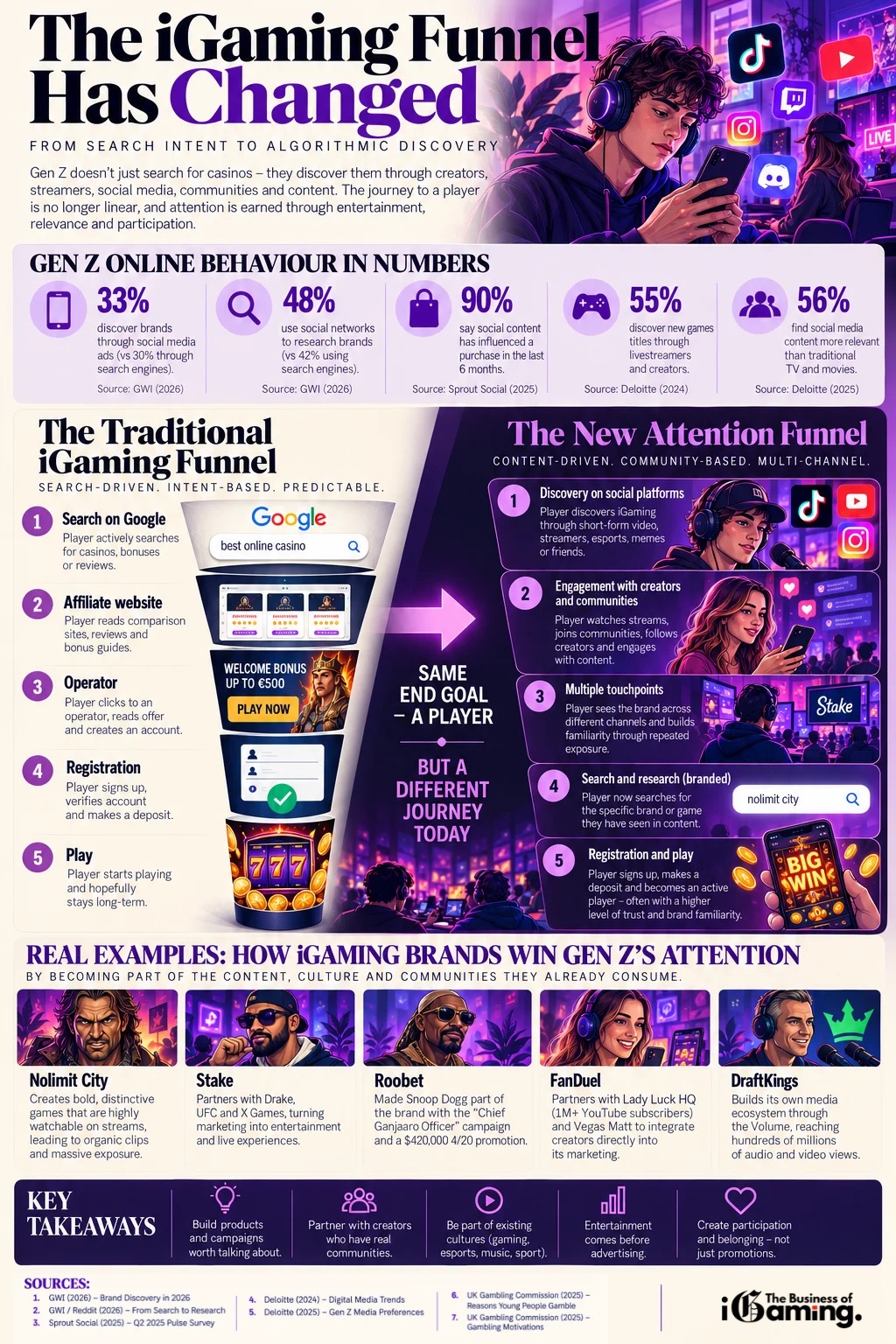
This shift extends far beyond iGaming. GWI’s current brand-discovery data shows that social advertising has overtaken search engines as Gen Z’s leading source of brand discovery. Some 33% of Gen Z consumers say they discover brands through ads on social media, compared with 30% through search engines. The difference becomes even more striking when consumers move from discovery to research: 48% of Gen Z mainly use social networks to research brands, compared with 42% who mainly use search engines.
The longer-term trend is perhaps even more interesting. GWI research covering Gen Z consumers in Europe and North America found that brand discovery through social media increased from 36% in 2018 to 49% in 2023, while discovery through search engines declined from 34% to 29%. In other words, the change is not simply that young consumers use TikTok or Instagram more often; the fundamental direction through which products reach consumers is changing. Instead of consumers always going looking for products, algorithms increasingly bring products to consumers.
Sprout Social found something similar in its Q2 2025 Pulse Survey of more than 2,200 social-media users in the US, UK and Australia. When Gen Z respondents wanted information, 41% said they turned to social platforms first, compared with 32% who went first to traditional search engines. The commercial implications are significant: 90% of Gen Z respondents said social content had influenced a purchase during the previous six months.
This doesn’t mean Google is dead, nor does it mean that SEO suddenly has no value. What it means is that the customer journey is becoming much more fragmented.
The traditional iGaming journey might have looked something like Google → Affiliate → Operator → Registration → Deposit. The emerging journey can be considerably messier: Streamer → Clip → TikTok → Google → Reddit → Operator, or perhaps Esports → Creator → YouTube → Brand → App. A consumer might encounter the same operator five or ten times through entirely different channels before finally conducting a branded Google search.
Google hasn’t necessarily disappeared from the journey. It has simply moved further down the funnel.
Creators have become distribution channels
Perhaps the clearest indication of where iGaming could be heading comes from the wider gaming industry. Deloitte found that 63% of surveyed Gen Z gamers discover new video games through livestreamers and social-media content creators. Even more interestingly, 56% said they were more likely to trust a video-game publisher when one of their favourite gaming creators had promoted one of its games.
That represents a major shift in media power and has particular implications for affiliates. A conventional affiliate is exceptionally good at capturing existing intent. Someone searches for “best online casino”, “casino bonus”, “new casino 2026” or “Nolimit City casinos”, and the affiliate attempts to capture that search and convert it.
A creator can operate one stage earlier. They can create the intent before the search exists.
That distinction is crucial. Search marketing is predominantly about being present when somebody wants something. Algorithmic and creator-driven marketing can make somebody want something they weren’t actively searching for in the first place.
Some iGaming companies understood this remarkably early.
Nolimit City: build games people want to watch
Nolimit City is perhaps one of the clearest examples of an iGaming company becoming culturally relevant without behaving like a conventional B2B game studio.
The company’s games are instantly recognisable. Extreme volatility, dark humour, provocative themes, unusual graphics and proprietary mechanics such as xWays, xNudge and xSplit helped games including Mental and San Quentin stand apart in casino lobbies containing thousands of competing titles. Evolution itself highlighted Nolimit City’s provocative themes, humour and distinctive graphical style when announcing its acquisition of the studio in 2022.
More importantly for the attention economy, many Nolimit City games are extremely watchable. That matters enormously in the streamer environment because volatility creates tension, large wins create reactions, unusual mechanics create discussion and controversial themes create conversations. A game therefore becomes more than something somebody plays privately on a casino website; it becomes material that can be streamed, clipped, shared and discussed.
Nolimit City recognised this relationship relatively early. In 2018, the company was already highlighting LetsGiveItASpin playing one of its releases to followers on YouTube and Twitch. Two years later it announced a collaboration with MrGamble, explicitly describing the relationship with the casino-streaming channel as mutually beneficial.
The point isn’t that streamer marketing single-handedly built Nolimit City. It clearly didn’t. Product quality, mathematics, distribution, operator relationships and management all mattered. But the company demonstrates something important about modern iGaming: designing a product that people naturally want to talk about can be considerably more powerful than designing another product that constantly needs to be advertised.
The commercial development of the company shows how valuable its distinctive positioning eventually became. When Evolution agreed to acquire Nolimit City in 2022, it paid €200 million upfront, with earn-outs potentially taking the total consideration to €340 million. At the time, Evolution expected Nolimit City to generate approximately €30 million in annual revenue and €23 million in EBITDA.
Again, those numbers cannot be attributed to streaming. But they show what can happen when a studio succeeds in creating a differentiated brand in a highly commoditised market.
Hacksaw Gaming: product, personality and distribution
Hacksaw Gaming provides another example of the same phenomenon. As early as 2020, Hacksaw was working with MrGamble to feature its games during livestreams. The announcement itself is interesting because the streamers didn’t simply discuss promotions or bonuses; they talked about individual game mechanics, graphics, multipliers and bonus rounds.
This illustrates the flywheel that modern game studios can potentially create. Distinctive games are easier to remember. Memorable games are easier for creators to build content around. Creator content generates clips and social distribution. Social distribution creates awareness, and awareness can eventually produce branded searches and operator demand.
That is a fundamentally different marketing mechanism from publishing a press release and waiting for 150 affiliate websites to rewrite it.
Stake: don’t advertise around culture – become part of it
Few operators illustrate the emerging attention economy better than Stake. The company launched in 2017, but instead of relying exclusively on traditional casino acquisition channels, it connected the brand aggressively with creators, entertainment, sport and internet culture.
Its relationship with Drake demonstrates the difference particularly well. Rather than simply putting a celebrity’s face on conventional advertisements, Stake has turned the partnership into entertainment through livestreams, promotions and interactive events. When Stake celebrated its ninth birthday in 2026, Drake headlined a livestream on Kick accompanied by more than $1 million in prizes. Viewers could link their Kick and Stake accounts to become eligible for bonus drops during the stream.
Think about how different that is from buying an affiliate banner. The marketing itself becomes entertainment.
Stake has applied a similar philosophy to sport. Its UFC partnership includes not just conventional branding but promotions, VIP experiences and exclusive digital and social content featuring UFC athletes.
This is an important distinction for anyone trying to understand younger audiences. The objective isn’t necessarily to rent their attention for thirty seconds. The more ambitious objective is to become part of something they already choose to watch.
Roobet and Snoop Dogg: when the ambassador becomes the product
Roobet took a similarly unconventional approach with Snoop Dogg. In 2023, the company didn’t merely announce him as another gambling ambassador. It gave him the deliberately absurd title of “Chief Ganjaroo Officer” and built campaigns around his existing cultural identity.
One of the clearest examples was the company’s 4/20 campaign, during which Roobet offered more than $420,000 in cash and prizes. The promotion was deliberately tied to Snoop’s persona and included a Roobet game called Snoop’s HotBox.
The significance is less about the celebrity himself and more about how the relationship was structured. Instead of using a famous person as decoration around an otherwise conventional casino campaign, the celebrity became part of the content, product and brand personality.
That distinction is becoming increasingly important. Younger consumers have grown up in an environment where the boundaries between media, creators, brands, entertainment and products are becoming increasingly difficult to identify. Successful digital brands frequently operate across all of them simultaneously.
FanDuel: casino creators are becoming media companies
This creator strategy is not limited to crypto casinos. FanDuel has increasingly integrated established casino creators directly into its marketing.
In 2025, FanDuel announced Lady Luck HQ as an exclusive casino ambassador. At the time of the announcement, she had more than one million YouTube subscribers, alongside audiences on Instagram, Facebook and TikTok. FanDuel explicitly described its ambassador roster, which also included Vegas Matt, as representing a new generation of digital casino entertainment.
This tells us something important about the changing affiliate model.
In traditional online gambling, the casino brand bought advertising or traffic from the media company. In the creator economy, the person holding the camera can effectively be the media company.
That individual can own the audience relationship, content production, distribution and community simultaneously. For traditional affiliates accustomed to deriving most of their competitive advantage from Google rankings, that represents a very different type of competitor.
DraftKings: what if the operator becomes the media company?
DraftKings demonstrates another possible direction: rather than simply advertising through media, operators can build or integrate themselves deeply into media ecosystems.
Its multiyear agreement with Colin Cowherd’s The Volume is a useful example. When the partnership was announced in 2023, The Volume’s shows had already generated more than 600 million audio downloads and 550 million video viewssince launching in 2021, while its six YouTube channels had accumulated more than 2.5 million subscribers. DraftKings became the presenting sponsor across the network’s podcasts and video content.
This represents a broader change in thinking. Instead of asking only, “How do we advertise our sportsbook?”, an operator can ask, “What does our audience want to watch when they aren’t betting?”
The second question opens a much larger opportunity.
Gen Z doesn’t necessarily want “gambling content”
This may be one of the most important lessons for the industry. The answer isn’t simply to produce more casino TikToks or pay more influencers to hold up a gambling brand.
What younger consumers appear to respond to is the wider ecosystem around entertainment, creators, community, participation and discovery.
Research from Britain’s Gambling Commission adds an interesting dimension to this. Its 2025 Young People and Gambling study found that 78% of young people who had spent their own money on some form of gambling during the previous 12 months cited fun as a reason. Among the 18–24 age group in the adult Gambling Survey for Great Britain, 83% cited gambling for fun. The Commission’s broader research has also concluded that monetary reasons are not the main motivation for participation in most gambling activities, with motivations spanning social reasons, entertainment, challenge, coping and money.
These figures need to be interpreted carefully, particularly because “gambling” in the youth study includes activities such as arcade machines and other forms of gambling rather than simply online casino play. But they nevertheless reinforce an important point: the experience surrounding gambling matters.
The industry has historically marketed primarily around winning. The emerging entertainment environment is much broader: watch, play, share, compete, participate and belong.
Winning obviously remains fundamental to gambling. But online casino and betting are competing for the same finite amount of consumer attention as gaming, TikTok, YouTube, streaming, music, esports and countless other forms of entertainment.
From search intent to algorithmic discovery
This brings us back to affiliates. Traditional SEO isn’t disappearing. Someone searching “best online casinos in Sweden” remains commercially valuable precisely because that person has unusually high intent. Search will continue to be important, particularly at the research and conversion stages.
But SEO has a structural limitation in the new attention economy: it generally waits for somebody to search. TikTok doesn’t. YouTube doesn’t. A livestream doesn’t. Recommendation algorithms don’t.
They can manufacture discovery before the consumer knows what they are looking for.
GWI’s data illustrates exactly this shift. Gen Z brand discovery through social media in Europe and North America increased from 36% in 2018 to 49% in 2023, while discovery through search declined from 34% to 29%.
That changes the competitive landscape dramatically. A conventional affiliate may have spent ten years building domain authority, accumulating thousands of backlinks and publishing 20,000 pages. A creator can theoretically upload one exceptional piece of content tomorrow and reach millions of people.
That doesn’t make the affiliate obsolete. It means the affiliate increasingly needs to become something more than a website.
The next great affiliate might not look like an affiliate
The future iGaming affiliate could increasingly resemble a hybrid between a publisher, creator, community, data company and consumer brand.
Articles capture search demand. YouTube builds authority and personality. Short-form video creates discovery. Newsletters create an owned audience. Communities create direct relationships. Original research generates citations and backlinks. Tools provide utility. Events create physical connections, while recognisable personalities create trust.
In that model, SEO remains important, but it becomes one distribution channel rather than the entire business model.
The same principle applies to operators and providers. Instead of asking only how to rank for a keyword or purchase another impression, companies need to ask whether they are building something people would voluntarily seek out, watch, discuss or share.
So how do you actually get Gen Z’s attention?
There probably isn’t one platform, creator or campaign that solves the problem. The examples above suggest something more fundamental.
First, companies need to build things worth talking about. Nolimit City demonstrates this particularly well. Rather than asking only how to promote a game, the better question is whether anybody would create content about that game without being paid to do so.
Products should increasingly also be designed with the modern content ecosystem in mind. Dramatic moments, unusual mechanics, spectacular wins, humour, controversy, statistics, competition and surprising outcomes all have the potential to become clips. A 30-second moment that spreads across social media can sometimes introduce a product to more people than a meticulously optimised 1,500-word landing page.
Creator selection also needs to go beyond follower counts. The most valuable creators don’t merely have audiences; they have communities. Fifty thousand people who watch somebody regularly, understand their humour and participate in their streams may be considerably more valuable than a million largely passive followers. Deloitte’s finding that 56% of surveyed Gen Z gamers were more likely to trust a game publisher promoted by a favourite gaming creator helps explain why those relationships can be so powerful.
Brands should also consider joining cultures that already exist rather than attempting to manufacture one from scratch. Stake didn’t invent MMA or streaming. Roobet didn’t create Snoop Dogg’s cultural relevance. These companies connected themselves with established communities and then attempted to add something to them.
Finally, entertainment increasingly needs to come before advertising. A conventional “100 free spins” banner is competing for attention with TikTok, Netflix, YouTube, Spotify, gaming, sport and virtually every creator on the internet. As an advertisement, it has little chance of winning that competition on entertainment value. Content at least has the opportunity.
There is also an uncomfortable side to all of this
Any discussion about Gen Z and gambling marketing needs an important qualification: Gen Z still includes people who are below the legal gambling age in many jurisdictions. Understanding how adult Gen Z consumers discover brands is therefore very different from indiscriminately targeting a generation.
That distinction becomes particularly important when creators, streaming and social algorithms are involved because these channels can reach audiences well beyond the people marketers intended to target. Gambling companies therefore need sophisticated age targeting, compliance and responsible-gambling controls alongside sophisticated content strategies.
The lesson should not be “target younger people more aggressively”. It should be that the adult consumer entering the gambling market has grown up with a completely different media environment from previous generations.
SEO isn’t dead. The monopoly of search is.
For roughly two decades, much of online iGaming was built around a relatively simple idea. Google controlled discovery, so whoever controlled Google rankings controlled traffic, and whoever controlled traffic had a powerful position in the customer-acquisition chain.
That world is fragmenting.
Search remains enormously important, but discovery now happens across far more surfaces. Creators have become media companies. Streamers have become affiliates. Operators have become publishers. Game studios have become entertainment brands. Sports sponsorships have become content engines, and recommendation algorithms increasingly determine what consumers encounter before those consumers ever search for it.
That may ultimately be the biggest lesson from Gen Z.
The companies that succeed in the next era of iGaming won’t necessarily be those with the most backlinks, the largest affiliate network or the biggest television budget. Increasingly, the competitive advantage will belong to companies that understand where attention is moving, how culture spreads online and how to become part of the conversation before the search even begins.
Sources:
GWI – Brand Discovery in 2026
33% of Gen Z discover brands through social-media advertising versus 30% through search engines; 48% use social networks to research brands versus 42% using search engines.
GWI: Brand Discovery in 2026
GWI / Reddit – From Search to Research
For Gen Z in Europe and North America, brand discovery through social increased from 36% in 2018 to 49% in 2023, while search-engine discovery fell from 34% to 29%.
GWI: From Search to Research report
Sprout Social – Q2 2025 Pulse Survey
41% of Gen Z respondents turn to social first for information versus 32% for traditional search; 90% said social content had influenced a purchase in the previous six months. Survey: 2,200+ social-media users across the US, UK and Australia.
Sprout Social Gen Z search research
Deloitte – Digital Media Trends
63% of surveyed Gen Z gamers discover new games through livestreamers and social creators; 56% are more likely to trust a publisher when a favourite gaming creator has promoted its game.
Deloitte Digital Media Trends research
Evolution – Nolimit City acquisition
€200 million upfront purchase price, up to €340 million including earn-outs; expected 2022 revenue of €30 million and EBITDA of €23 million.
Evolution’s Nolimit City acquisition announcement
DraftKings / The Volume
At the announcement of their 2023 partnership, The Volume had exceeded 600 million audio downloads, 550 million social video views and 2.5 million subscribers across six YouTube channels since its 2021 launch.
DraftKings and The Volume partnership announcement
FanDuel / Lady Luck HQ
FanDuel reported more than one million YouTube subscribers for Lady Luck HQ when announcing her as an exclusive ambassador in October 2025.
FanDuel’s Lady Luck HQ announcement
Stake / Drake
Stake’s ninth-anniversary Drake livestream on Kick featured more than $1 million in giveaways and integration between users’ Stake and Kick accounts.
Stake ninth-anniversary announcement
UK Gambling Commission
78% of young people in its 2025 youth survey who had spent their own money gambling cited fun as a reason; the Commission also reports that 83% of 18–24-year-olds participating in its adult survey cited gambling for fun.
UK Gambling Commission: Reasons young people gamble
UK Gambling Commission – Gambling motivations
Commission analysis identifies monetary, social, enhancement, coping/escapism and challenge as broad gambling motivations and says monetary reasons are not the main motivation for most gambling activities.
UK Gambling Commission: Reasons for gambling analysis