




For years, the online gambling industry has largely been fighting over the same audiences. Whether the focus has been online casinos, sports betting, poker or esports, operators and affiliates have spent billions trying to acquire customers who already understand gambling products and actively seek them out. The acquisition channels may have evolved, and the technology has certainly become more sophisticated, but the underlying audience has remained relatively familiar.
Prediction markets could change that.
Over the past two years, platforms such as Polymarket and Kalshi have transformed what was once a niche concept into one of the most talked-about developments in online wagering and event speculation. What began as an alternative way to forecast elections and financial events has evolved into a global phenomenon attracting billions in trading volume and an entirely new type of user.
Now, traditional gambling suppliers are beginning to take notice.
In recent months, both SOFTSWISS and BETBY have launched dedicated prediction market products for operators, signalling that the category is moving beyond crypto-native exchanges and into mainstream iGaming. For affiliates, the implications could be significant. This is not simply another betting vertical. It may represent one of the first genuine opportunities in years to monetise audiences that have historically existed outside the reach of sportsbooks and online casinos.
What Exactly Are Prediction Markets?
At their core, prediction markets allow users to speculate on the outcome of future events.
Rather than betting on whether Manchester City will beat Arsenal this weekend, users can predict whether Bitcoin will reach a certain price, whether a political candidate will win an election, whether inflation will exceed expectations or whether a major geopolitical event will occur before a specified date.
The concept is remarkably straightforward.
Participants are presented with a future event and must decide which outcome they believe is most likely. If they are correct, they receive a payout. If they are wrong, they lose their stake.
What makes prediction markets different is the range of subjects they cover.
Politics has become one of the largest categories, particularly during election cycles. Cryptocurrency remains another major driver of activity, with users speculating on future price movements and industry developments. Technology launches, artificial intelligence breakthroughs, macroeconomic events, entertainment awards and even global conflicts have all become subjects of active prediction markets.
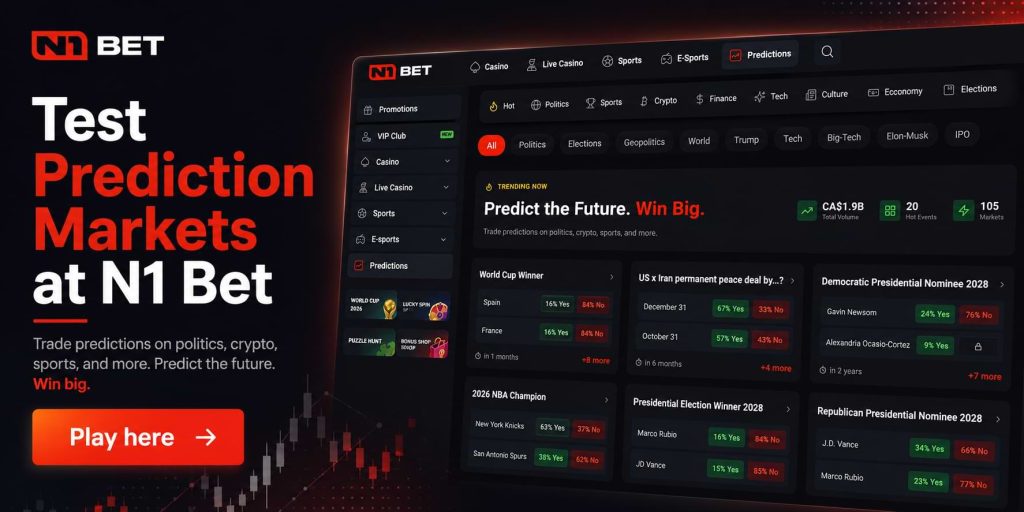
A glance at N1 Bet’s recently launched Predictions section illustrates how broad the category has become. Users can already speculate on everything from the winner of the 2026 FIFA World Cup and future NBA champions to Bitcoin price targets, US elections, diplomatic developments involving Iran and geopolitical tensions between major world powers. The result feels less like a traditional sportsbook and more like a real-time marketplace for opinions and expectations.
Why Prediction Markets Appeal To A Different Audience
One of the most interesting aspects of prediction markets is that they attract people who do not necessarily consider themselves gamblers.
Traditional sports betting is usually built around fandom. A football supporter places bets because they already follow the sport. Their interest begins with football and eventually extends into wagering.
Prediction markets often work in the opposite direction. The user arrives because they have an opinion.
Someone who spends hours every day following US politics may have no interest whatsoever in sports betting. A cryptocurrency trader monitoring Bitcoin markets around the clock may never have opened a sportsbook account. Likewise, a technology enthusiast following developments in artificial intelligence or a financially minded consumer tracking inflation data may not identify as a gambler at all.
Yet all of these individuals are potential prediction market participants.
That distinction matters because it dramatically expands the potential audience. Instead of competing exclusively for existing sports bettors, operators gain access to politically engaged users, crypto enthusiasts, investors, technology followers and news consumers. These are audiences that traditional gambling products have often struggled to reach, yet they are naturally drawn to products that allow them to act on knowledge and opinions they already possess.
Why The Conversion Barrier Is Lower Than Traditional Sports Betting
Another reason prediction markets are attracting so much attention is that they often feel more intuitive than traditional sports betting.
For many newcomers, sportsbooks can be intimidating. Odds formats, accumulators, Asian handicaps and countless other betting options create a learning curve that can discourage casual users. Prediction markets remove much of that complexity.
Most people already have opinions about politics, economics or technology. They may not understand how to build a same-game parlay, but they can usually form a view on whether Bitcoin will rise, whether a particular politician will win an election or whether a company will launch a new product.
In practice, prediction markets feel less like learning a new activity and more like putting a price on an opinion that already exists. That simplicity lowers the psychological barrier to entry and helps explain why prediction markets have been able to attract audiences that traditional betting products often fail to convert.
Why Suppliers Are Suddenly Racing Into Prediction Markets
What makes the recent launches particularly interesting is that N1 Bet and SOFTSWISS are not alone.
In April 2026, BETBY announced the launch of BETBY Predictions, a dedicated fixed-odds prediction markets solution designed specifically for sportsbook operators. Like the SOFTSWISS offering, the product allows users to place wagers on events related to cryptocurrency, finance, technology and entertainment through a familiar sportsbook interface.
The timing is difficult to ignore.
Within a matter of weeks, two major sportsbook suppliers launched products aimed at the same emerging category. Both are positioning prediction markets as a way to reach new audiences, increase engagement and reduce dependence on traditional sporting calendars. Both are also deliberately avoiding the exchange-based models that dominate much of the current prediction market landscape.
This suggests that suppliers increasingly view prediction markets not as an experimental feature, but as a potentially important new vertical.
For operators, the question is no longer whether prediction markets are becoming relevant. The question is which supplier can deliver the most compelling version of them.
How N1 Bet Differs From Polymarket
Whenever prediction markets are discussed, Polymarket inevitably enters the conversation. The platform became one of the biggest success stories in the category, attracting billions of dollars in trading volume and demonstrating enormous demand for event-based speculation. Yet despite some superficial similarities, N1 Bet’s approach is fundamentally different.
Polymarket operates as a peer-to-peer exchange.
Users are effectively trading against one another. Prices move according to supply and demand, with the market collectively determining the perceived probability of an event occurring. If enough users believe there is a 70% chance of a particular outcome, the market price adjusts accordingly.
This creates a dynamic environment that often resembles a financial exchange more than a traditional betting product. N1 Bet takes a different approach.
Powered by SOFTSWISS, the platform uses a fixed-odds model that closely resembles a traditional sportsbook. Users place wagers directly against the operator, odds are managed by the bookmaker and risk is handled through familiar sportsbook frameworks. Rather than requiring external liquidity or complex market mechanics, the product fits neatly into an existing gambling ecosystem.
For operators, that significantly lowers the operational complexity. For users, it creates a more familiar experience that requires little explanation.
How N1 Bet Differs From Kalshi
Kalshi occupies another unique position within the prediction market ecosystem.
While Polymarket emerged from the cryptocurrency world, Kalshi has positioned itself closer to traditional financial markets. Many of its contracts revolve around economic indicators, inflation figures, interest rates and political events, creating an experience that often feels more like trading than betting.
In many respects, Kalshi resembles a regulated event-exchange platform rather than a conventional gambling product.
N1 Bet sits much closer to the sportsbook end of the spectrum.
Rather than introducing financial-market mechanics, it integrates prediction markets directly into a casino and sportsbook environment. Users can access the product alongside sports betting and gaming products, while operators can manage it through systems they already understand.
That may prove to be one of the most important differences as prediction markets move toward a broader audience. The easier the product feels to existing sportsbook users, the easier adoption becomes.
Why Affiliates Should Be Paying Attention
For affiliates, prediction markets may represent something the industry rarely encounters: an opportunity to build traffic outside traditional gambling niches.
Sportsbook SEO has become intensely competitive. The same is true for casino-related search terms. In many markets, acquisition costs continue to rise while organic visibility becomes increasingly difficult to secure.
Prediction markets open the door to entirely different content strategies.
Political analysis, cryptocurrency forecasts, technology trends, macroeconomic developments and breaking news coverage can all become potential acquisition channels. A publisher covering Bitcoin may find prediction markets more relevant to its audience than a traditional sportsbook. A political website discussing election forecasts suddenly has a natural monetisation angle that did not exist before.
Perhaps most importantly, prediction markets thrive on relevance.
Every major news story creates new opportunities for engagement. Elections, economic announcements, corporate earnings, technological breakthroughs and geopolitical developments all have the potential to drive interest. In an era where media consumption increasingly revolves around real-time events, prediction markets fit naturally into the way many consumers already engage with information.
Why Prediction Markets Could Become A Retention Powerhouse
The industry’s interest in prediction markets is not solely about acquisition. Retention may ultimately prove to be an even stronger argument.
Sportsbooks remain heavily dependent on sporting calendars. Activity rises during major tournaments and league seasons, then often slows during quieter periods.
Prediction markets operate according to a different rhythm. The world rarely runs out of stories.
There is always another election approaching, another economic announcement on the horizon, another technology launch generating headlines or another geopolitical development dominating the news cycle. This creates a continuous stream of potential markets that can keep users engaged throughout the year.
For operators, that means more consistent activity. For affiliates, it creates traffic opportunities that extend far beyond traditional sporting events.
The Bigger Opportunity For iGaming
It would be premature to suggest that prediction markets are about to replace sportsbooks. Football, basketball, horse racing and other established betting products continue to generate enormous engagement globally and remain deeply embedded within gambling culture.
But that may also be missing the point. The real opportunity lies not in replacing existing betting activity but in expanding beyond it.
For decades, operators have primarily competed for customers who already viewed themselves as gamblers. Prediction markets offer the possibility of attracting entirely new segments of consumers – people whose primary interests lie in politics, finance, technology, cryptocurrency or current affairs.
Whether prediction markets ultimately become a permanent pillar of iGaming remains to be seen. What is becoming increasingly clear, however, is that the industry’s largest suppliers are no longer treating them as a niche experiment.
The near-simultaneous launches from SOFTSWISS and BETBY suggest that prediction markets have entered a new phase. The conversation is no longer centred on whether the concept works—platforms such as Polymarket and Kalshi have already demonstrated that. Instead, the focus has shifted towards how traditional gambling operators can adapt the model for mainstream audiences.
For affiliates, that could create entirely new acquisition opportunities. For operators, it may unlock customer segments that sportsbooks have historically struggled to reach. And for suppliers, it is rapidly becoming one of the most important product battles in the industry.
The future of betting may still revolve around sport. Increasingly, however, some of the industry’s biggest suppliers are betting that the future itself could become the next market worth wagering on.