



In iGaming, catalogue size has long been treated as a secondary metric — a byproduct of time in the market rather than a defining strategy.
That is no longer the case.
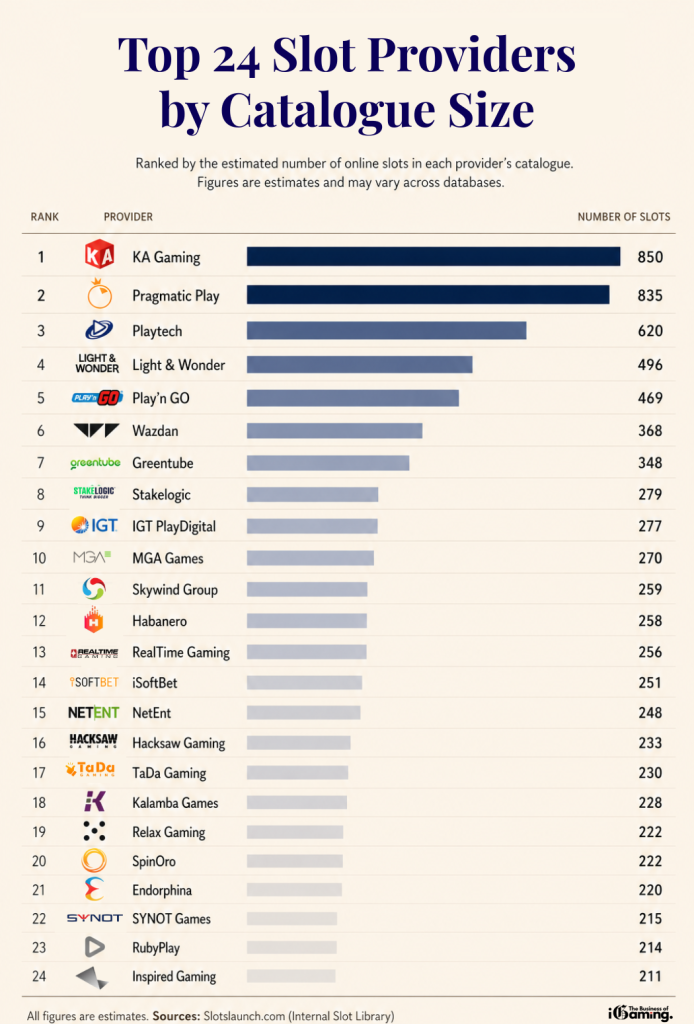
Data compiled from the internal slot library at Slotslaunch.com shows a market increasingly shaped by scale, where the number of titles a provider controls has become a direct proxy for distribution power, lobby visibility and, ultimately, market share.
At the top of that shift now sits KA Gaming.
With an estimated 850 titles, the company has overtaken Pragmatic Play to become the largest slot provider by catalogue size. It is a development that reflects less a sudden breakthrough and more the result of a deliberate, industrial approach to content production — one that has largely taken place outside the spotlight of Western-facing markets.
Top Slot Providers by Catalogue Size
| # | Provider | Number of Slots |
|---|---|---|
| 1 | KA Gaming | 850 |
| 2 | Pragmatic Play | 835 |
| 3 | Playtech | 620 |
| 4 | Light & Wonder | 496 |
| 5 | Play’n GO | 469 |
| 6 | Wazdan | 368 |
| 7 | Greentube | 348 |
| 8 | Stakelogic | 279 |
| 9 | IGT PlayDigital | 277 |
| 10 | MGA Games | 270 |
| 11 | Skywind Group | 259 |
| 12 | Habanero | 258 |
| 13 | RealTime Gaming | 256 |
| 14 | iSoftBet | 251 |
| 15 | NetEnt | 248 |
| 16 | Hacksaw Gaming | 233 |
| 17 | TaDa Gaming | 230 |
| 18 | Kalamba Games | 228 |
| 19 | Relax Gaming | 222 |
| 20 | SpinOro | 222 |
| 21 | Endorphina | 220 |
| 22 | SYNOT Games | 215 |
| 23 | RubyPlay | 214 |
| 24 | Inspired Gaming | 211 |
KA Gaming’s positioning is unusually direct. Its branding leans into a bold identity — “Makers of Kick A$$ Games, from Asia to World” — but beneath that sits a highly systematic production model. The company releases between 10 and 18 games per month, building a library that is both vast and tailored for global distribution. Much of its output is designed for high-frequency engagement environments, including fish and shooting games, and is supported across more than 100 currencies, including cryptocurrencies.
In practical terms, this is not just scale for its own sake. It is scale engineered for reach.
Pragmatic Play, long seen as the benchmark for volume-driven growth, remains close behind with 835 titles and continues to dominate in terms of visibility across regulated markets. Together with legacy providers such as Playtech and Light & Wonder, it represents a model built on consistent expansion, deep operator relationships and broad market coverage.
Yet what becomes clear when looking beyond the top tier is how compressed the rest of the market has become.
A large cluster of providers — including IGT, Stakelogic, Skywind, Habanero and NetEnt — now sits within a narrow range of roughly 220 to 280 titles. The differences between them are marginal, suggesting that many providers reach a natural plateau unless they commit fully to scale.
That plateau is where the industry begins to diverge.
On one side are the companies pursuing catalogue dominance, building ever-larger libraries to secure position within aggregator ecosystems and operator lobbies. On the other are studios that have moved in the opposite direction, focusing on fewer releases with greater impact.
Hacksaw Gaming is perhaps the clearest example of the latter. With a catalogue significantly smaller than many of its peers, it has nonetheless established a disproportionate presence through distinctive game design, strong branding and close alignment with streaming communities. Its success points to a broader shift in how influence is built in the modern iGaming landscape.
The result is a market increasingly defined by two competing logics.
One is based on volume, where scale drives distribution and visibility. The other is based on impact, where individual titles carry more weight and cultural relevance becomes a differentiator.
Few providers have managed to reconcile the two.
KA Gaming’s rise underscores how powerful the scale model can be when executed consistently and globally. But it also highlights the limits of a strategy built solely on output. As the market matures, the ability to combine reach with relevance — to balance quantity with quality — is likely to determine which providers move beyond scale and into true market leadership.
For now, however, the direction of travel is clear.
The slot market is no longer simply growing. It is consolidating — and increasingly, it is being shaped by those with the capacity to produce at scale.