




The regulated gambling industry has spent years building a narrative around maturity. Licensing frameworks have expanded. Compliance requirements have tightened. Investor presentations increasingly emphasise sustainability, responsible gaming, and regulatory legitimacy.
But what if the real story is far less flattering?
According to new analysis from Gaming Compliance International, unregulated online gambling reached an estimated $5.9 trillion in global wagering value in 2025, with regulated operators accounting for just 22% of the broader online gambling ecosystem .
That is the kind of number designed to stop people mid-scroll. And while the exact methodology deserves scrutiny, the bigger underlying question is difficult to ignore:
Has the regulated iGaming industry become too restrictive to remain globally competitive?
The $5.9 Trillion Snapshot
| Metric | Estimate |
|---|---|
| Global unregulated wagering value (2025) | $5.9 trillion |
| Estimated market split | 78% unregulated / 22% regulated |
| Emerging category | “Unacknowledged gambling” |
| Key concern | Migration away from licensed ecosystems |
| Source | Gaming Compliance International |
Editorial note: The figures originate from Gaming Compliance International’s market analysis and should be treated as industry estimates rather than universally accepted consensus data.
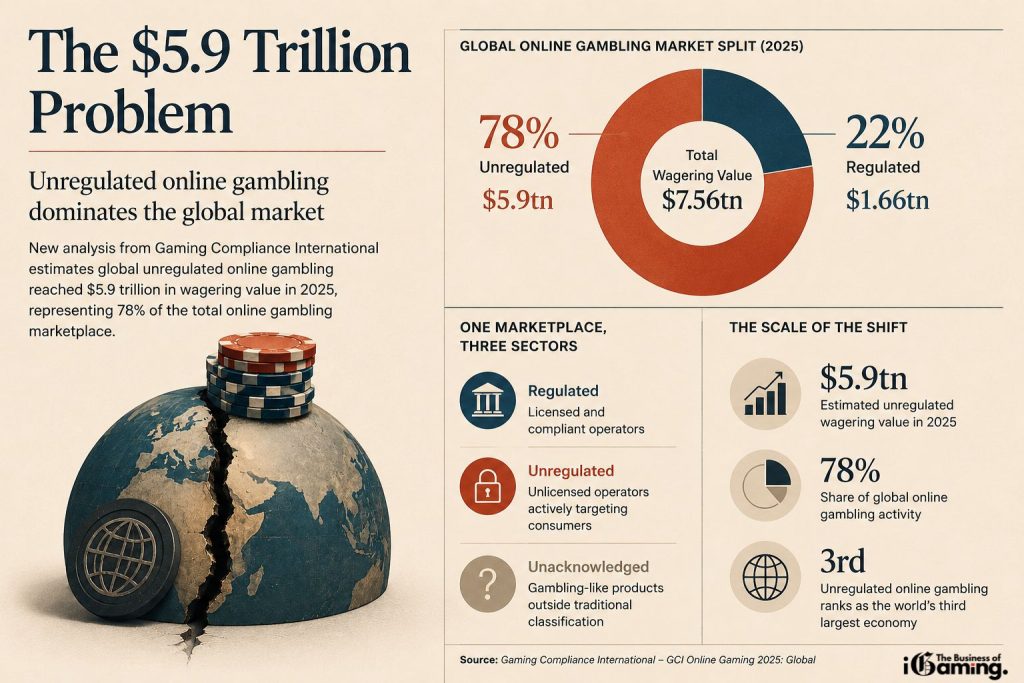
A Number That Demands Context
Whenever a trillion-dollar figure enters the conversation, context becomes essential. The immediate assumption many readers will make is that this reflects operator revenue.
It does not. The $5.9 trillion figure refers to wagering volume – the total value of bets placed – not gross gaming revenue. That distinction matters enormously.
A sportsbook may process hundreds of millions in betting turnover while retaining only a fraction as actual revenue. Casino margins work differently, but the principle remains the same: turnover and earnings are not interchangeable.
Still, even after making that distinction, the number remains striking.
Because the real takeaway is not the exact headline figure. It is the scale of player activity occurring beyond regulated frameworks.
If consumer betting behaviour outside licensed markets is even remotely close to these estimates, the regulated sector may be fighting for a much smaller share of global demand than many assume.
The Real Threat Isn’t Illegal Gambling. It’s Better Product Experience.
The gambling industry often frames the offshore problem as a compliance issue. That’s understandable. Regulators see black-market operators as a threat to taxation, oversight, and player protection.
But consumers rarely think like regulators. Players think in terms of experience.
- How quickly can I deposit?
- How easily can I withdraw?
- What games are available?
- Do I need to complete intrusive verification immediately?
- Can I use crypto?
- Is the bonus competitive?
The uncomfortable truth is that many unregulated operators have built experiences around exactly these pain points. Meanwhile, regulated operators have increasingly added friction.
That friction often exists for legitimate reasons. Enhanced KYC requirements, affordability checks, payment monitoring, advertising restrictions, and bonus limitations are all rooted in regulatory objectives.
But from the player’s perspective, the result can feel very different.
- Slower onboarding.
- Reduced flexibility.
- More barriers.
- Less spontaneity.
This is where the competitive imbalance begins.
The Rise of the Third Market
Perhaps the most interesting element in Gaming Compliance International’s framing is the suggestion that the market is no longer simply divided between legal and illegal operators.
Instead, a third segment is emerging: what the report describes as “unacknowledged gambling” . This is where definitions become blurry.
Products increasingly exist in adjacent categories that replicate gambling-like mechanics without fitting neatly into conventional regulatory models.
Sweepstakes casinos are one obvious example. Social casinos have operated in this grey area for years. Skin betting ecosystems, gamified speculative products, and prediction-market mechanics all further complicate the landscape.
This matters because regulators know how to target a clearly unlicensed sportsbook. They are far less equipped to respond when gambling behaviour migrates into categories that are not universally classified as gambling at all.
That creates a structural challenge, not just an enforcement one.
Why Affiliates Saw This Coming
For affiliates, very little about this feels surprising. Search behaviour has long hinted at the underlying demand. Users actively look for alternatives outside regulated ecosystems. Search intent around offshore brands, crypto casinos, low-friction registration, and unrestricted offers reflects that reality.
The exact terminology varies by market, but the behavioural pattern remains consistent. This is not necessarily an endorsement of unlicensed ecosystems.
It is simply evidence that consumer demand does not always align with regulatory intent. Affiliates, perhaps more than anyone, understand how quickly acquisition flows toward whichever products best satisfy user intent.
That creates a difficult dynamic for regulated operators, particularly in mature markets where product differentiation is increasingly constrained.
A Tax Problem Hidden Behind a Consumer Story
There is also a broader economic consequence. If significant consumer activity shifts beyond licensed markets, governments lose far more than theoretical oversight.
- They lose licensing revenue.
- Tax income.
- Employment opportunities.
- Local investment.
- Supplier ecosystems.
- Strategic control over a growing digital entertainment sector.
This is particularly relevant in Europe, where regulatory tightening has accelerated across several jurisdictions. The political instinct is often to assume stricter regulation improves market outcomes.
But there is a tipping point where consumer behaviour simply relocates. That is the balancing act regulators increasingly face. Too little oversight creates obvious risks, while too much friction can produce market leakage.
Neither outcome is desirable.
Should We Believe the $5.9 Trillion Figure?
That question deserves a direct answer. Not uncritically.
The report available here is a press-distributed market summary rather than a fully transparent methodology document. That does not make the conclusion invalid. But it does mean the figure should be treated carefully.
Serious questions remain around methodology, classification, overlap between categories, and how adjacent sectors were modelled. Still, it is possible to question the exact number while accepting the broader thesis.
Few industry observers would argue that unregulated digital gambling activity is insignificant. The debate is likely about scale, not existence.
And even if the true number were materially lower, the underlying strategic issue remains.
Regulated Operators May Have a Relevance Problem
This may be the most important takeaway of all. The regulated industry often assumes compliance itself creates competitive strength.That is only partially true.
Trust matters. Brand legitimacy matters. Consumer protection matters. But none of those factors automatically outweigh product convenience.
If licensed operators become consistently slower, more expensive, less flexible, and less entertaining, then regulation alone will not preserve market share. Consumers do not reward compliance frameworks. They reward experiences.
That distinction matters enormously.
What Happens Next?
The likely response will emerge on several fronts. Regulators will almost certainly intensify enforcement through payment restrictions, affiliate scrutiny, domain blocking, and platform pressure.
Operators will face growing pressure to make regulated products more competitive without undermining compliance objectives.
And adjacent sectors – particularly prediction mechanics, sweepstakes ecosystems, and hybrid speculative products – will likely face far greater regulatory attention.
But perhaps the biggest strategic question is simpler: Can regulated gambling evolve fast enough to remain attractive?
Because if it cannot, the industry’s biggest threat may not be the traditional black market. It may be irrelevance.