

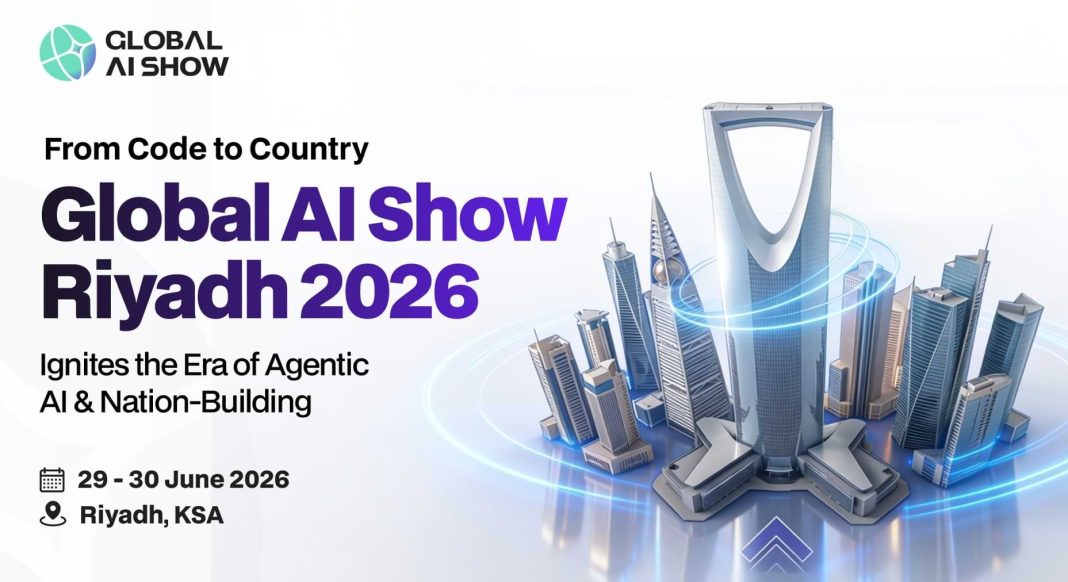

Saudi Arabia’s ambitions to become a global technology powerhouse took another step forward at the Global AI Show Riyadh 2026, where thousands of executives, policymakers, investors and technology leaders gathered to discuss how artificial intelligence is moving from experimentation to large-scale deployment.
Held alongside the Global Blockchain Show Riyadh and the Global Games Show Riyadh, the event reflected a broader shift taking place across the Kingdom. Rather than treating AI as a standalone technology, Saudi Arabia is increasingly integrating artificial intelligence into its wider Vision 2030 strategy, spanning government services, healthcare, finance, gaming, entertainment and digital infrastructure.
According to the organizers, the two-day event attracted more than 15,000 registrations, welcomed 6,723 attendees, featured over 100 speakers, more than 100 exhibitors, and brought together delegates from over 80 countries, with approximately 70% of attendees holding C-level positions.
AI Is Becoming National Infrastructure
Perhaps the biggest takeaway from Riyadh was that conversations around AI are rapidly evolving. Only a few years ago, discussions largely focused on chatbots and productivity software. At the Global AI Show, however, the emphasis shifted towards nation-scale deployment.
Sessions explored topics including:
- Agentic AI
- Sovereign AI infrastructure
- Enterprise transformation
- AI governance
- Financial services
- Cybersecurity
- Healthcare
- Workforce development
- Intelligent automation
Collectively, they reflected how governments and enterprises are beginning to view AI less as another software category and more as critical infrastructure for economic growth.
Saudi Arabia’s Vision Is Becoming Increasingly Clear
Saudi Arabia has invested billions of dollars into future industries during the past decade. Gaming, esports, cloud computing, semiconductors, smart cities and digital infrastructure have all become strategic priorities under Vision 2030.
Artificial intelligence now appears to be the technology connecting these investments. Rather than focusing solely on developing AI models, Saudi Arabia is attempting to build an ecosystem that combines talent, enterprise adoption, venture capital, regulation and infrastructure.
That ambition was evident throughout the conference.
Building Talent Alongside Technology
One recurring theme throughout the summit was that successful AI adoption depends just as much on people as on technology.
The event’s “Human-AI Interaction” framework highlighted workforce planning, AI-driven recruitment and upskilling initiatives designed to prepare Saudi professionals for a future increasingly shaped by autonomous AI systems.
Opening the conference, Dr. Mohammed Nasser Alshahrani, Executive Advisor to the Minister at the Council of Economic and Development Affairs, discussed how trustworthy data and transparency will determine which organisations succeed during the AI era. On the second day, Nezar Al Turki, Chief Information Officer at the Ministry of National Guard, focused on the transition from digital transformation towards AI transformation, emphasising governance, leadership and workforce readiness.
Investors See AI Entering A New Phase
Artificial intelligence is also changing how investors evaluate startups. During the event, Michael Lints, Founding Partner MENA at Golden Gate Ventures, argued that AI founders increasingly require more than capital alone.
Instead, successful startups need access to infrastructure, strategic partnerships and international networks capable of helping them scale globally.
That philosophy aligns closely with another major announcement from the conference.
VAP Ventures Targets 100 Startups By 2030
One of the headline announcements during the event was the launch of VAP Ventures, a new initiative from VAP Group that aims to support 100 startups by 2030.
The initiative represents an expansion beyond conferences into ecosystem development, providing emerging companies with funding opportunities, strategic guidance and industry connections.
According to Vishal Parmar, Founder and CEO of VAP Group, the objective is to transform conversations into tangible innovation by helping founders commercialise new technologies and scale internationally.
Industry Leaders Across Government And Enterprise
The speaker lineup reflected Saudi Arabia’s ambition to involve both government institutions and private industry in AI development. Notable speakers included:
- Dr. Ibraheem Sheerah — Saudi Arabian Airlines Holding (Saudia Group)
- Eng. Layla AlSalehi — Ministry of Health
- Paul Pacifico — Saudi Music Commission
- Nate Busa — NEOM
- Amal Dokhan — 500 Global MENA
- Kalyana Sivagnanam — Petromin Corporation
- Ayman Alhabib — D360 Bank
- Abdulrahman Alonaizan — Arab National Bank
- Abdulaziz Al-Ghufaili — Saudi Aramco
- Abdullah Alshargi — Saudi Authority for Data and Artificial Intelligence (SDAIA)
- Aamir Khalid Pirzada — Mozn
Together, they represented sectors ranging from aviation and banking to healthcare, energy, music, venture capital and smart cities, illustrating how AI adoption is becoming a cross-industry priority rather than a technology-specific initiative.
Innovation Beyond The Stage
The exhibition floor showcased another important aspect of Saudi Arabia’s strategy. Rather than focusing exclusively on global technology giants, the event featured a broad mix of enterprise software companies, AI startups and infrastructure providers.
Among the exhibitors were:
- NTT DATA
- Dynatrace
- SAS
- ManageEngine
- Scale AI
- Netskope
- ZenHR
- Wakeb Data Company
- Magna AI
- NourNet
- Spark.ai
- Edarat Group
The diversity of exhibitors highlighted the breadth of Saudi Arabia’s digital transformation agenda, covering cybersecurity, cloud services, HR technology, observability, enterprise AI, autonomous systems and intelligent infrastructure.
Why This Matters Beyond Saudi Arabia
The significance of the Global AI Show extends beyond the conference itself. For companies operating in gaming, fintech, blockchain and digital entertainment, Saudi Arabia is rapidly becoming one of the world’s most influential technology markets.
The Kingdom has already become a major investor in esports, gaming studios, sport and digital infrastructure. AI now appears set to become another pillar of that strategy.
Whether through enterprise transformation, startup funding or international partnerships, Saudi Arabia is signalling that it wants to play a leading role in shaping the next generation of digital innovation.
For technology companies, investors and founders, Riyadh is becoming more than a destination for conferences—it is increasingly positioning itself as one of the world’s fastest-growing innovation ecosystems.
The momentum established at this summit will carry forward to the next Global AI Show set for Abu Dhabi on 12-13 November, 2026. This creates a perfect window for the discussions at Riyadh to materialize into something tangible and distribution-ready for the Abu Dhabi edition.