



When most people think about the FIFA World Cup, they think about iconic goals, packed stadiums and the battle to lift football’s most coveted trophy. For the global sports business, however, the tournament represents something much larger: one of the world’s biggest commercial events.
The FIFA World Cup 2026, hosted across the United States, Canada and Mexico, will be the largest tournament in football history. With 48 national teams, 104 matches and 39 days of competition, the event is expected to generate unprecedented economic activity across sports betting, media, technology, payments, tourism and sponsorship.
For the iGaming industry in particular, the World Cup is the equivalent of Black Friday, Cyber Monday and Christmas rolled into a single month. Betting volumes surge, customer acquisition accelerates, infrastructure is pushed to its limits and entire ecosystems—from odds providers to payment processors—experience record demand.
But while sportsbooks often receive most of the attention, they are only one part of a much larger commercial machine.
A Tournament Worth Billions
Every World Cup creates a wave of economic activity that extends far beyond ticket sales and broadcasting rights.
Industry estimates suggest that more than $150 billion could be wagered globally during World Cup 2026, across regulated and international betting markets, reflecting the enormous commercial scale of the tournament. At the same time, billions more are generated through sponsorships, media rights, tourism, hospitality and technology investments.
Unlike domestic football leagues, the World Cup creates concentrated demand over just five and a half weeks. Every match becomes a global event, meaning millions of users access sportsbooks simultaneously, streaming platforms experience record traffic and operators invest heavily in customer acquisition.
For suppliers serving the gambling industry, the tournament is often one of the most important commercial periods in an entire four-year cycle.
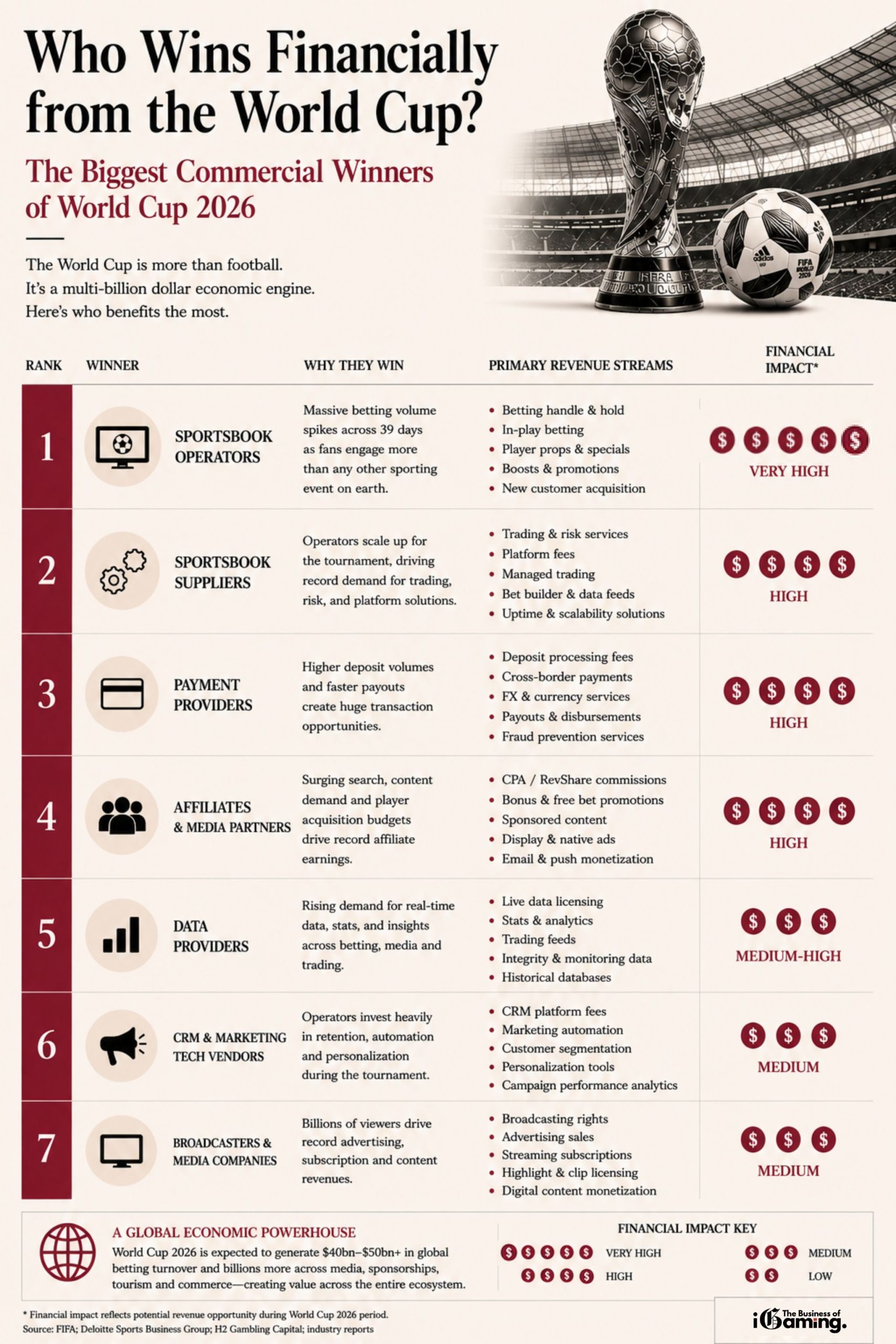
1. Sportsbook Operators: The Biggest Winners
No industry benefits more directly than sportsbook operators. During the World Cup, betting activity expands across every key performance indicator:
- First-time depositors increase significantly.
- Existing players become more active.
- Casual football fans return to betting.
- Average betting frequency rises.
- Live betting sessions become substantially longer.
Unlike regular league football, where betting interest is fragmented across multiple competitions, the World Cup concentrates global attention into a single event.
Every match offers hundreds of betting opportunities:
- Match winner
- Over/Under goals
- Both teams to score
- Player props
- Cards
- Corners
- Bet builders
- Live markets
Operators also use the tournament to cross-sell casino products, loyalty programmes and other sportsbook offerings once customers have registered.
For many companies, the objective extends beyond tournament revenue. Acquiring customers during the World Cup creates long-term value if those players remain active after the final whistle.
2. Sportsbook Suppliers: Quietly Powering the Tournament
Behind every sportsbook sits an extensive technology stack. Most operators do not build every component themselves. Instead, they rely on specialised suppliers providing:
- Trading services
- Odds compilation
- Risk management
- Betting platforms
- Live data
- Bet builders
- Cash-out functionality
- Settlement systems
As betting volume increases dramatically during the World Cup, suppliers process millions of pricing updates every hour. Any technical failure can have significant financial consequences.
Consequently, suppliers spend months preparing for tournament traffic through stress testing, infrastructure upgrades and additional trading resources.
For B2B technology companies, World Cup 2026 is arguably the industry’s biggest operational showcase.
3. Payment Providers Become Mission Critical
Deposits and withdrawals often determine whether players remain loyal to a sportsbook. The World Cup dramatically increases payment activity.
Operators process:
- Higher deposit volumes
- More withdrawal requests
- Increased international transactions
- Higher fraud attempts
- Larger VIP payouts
Modern players expect instant deposits and increasingly rapid withdrawals. Any delays during major matches can quickly damage customer satisfaction.
Payment providers therefore play an increasingly strategic role rather than simply acting as transaction processors.
Many operators now optimise payment flows based on geography, device type and customer behaviour, reducing friction while improving conversion rates.
4. Affiliates Experience Their Biggest Traffic Peaks
Affiliate businesses have evolved considerably over the past decade. The traditional model of ranking for “best betting sites” has become increasingly competitive. Major sporting events, however, create fresh opportunities.
Search interest surges for queries such as:
- World Cup betting
- Best World Cup bookmakers
- Team betting guides
- Outright winner odds
- Match predictions
- Player specials
Well-prepared affiliates publish comprehensive tournament hubs months before kickoff, enabling them to build search visibility before competition intensifies. Traffic also grows across social media, newsletters, YouTube and Telegram communities as fans seek betting insights.
For many affiliate businesses, the World Cup represents one of the year’s most valuable acquisition periods.
5. Data Providers Turn Information into Revenue
Modern sports betting depends on data. Every statistic visible to bettors originates somewhere. Specialised providers collect:
- Match events
- Player statistics
- Tracking data
- Historical databases
- Live scoring
- Predictive analytics
As operators expand their live betting offerings, demand for real-time data continues to increase. Latency becomes increasingly important.
A delay of even a few seconds between on-field action and sportsbook pricing can create trading risk. Data providers therefore invest heavily in infrastructure capable of delivering near real-time information across thousands of simultaneous betting markets.
6. CRM and Marketing Technology Companies
Customer acquisition receives significant attention during the World Cup, but retention is equally important. Operators increasingly personalise every aspect of the customer journey.
Modern CRM platforms help sportsbooks:
- Segment audiences
- Automate campaigns
- Personalise promotions
- Predict churn
- Recommend markets
- Optimise bonuses
Artificial intelligence now allows operators to tailor communications based on betting history, favourite teams, preferred markets and previous engagement.
The result is a more personalised betting experience than ever before.
7. Broadcasters and Media Companies
The World Cup remains one of television’s biggest events. Broadcasters generate revenue through:
- Advertising
- Subscription services
- Digital streaming
- Highlight rights
- Sponsored programming
At the same time, media companies covering betting content experience significant increases in readership. Match previews, tactical analysis, odds comparisons and live coverage all attract large audiences.
The rise of digital publishing has also expanded commercial opportunities beyond traditional television. Publishers, newsletters, podcasts and social creators all benefit from heightened football interest during the tournament.
Why Preparation Has Become More Complex Every Four Years
Preparing for the World Cup today bears little resemblance to preparations a decade ago. Previously, operators primarily focused on:
- Bonuses
- Additional trading staff
- Marketing campaigns
Today’s preparations are far more sophisticated. Companies now invest heavily in:
Infrastructure
Systems must withstand traffic spikes many times greater than normal operating levels.
AI-driven Personalisation
Operators increasingly deliver personalised offers rather than blanket promotions.
Payment Optimisation
Multiple payment methods are prioritised depending on geography and customer behaviour.
Risk Management
Automated exposure monitoring has become essential as betting volumes increase.
Responsible Gambling
Regulators increasingly expect operators to monitor customer behaviour during high-profile sporting events.
Localisation
Global campaigns are replaced with country-specific strategies reflecting local payment preferences, languages and football culture. The tournament has become as much a technology challenge as a marketing opportunity.
Not Everyone Wins Equally
Although the World Cup generates enormous economic activity, success is not guaranteed. Operators with unstable platforms, slow payments or weak customer support risk damaging their reputation during the industry’s busiest period.
Similarly, affiliates launching content shortly before kickoff may struggle to compete against publishers who have spent months building authority. Preparation increasingly determines commercial success.
Looking Beyond the Final
One of the most overlooked aspects of the World Cup is what happens after the tournament ends.
The most successful operators do not measure success solely by betting turnover.
Instead, they evaluate:
- Customer lifetime value
- Retention rates
- Cross-selling performance
- Brand awareness
- Long-term engagement
Acquiring a player during the World Cup is valuable.
Retaining that player for the following four years is considerably more valuable.
The FIFA World Cup 2026 is far more than a football tournament. It is one of the largest commercial events on the global sporting calendar and a defining moment for the betting industry.
Sportsbook operators may generate the most visible revenues, but the real economic impact extends across an interconnected ecosystem of suppliers, payment providers, affiliates, data companies, CRM platforms and media businesses.
As the tournament grows from 64 to 104 matches, the commercial opportunity expands alongside it. Yet the complexity of preparing for that opportunity has never been greater.
Winning the World Cup off the pitch increasingly depends on technology, infrastructure, localisation and long-term customer strategy as much as marketing budgets.
For the global iGaming industry, World Cup 2026 will not simply be another sporting event. It will be a large-scale test of operational excellence, innovation and commercial execution—one that could shape competitive positions long after the trophy has been lifted.