


The World Cup has always been football’s biggest global event. But the 2026 tournament may become something else entirely: the most personalized betting event the industry has ever seen.
Operators are no longer preparing for the World Cup by simply adding football-themed banners, boosted odds, and generic welcome bonuses. The industry is moving into an era where AI, behavioral data, predictive analytics, and real-time personalization are shaping nearly every part of the customer experience.
For many operators, the World Cup is becoming less about broadcasting one campaign to millions of users — and more about delivering millions of individualized experiences simultaneously.
And that shift may fundamentally change how acquisition, retention, and player engagement work during major sporting events.
The end of mass-market betting campaigns
Historically, major tournaments followed a familiar formula. Operators launched large-scale campaigns around national teams, star players, tournament specials, and major sponsorship activations. Bonuses were often broad and identical for large segments of the player base.
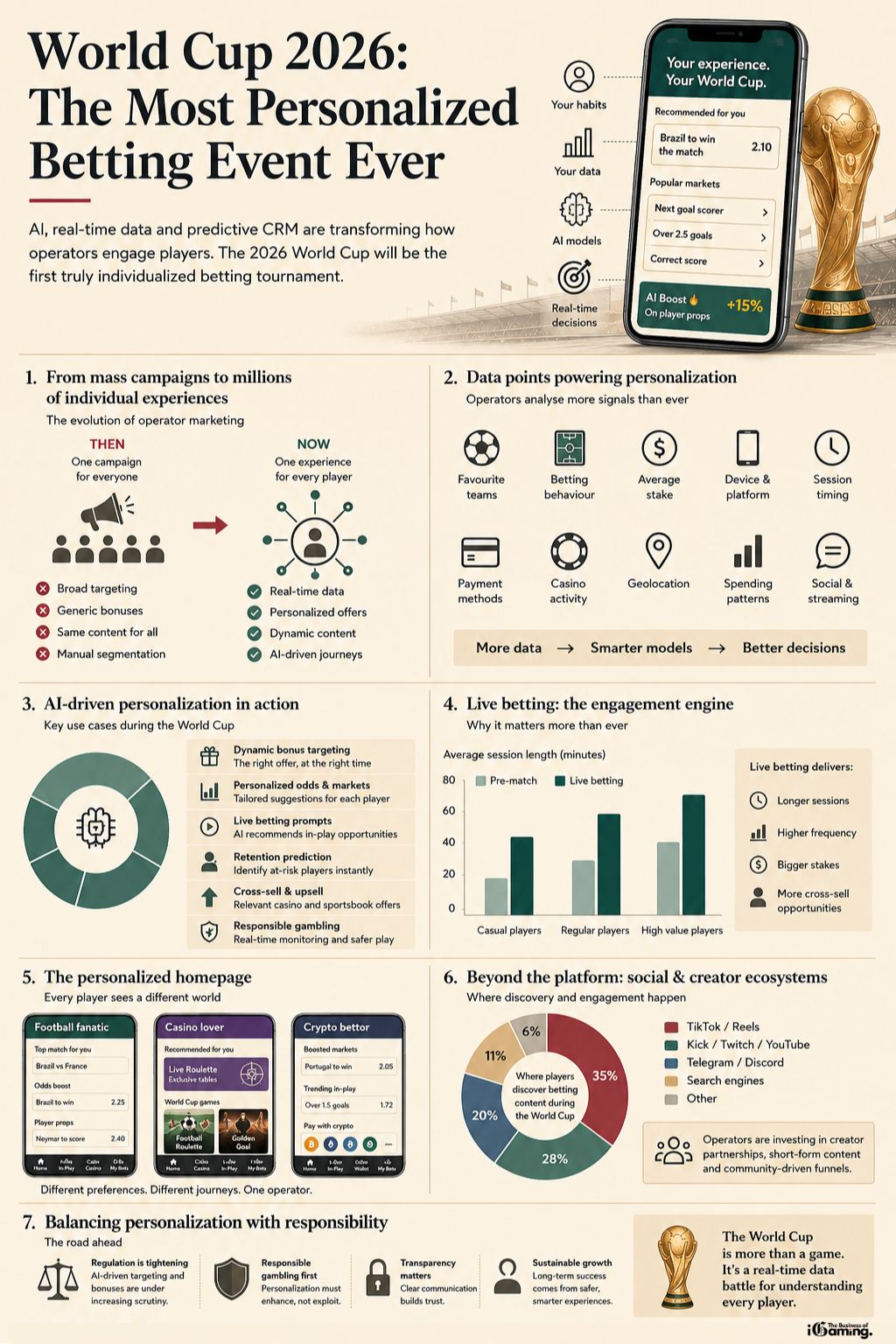
That approach still exists, but it is increasingly being replaced by highly segmented marketing ecosystems driven by real-time data. Today, operators can analyze:
- Favorite teams
- Betting patterns
- Average stake size
- Device usage
- Session timing
- Deposit behavior
- Preferred payment methods
- Casino crossover activity
- Risk profiles
- Geolocation data
- Streaming habits
- Social engagement
This allows operators to create highly individualized customer journeys during the World Cup. A player betting on Premier League football every weekend may receive entirely different offers, homepage layouts, odds boosts, and notifications compared to a casual mobile bettor who only becomes active during international tournaments.
The same World Cup may effectively look different for every customer.
AI is becoming the engine behind personalization
Artificial intelligence is rapidly becoming one of the most important competitive advantages in online gambling. During the World Cup, AI systems are expected to play a growing role in dynamic bonus targeting, personalized odds suggestions, real-time CRM optimization, cross-sell recommendations, retention prediction, and VIP segmentation.
Operators are increasingly using machine learning models to determine not only what a player is likely to bet on, but when they are most likely to engage. This creates opportunities for highly targeted campaigns delivered at precise moments. For example:
- A player who frequently bets on goalscorer markets may receive customized player prop suggestions before kickoff.
- A user showing reduced activity could automatically receive retention offers during halftime.
- Casino-first users may be targeted with football-themed live casino games during match breaks.
In many ways, the World Cup is becoming a massive real-time data environment.
The rise of predictive CRM
CRM teams have evolved dramatically over the past few years. Instead of manually scheduling broad email campaigns, operators are increasingly building automated systems that react instantly to user behavior.
The World Cup is likely to accelerate this trend further. Predictive CRM systems can already identify:
- Which players are likely to churn
- Which users may increase spending
- Which players are likely to deposit again
- Which customers respond to free bets vs cashback
- Which betting markets users prefer
- Which communication channels perform best
This means operators can automate thousands of micro-decisions during the tournament. The result is a betting experience that feels increasingly tailored to individual users rather than large customer segments.
Live betting becomes even more important
One of the biggest business shifts around modern football tournaments is the continued growth of live betting. For operators, live betting is often significantly more valuable than pre-match betting due to higher engagement, longer session times, increased betting frequency, and greater cross-sell opportunities.
The World Cup creates ideal conditions for live betting growth because it attracts both casual and experienced players simultaneously. Operators are increasingly using personalization engines to recommend live betting opportunities in real time based on previous bets, favorite teams, historical behavior, match momentum, and preferred risk level.
Some platforms are already experimenting with AI-generated betting suggestions during matches. This could become significantly more common by the time the tournament begins.
The homepage itself is becoming personalized
One of the less visible but most important changes in iGaming is the evolution of dynamic interfaces. Many operators are no longer showing identical sportsbook or casino homepages to every player. Instead, platforms increasingly personalize:
- Featured matches
- Promotional banners
- Casino recommendations
- Odds boosts
- Payment methods
- Navigation layouts
- Notification timing
- Featured streamers
- Live content
During the World Cup, this could become one of the industry’s most important retention tools. A Brazilian football bettor, a Swedish live casino player, and a crypto-native esports bettor may all encounter entirely different versions of the same operator platform.
Social media and streaming are becoming part of the personalization ecosystem
The next phase of personalization extends beyond operator websites. Streaming platforms, influencers, Telegram communities, Discord groups, and short-form video content are becoming integrated into customer acquisition and retention strategies.
Operators are increasingly using:
- Streamer-specific offers
- Personalized affiliate funnels
- Region-based creator campaigns
- AI-generated social clips
- Real-time content targeting
- Dynamic social ads
The World Cup may become the first truly creator-driven betting tournament. For younger audiences especially, betting discovery is increasingly happening through TikTok, Kick, YouTube Shorts, Telegram, and Instagram Reels – not traditional search engines.
This is one reason why operators and affiliates are investing heavily into social-first acquisition strategies ahead of major sporting events.
The balance between personalization and regulation
As personalization becomes more sophisticated, regulatory scrutiny is also increasing. Many regulators are closely monitoring AI-driven targeting, personalized bonuses, behavioral tracking, player profiling, and responsible gambling systems.
The World Cup will likely become a testing ground for how far operators can push personalization while remaining compliant. This is especially relevant in regulated markets where concerns around vulnerable players and aggressive targeting continue to grow.
Operators that can balance personalization with responsible gambling safeguards may gain a significant long-term advantage.
A real-time battle for attention
The 2026 World Cup is not just shaping up to be football’s biggest commercial event. It may also become the largest real-time customer acquisition and retention battle the gambling industry has ever seen. Every operator will compete for:
- Attention
- Screen time
- Engagement
- Retention
- Social visibility
- Deposits
- Live betting activity
And increasingly, success may depend on who understands their customers best. The future of betting may not be defined by who offers the biggest bonuses or the best odds alone. It may be defined by who delivers the most personalized experience.