




The FIFA World Cup 2026 will not simply be another football tournament. For the global iGaming industry, it is likely to become the most important customer-acquisition, retention and product-stress event in years.
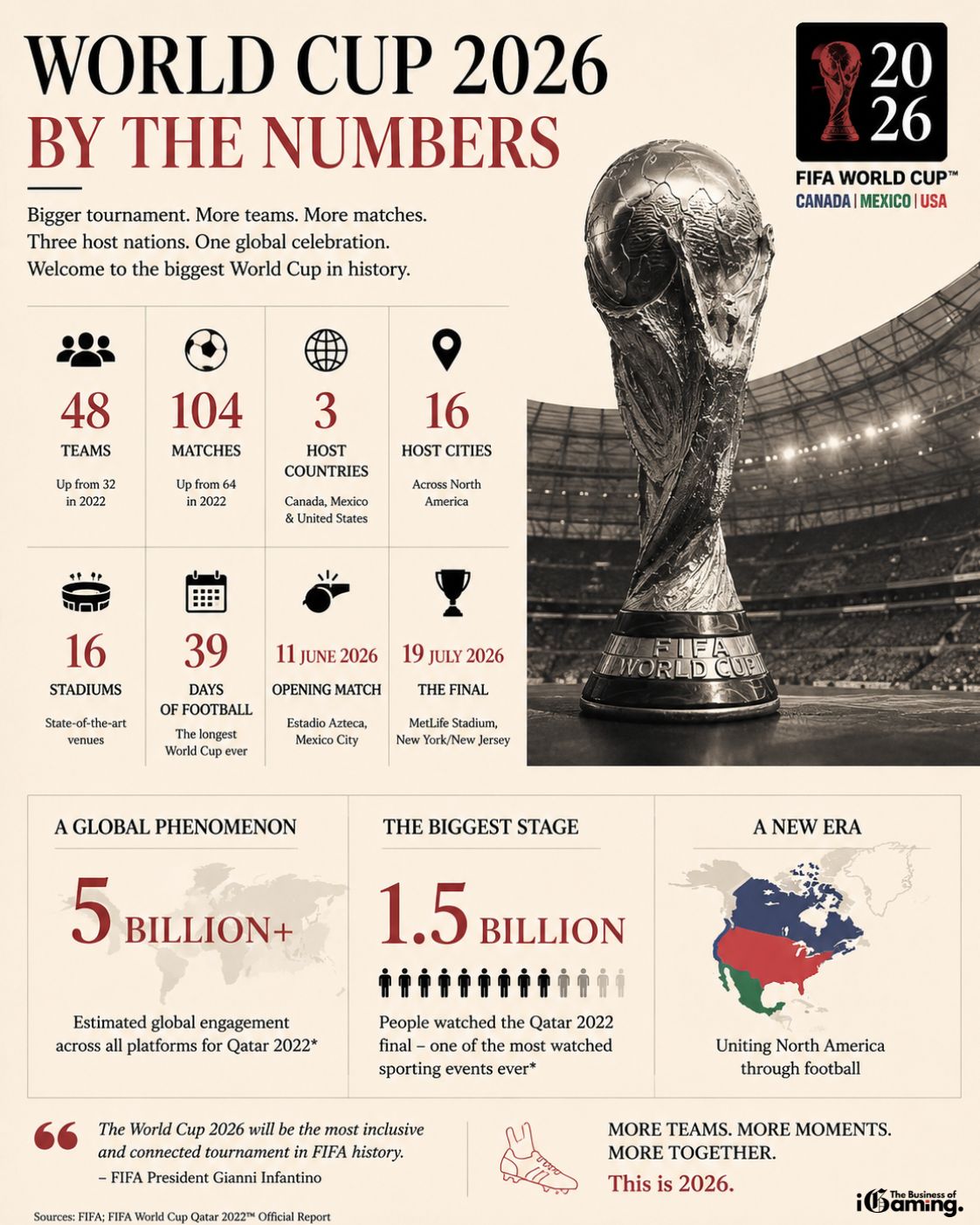
The reasons are obvious: this will be the first World Cup with 48 teams, the first hosted across three countries, and the largest edition ever, with 104 matches played across 16 host cities in Canada, Mexico and the United States. FIFA has confirmed that the tournament begins on 11 June 2026 in Mexico City and ends with the final on 19 July 2026 in New York/New Jersey.
For betting operators, this means more matches, more markets, more player sessions and more pressure on the sportsbook product. For affiliates, it means one of the biggest SEO and content windows in the decade. For data suppliers, payments companies and platform providers, it will be a live test of infrastructure at global scale.
The 2022 World Cup already showed the size of the opportunity. FIFA said around five billion people engaged with Qatar 2022 across platforms, while the final alone reached close to 1.5 billion viewers worldwide.
The 2026 edition adds something Qatar did not have: a North American betting market that is far more mature than it was even four years ago.
World Cup 2026 by the Numbers
| Metric | World Cup 2026 figure |
|---|---|
| Teams | 48 |
| Matches | 104 |
| Host countries | 3 |
| Host cities | 16 |
| Tournament dates | 11 June–19 July 2026 |
| Final | New York/New Jersey, 19 July 2026 |
| Previous World Cup global engagement | Around 5 billion |
| Qatar 2022 final global reach | Close to 1.5 billion |
Sources: FIFA.
The core commercial point is simple: the 2026 World Cup is not just bigger in format. It is bigger in betting opportunity. More teams means more local fan bases. More matches means more betting inventory. More host markets means more media attention across multiple time zones. And the North American setting gives operators access to a powerful mix of regulated sportsbook growth, mainstream sports media, Hispanic football culture, and global digital viewing.
Why World Cup 2026 Matters so Much for iGaming
The World Cup has always been one of the largest sports betting events in the world, but 2026 has a different profile.
Qatar 2022 was played in November and December, disrupting the European club calendar but giving sportsbooks a rare football peak outside the usual summer window. World Cup 2026 returns to the traditional summer slot, but with a bigger tournament and more favourable scheduling for the Americas.
That matters for operators in several ways.
First, football remains the most global betting product. Unlike the Super Bowl, which is huge but still largely concentrated in the US, the World Cup creates overlapping waves of demand across Europe, Latin America, Africa, Asia and North America.
Second, the tournament is emotional. National-team betting often brings in users who do not normally bet every weekend. Many are casual bettors, patriotic bettors or tournament-only players. That makes the World Cup a customer acquisition moment — but also a responsible gambling risk period.
Third, the 2026 tournament will be played in the most commercially developed sports market in the world. The United States has become a major legal sports betting market since the Supreme Court’s 2018 decision opened the door for state-by-state regulation. Reuters reported that legal sports betting is now available in 38 states and Washington, D.C., with the American Gaming Association estimating $1.76 billion in legal wagers for the 2026 Super Bowl alone.
That Super Bowl number is useful context. The World Cup is not a one-day event. It is a 39-day betting cycle, with 104 matches, global fan bases, and a final that historically reaches far beyond US sports audiences.
The Betting Scale: What We Know from Previous Tournaments
Exact global World Cup betting turnover is difficult to measure because it spans regulated markets, grey markets, offshore operators, retail betting, exchanges and informal wagering. But several public indicators give a sense of scale.
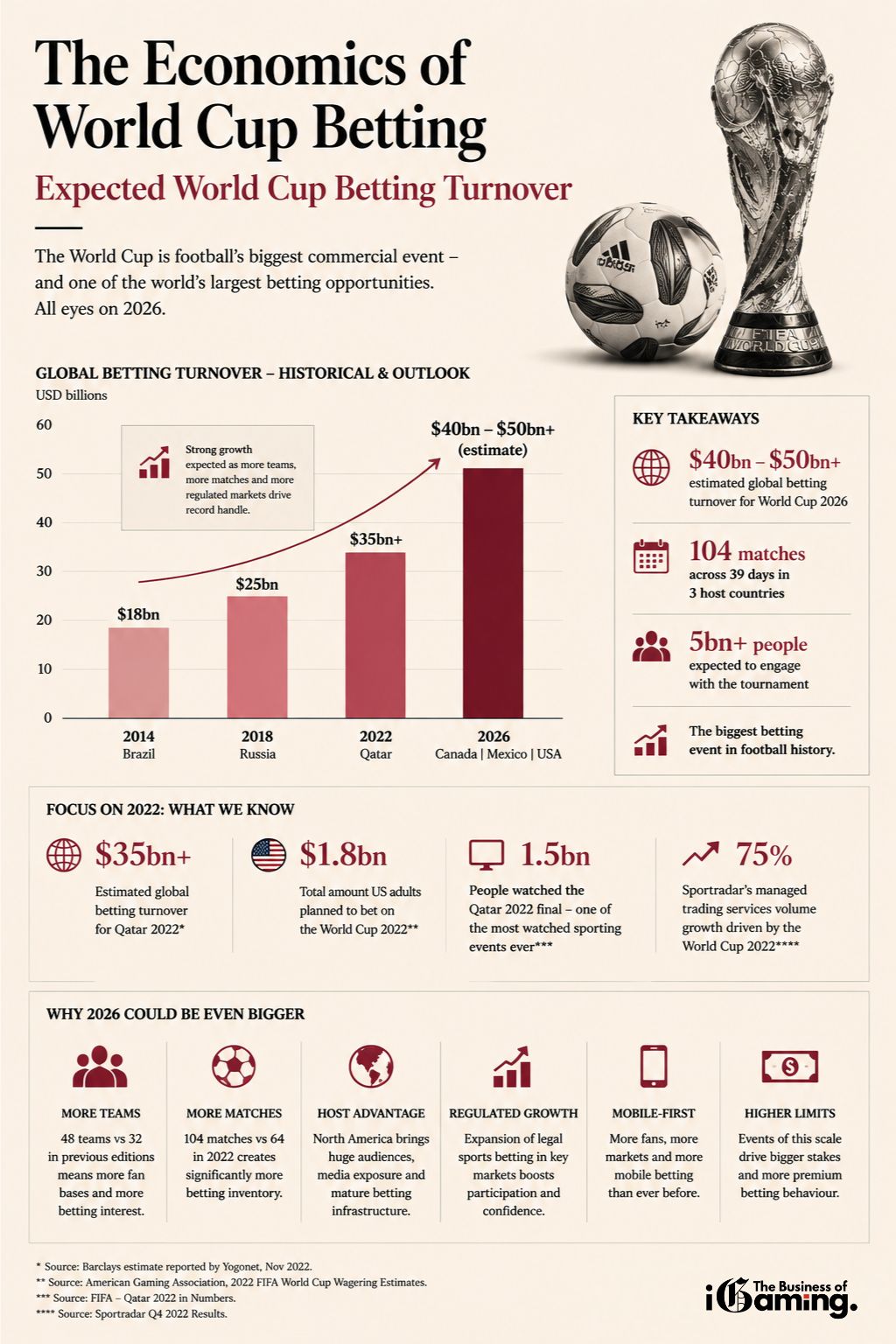
The American Gaming Association estimated that 20.5 million American adults planned to bet a combined $1.8 billion on the 2022 World Cup.
At global level, Barclays analysts estimated that $35 billion would be wagered on the 2022 FIFA World Cup, representing a significant increase on the previous edition.
Sportradar’s 2022 results also showed the commercial impact of the tournament on B2B sports betting suppliers. The company said its Managed Trading Services volume grew 75%, primarily driven by strong FIFA World Cup performance.
That is important because it shows how the World Cup affects not only B2C sportsbooks, but also the wider supplier ecosystem: data providers, trading services, risk tools, streaming products, odds feeds and managed sportsbook solutions.
For 2026, the opportunity is likely larger because of four structural factors:
| Driver | Why it matters |
|---|---|
| More matches | 104 matches instead of 64 |
| More teams | 48 national markets with direct fan interest |
| North American hosts | US, Mexico and Canada combine large media and betting markets |
| Mature US betting | More regulated states and more active sportsbook accounts than in 2022 |
This does not mean every operator will benefit equally. The World Cup will favour companies that prepare early, localise properly, segment players intelligently and keep their product stable under pressure. Macquarie even forecasts global wagers will exceed $50 billion, nearly $0.5 billion per match.
Audience: Where the World Cup is Watched
For operators and affiliates, audience geography matters because betting value does not always follow population. Brazil may deliver huge football engagement. The UK may deliver mature sportsbook value. The US may deliver high commercial upside. India and China may deliver enormous audience scale but complicated betting-market realities.
FIFA’s Qatar 2022 figures showed the breadth of the tournament. Around five billion people engaged with the World Cup, and the final reached close to 1.5 billion viewers.
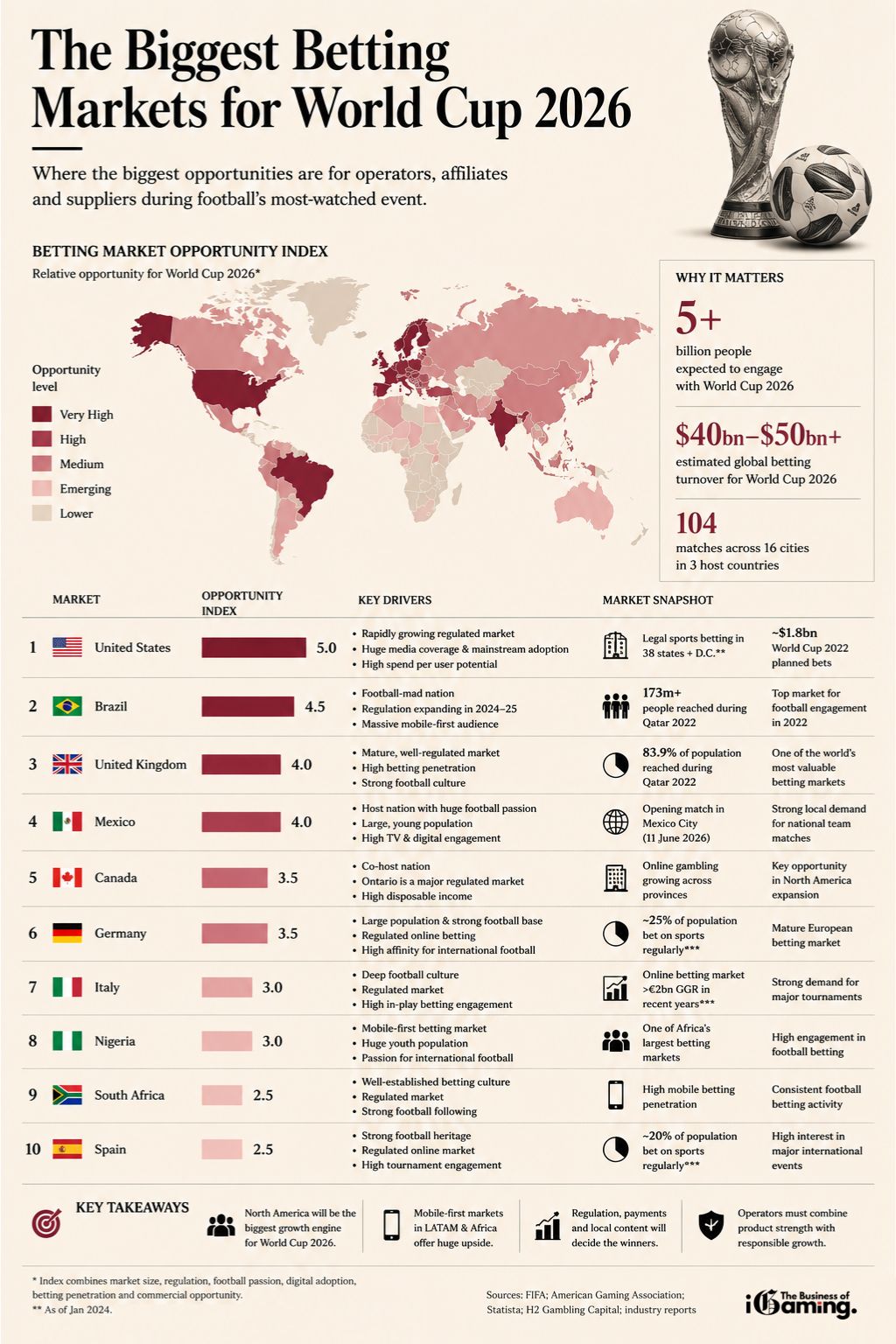
FIFA also reported strong country-level audience figures. Brazil reached 173 million people across the tournament, while the UK reached 51.2 million, equivalent to 83.9% of the population.
The US final audience was also significant. FIFA said the 2022 final attracted nearly 26 million viewers on FOX and nine million viewers on Spanish-language coverage, with the Spanish-language audience up 65% versus 2018.
That Spanish-language figure is particularly important for 2026. With Mexico co-hosting, matches across US time zones, and a large Hispanic audience in the United States, operators should not treat the US as a single-language betting market.
The Biggest Betting-Market Opportunities
The best World Cup markets for iGaming are not simply the countries with the largest populations. The real opportunity comes from the intersection of:
- football passion
- regulated or accessible betting
- payment reliability
- affiliate competition
- media reach
- local language demand
- mobile-first player behaviour
- bonus responsiveness
1. United States
The US will be one of the most important World Cup 2026 markets because it combines host-nation attention with an expanding regulated sportsbook ecosystem.
The American market is still not as football-native as Europe or Latin America, but the World Cup will benefit from mainstream sports media, local stadium hosting, and a growing betting habit around major events. The US is also where same-game parlays, player props, boosts and app-led sports betting UX have advanced quickly.
For operators, the key challenge is education. Many US users understand NFL, NBA and MLB betting better than football betting. The winning sportsbooks will simplify football betting without making the product feel basic. Good UX around “both teams to score”, “over/under goals”, “player shots”, “cards”, “corners” and bet builders will matter.
2. Brazil
Brazil is arguably the most natural World Cup betting market: huge football culture, deep national-team identity, massive audience scale and rapidly developing regulated betting interest.
It is also a market where affiliates and operators should localise heavily. Portuguese content, Pix payments, local football narratives and Brazil-specific player props can outperform generic global pages.
3. United Kingdom
The UK remains one of the most mature sports betting markets in the world. The opportunity is not just acquisition, but reactivation and wallet share.
UK players are familiar with accas, bet builders, free bets and live betting. For operators, differentiation will come from price, market depth, app stability, personalisation and responsible gambling safeguards.
4. Mexico
Mexico is a host nation and a major football culture. It should be treated as more than a Spanish-language extension of the US strategy.
Operators should build Mexico-specific content, team guides, local payment explainers and promotions around national-team fixtures. The opening match in Mexico City will create a natural first spike in tournament attention. FIFA has confirmed that the tournament opens in Mexico City on 11 June 2026.
5. Canada
Canada’s role is interesting because it is a host nation but also a fragmented betting market. Ontario has become one of North America’s most important regulated online gambling markets, while other provinces follow different models.
That creates both opportunity and friction. Operators, affiliates and suppliers need province-specific planning rather than assuming Canada behaves like a single national market.
6. Germany, Italy, Spain and France
These are mature European football markets with strong national-team interest and established betting behaviour. However, they are also heavily regulated and highly competitive.
For affiliates, ranking for head terms like “World Cup betting sites” in these markets will be extremely difficult. Long-tail content around team previews, tactical analysis, odds explainers and match-specific guides may be more realistic.
7. Africa: Nigeria and South Africa
Nigeria and South Africa are major football betting markets with mobile-first behaviour and strong engagement around international football.
For operators and affiliates, the opportunity is substantial — but payment, regulation and trust signals are crucial. Content must be localised, not simply translated.
8. India
India is not traditionally a football-first betting market in the same way as Brazil or the UK, but the population scale and digital sports audience make it impossible to ignore. The World Cup can attract large casual viewing audiences, especially around star players, finals and major nations.
For iGaming companies, however, India requires careful regulatory and product-market analysis. It should be treated as a complex opportunity, not an easy win.
The Operator Playbook: How Sportsbooks Should Prepare
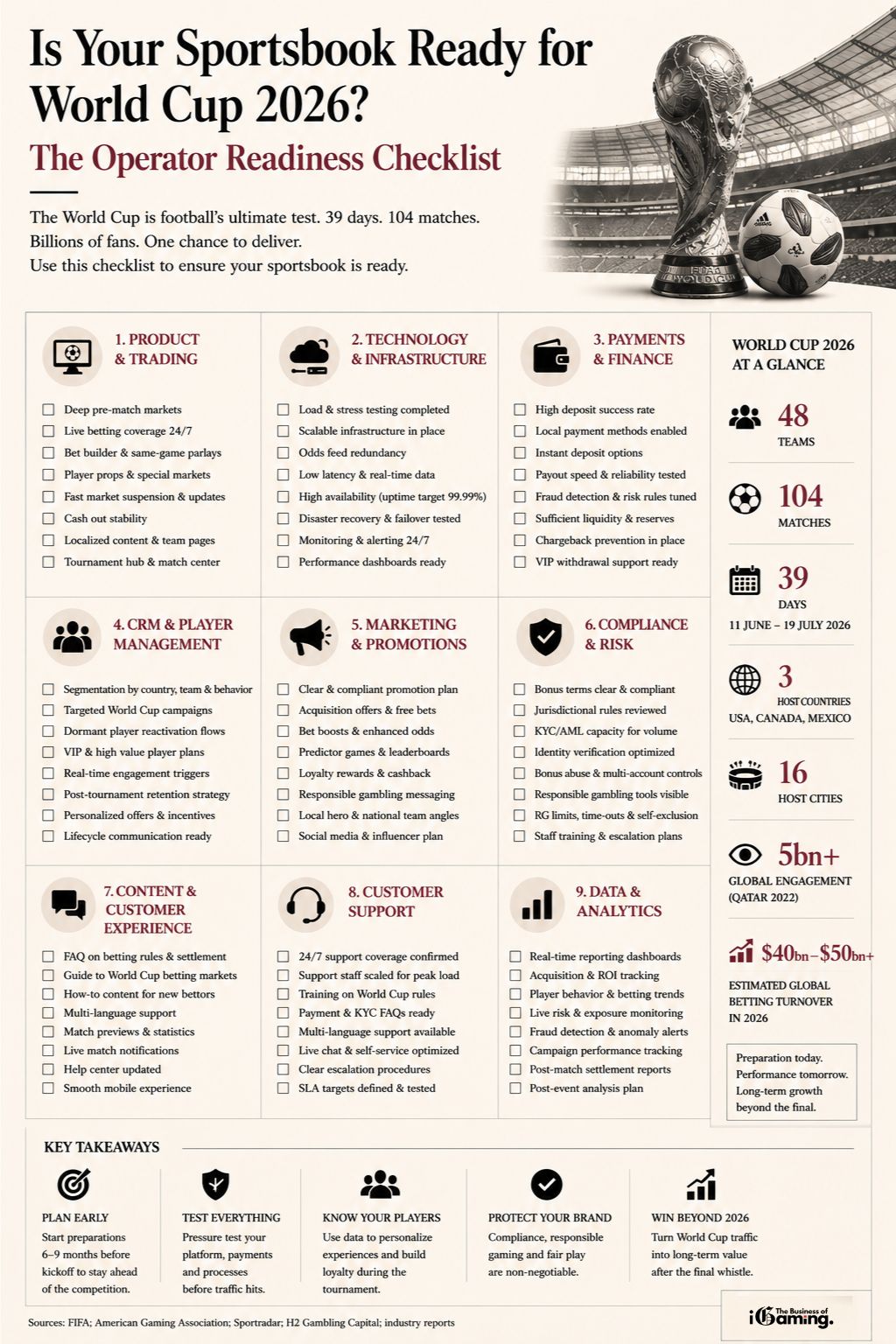
The World Cup will expose weak sportsbook operations. A normal football Saturday is predictable. A World Cup matchday is different: emotional traffic, casual bettors, volatile live markets, payments pressure, bonus abuse risk and customer support spikes all arrive together.
1. Stress-test the platform early
Operators should prepare for traffic bursts around:
| Moment | Risk |
|---|---|
| Opening match | mass login and deposit spike |
| Host nation matches | local traffic concentration |
| England/Brazil/Argentina matches | global betting volume |
| Knockout games | higher stake sizes |
| Final | maximum traffic, maximum pressure |
The biggest risk is not just downtime. It is degraded UX: slow odds refresh, betslip lag, failed deposits, delayed cash-out, broken verification or frozen live markets.
2. Build a tournament-specific sportsbook UX
Most sportsbooks already have football pages. But World Cup players need a cleaner path.
Recommended modules:
- World Cup homepage
- today’s matches
- outright winner odds
- group standings
- team pages
- player markets
- bet builder hub
- live betting centre
- responsible gambling panel
- promotions hub
The best World Cup UX should answer one question quickly: “What can I bet on right now, and why does it matter?”
3. Prepare CRM around National Identity
Generic email campaigns will not be enough. Operators should segment by:
- country of residence
- preferred language
- favourite teams
- previous football betting history
- VIP status
- deposit behaviour
- dormant/reactivated players
- live betting usage
A player in Brazil should not receive the same tournament messaging as a player in Ontario, Germany or Nigeria.
4. Make Promotions Simple
The temptation during the World Cup is to overbuild complex campaigns. But casual bettors often respond better to simple offers.
Examples:
| Promotion | Why it works |
|---|---|
| Free bet for first World Cup wager | acquisition |
| Bet builder boost | product education |
| Goal insurance | casual-friendly |
| Daily match predictor | retention |
| Leaderboard | repeat engagement |
| National-team cashback | emotional hook |
| Final free bet | peak-event conversion |
The important point: promotions must be easy to understand and compliant in each market.
5. Prepare Customer Support
Support pressure will rise around KYC, payments, bonus terms, bet settlement and cash-out disputes.
Operators should prepare tournament-specific FAQ pages before kickoff. These should cover:
- how World Cup bets are settled
- what happens in extra time
- what happens with penalty shootouts
- how player props are graded
- bonus eligibility
- withdrawal timelines
- responsible gambling tools
This is not just good UX. It is also good SEO and trust-building content.
The Affiliate Playbook: The SEO Window is Already Open
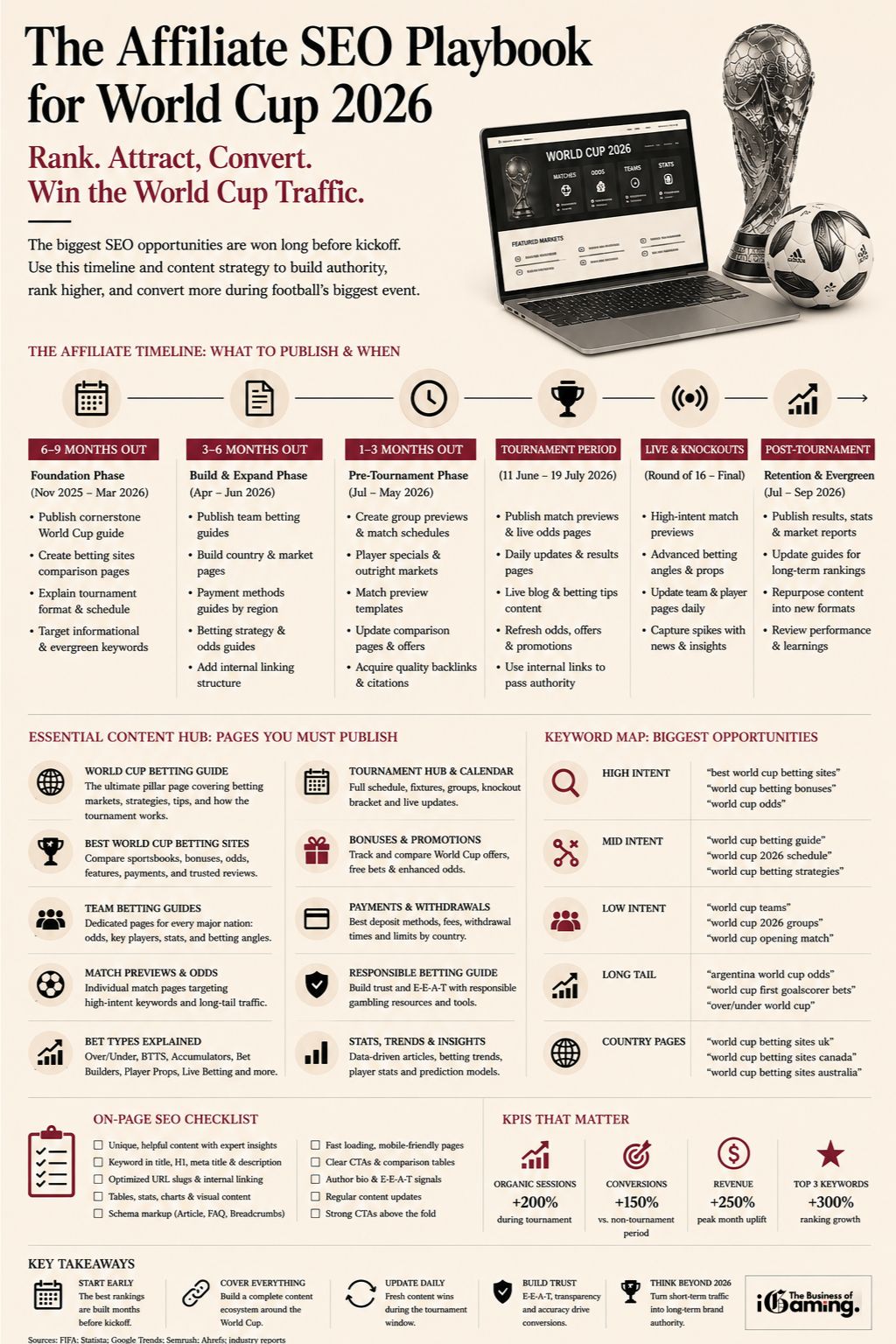
For affiliates, the World Cup is not a content idea to start during the tournament. By then, it is largely too late.
Google needs time to discover, evaluate, rank and trust content. Affiliates that publish deep World Cup hubs months before kickoff have a better chance of ranking than those who chase match previews at the last minute.
Recommended Affiliate Content Structure
| Page type | Purpose |
|---|---|
| World Cup betting guide | cornerstone SEO page |
| Best World Cup betting sites | commercial comparison |
| Team betting guides | long-tail search |
| Match previews | freshness and daily traffic |
| Bet type explainers | educational trust |
| Odds pages | commercial intent |
| Country-specific pages | localisation |
| Responsible betting guide | E-E-A-T and trust |
| Free bet guide | conversion |
| World Cup calendar | utility and links |
A strong affiliate hub should not only list betting sites. It should explain how World Cup betting works, how odds move, which bet types are common, what risks casual bettors face, and how different markets compare.
That is where many affiliate sites fail. They treat the World Cup as a bonus keyword, not as a complete user journey.
Content Calendar for Affiliates
| Timing | What to publish |
|---|---|
| 6–9 months before kickoff | cornerstone guide, betting sites, tournament format |
| 3–6 months before kickoff | team guides, market pages, payment pages |
| 1–3 months before kickoff | group previews, player specials, odds explainers |
| Tournament period | match previews, live odds, daily updates |
| Knockout stage | high-intent commercial pages |
| After final | results, data recap, evergreen updates |
The biggest affiliate mistake will be thin content. Google is unlikely to reward hundreds of low-value pages that simply rephrase odds. The winners will combine sportsbook comparisons with actual football knowledge, market context and useful explanations.
The Supplier Playbook: Where B2B Companies Can Win
The World Cup is also a supplier event.
Sportsbook suppliers, data companies, risk-management providers, payment processors, CRM platforms, KYC firms, affiliate platforms and fraud-prevention tools can all use the tournament to prove their value.
Odds and Data Providers
World Cup betting requires depth, speed and reliability. Pre-match odds are only the starting point. Operators need live data, player props, bet builders, visualisation tools, settlement accuracy and trading support.
Sportradar’s 2022 results showed how strongly World Cup activity can affect supplier performance, with Managed Trading Services volume up 75% primarily due to FIFA World Cup performance.
Payment Providers
Payments are a hidden World Cup battleground. Failed deposits during high-intent match windows are expensive. Slow withdrawals damage trust. Fraud spikes can overwhelm weak systems.
World Cup payment preparation should include:
- deposit success-rate monitoring
- local payment methods
- instant payout readiness
- fraud rule tuning
- chargeback monitoring
- VIP withdrawal support
- payment routing redundancy
KYC and Fraud Tools
Major events attract bonus abuse, account farming, multi-accounting and identity friction. Operators need strong controls without creating unnecessary friction for legitimate users.
The best KYC experience during the World Cup is fast, clear and invisible until needed.
CRM and Retention Platforms
The World Cup gives CRM teams a rare behavioural map. Every match creates signals: team interest, market preference, bet size, live-betting behaviour, deposit timing and churn risk.
Operators should use these signals to build retention beyond the tournament. The real value is not only what players bet during the World Cup, but how many remain active in the following football season.
The Betting Trends to Watch
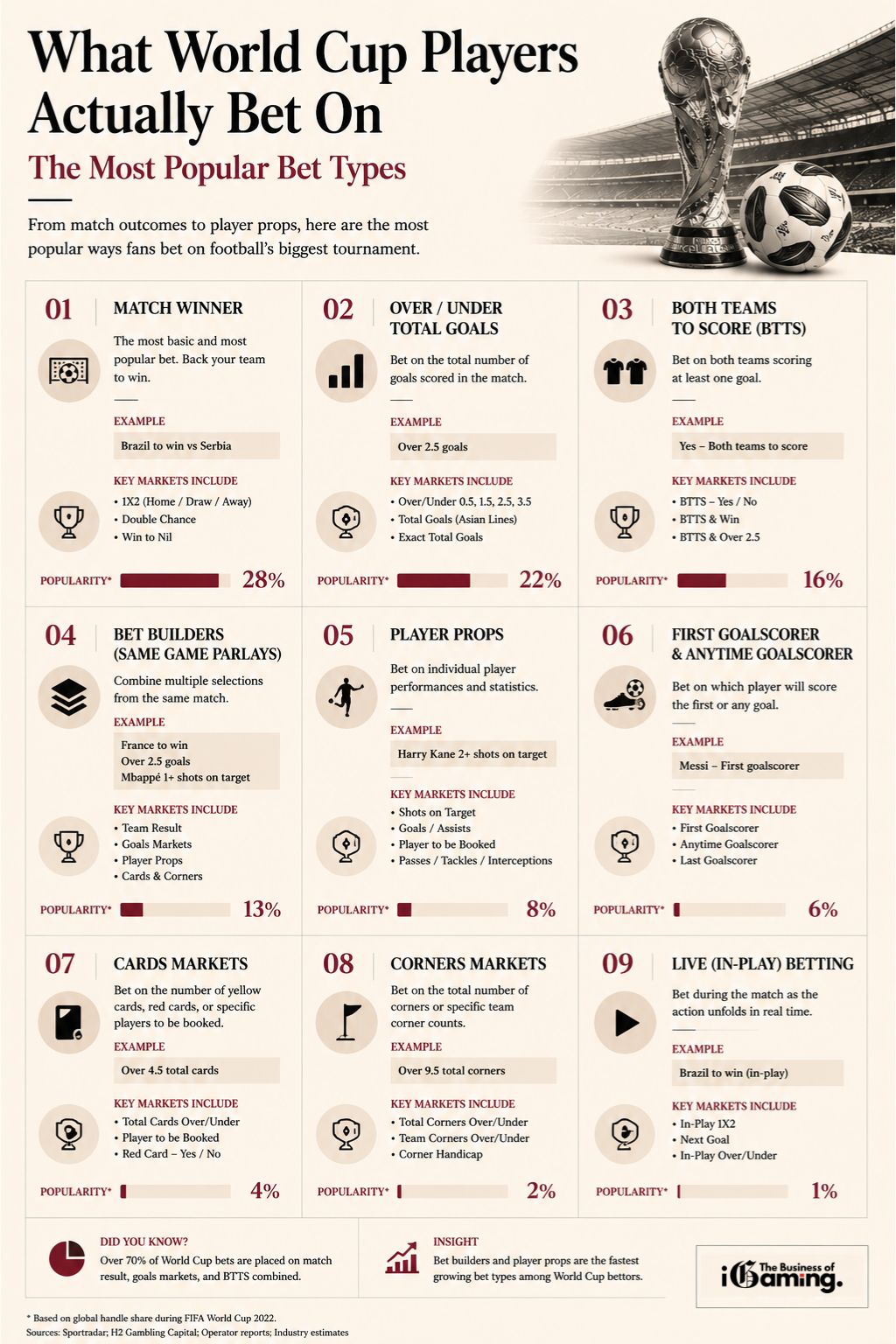
1. Live Betting
Live betting will be central. Football is perfectly suited to in-play markets because momentum changes constantly: goals, red cards, injuries, substitutions and tactical shifts all move prices.
Operators should prioritise live UX, fast market suspension, accurate cash-out and clear betslip communication.
2. Bet Builders and Same-Game Parlays
Bet builders are now a core football product. For casual players, they are easier to understand than traditional accumulators because they can construct a story around one match.
Example: Argentina to win, Messi replacement/player star to have 1+ shot on target, over 2.5 goals, both teams to score.
For operators, the challenge is margin management. For affiliates, the opportunity is education.
3. Player Props
Player props will grow around stars. Searches and bets will concentrate around goalscorers, shots, assists, cards and goalkeeper saves.
This is especially important for US-style sportsbook users who are familiar with player props from NFL and NBA betting.
4. Microbetting
Microbetting — next corner, next throw-in, next card, next free kick — may become more visible, but it carries UX and responsible gambling risks.
It can drive engagement, but it also increases bet frequency. Operators should be careful about how aggressively they promote it.
5. Prediction Markets
Prediction markets are becoming part of the sports-event conversation. They may not replace sportsbooks during World Cup 2026, but they can compete for attention around simple outcomes: winner, group qualification, top scorer, or match result.
The key question is whether casual users see prediction markets as simpler, more transparent, or more socially shareable than sportsbook odds.
6. Crypto Sportsbooks
Crypto sportsbooks will use the World Cup heavily for acquisition. Their pitch will focus on fast deposits, global access, privacy, and quick withdrawals.
But the World Cup will also highlight the same issues that follow crypto betting generally: licensing, KYC, volatility, disputes and responsible gambling standards.
Responsible Gambling: The section Google and Users Need
A serious World Cup betting guide should not only talk about opportunity. It must also talk about risk.
The World Cup can be a high-risk betting period because it attracts emotional, casual and patriotic bettors. Players may bet on their national team rather than on price. They may chase losses during live matches. They may increase stakes during knockout games. They may also bet more frequently because there are matches almost every day.
Operators should make safer gambling tools visible before the tournament begins:
- deposit limits
- loss limits
- reality checks
- time-outs
- self-exclusion
- cooling-off periods
- responsible gambling content
- clear bonus terms
Affiliates should also include responsible gambling information prominently, especially on commercial pages. This improves trust, protects users and supports a stronger E-E-A-T profile.
What Operators Should Prepare before Kickoff
| Area | Must-have before June 2026 |
|---|---|
| Product | World Cup hub, live betting, bet builder, team pages |
| Tech | load testing, odds-feed redundancy, payment monitoring |
| CRM | country segments, VIP campaigns, dormant reactivation |
| Compliance | bonus terms, safer gambling tools, jurisdiction checks |
| Content | explainers, FAQs, odds guides, team previews |
| Support | tournament settlement rules, KYC guidance, payment FAQs |
| Payments | local methods, instant payout messaging, fraud tuning |
| Data | dashboards for matchday acquisition and retention |
The best operators will not treat the World Cup as a marketing campaign. They will treat it as a full-company operating cycle.
What Affiliates Should Prepare before Kickoff
| Area | Recommended action |
|---|---|
| SEO | publish cornerstone content early |
| Commercial pages | compare World Cup betting sites |
| Long-tail | create team and match guides |
| Trust | include author expertise and responsible gambling |
| Internal linking | build a World Cup content hub |
| Social | convert stats into LinkedIn/X carousels |
| Data | track rankings and update pages frequently |
| Monetisation | negotiate World Cup-specific deals early |
For affiliates, the biggest opportunity is not only ranking for “World Cup betting sites”. It is owning the surrounding informational ecosystem: how to bet, where to bet, what markets mean, which teams attract action, what casual players misunderstand, and how the industry is preparing.
Final Analysis: World Cup 2026 will Reward Preparation, not Hype
The iGaming industry loves major sports events, but World Cup 2026 is different because of its scale, geography and timing.
It is the biggest World Cup format ever. It is hosted across three commercially important countries. It arrives at a time when US sports betting is more developed than ever. It gives affiliates a rare SEO window. It gives suppliers a chance to prove infrastructure value. And it gives operators a tournament-long opportunity to acquire, reactivate and retain players.
But it will not reward everyone equally.
Operators with weak payments, slow apps, unclear promotions and generic localisation will struggle. Affiliates that publish thin AI-style betting pages in June 2026 will be late. Suppliers that cannot prove reliability under live-event pressure will lose ground to competitors.
The winners will be the companies that start now: building content, testing systems, planning CRM, preparing responsible gambling controls and turning the World Cup into a complete commercial strategy.
For The Business of iGaming, that is the real story. World Cup 2026 is not just a football tournament. It is a global stress test for the modern betting industry.