



Crypto casinos can feel straightforward on the surface: connect a wallet, deposit coins, place a bet, withdraw if things go your way. Simple enough. But underneath that quick flow is a payment system that works very differently from a debit card, bank transfer or standard online casino balance.
That gap matters. Plenty of players are happy using digital coins without really knowing what happens in the background. In fact, one gambling-related survey suggested that around seven in ten respondents who had used crypto for casino activity still felt they had limited knowledge of cryptocurrency itself. Many were also unsure what blockchain actually does.
So, let’s strip it back. Not in a lecture-room way. Just enough to understand the machinery that makes crypto casino payments possible.
The Technology Shift That Made Crypto Casinos Possible
Casinos have always moved with technology. The early gambling houses were physical venues, with one of the best-known historical examples opening in Venice in the seventeenth century. Much later came the resort casino model, followed by online casinos in the 1990s once public internet use became widespread.
Crypto casinos are another step in that same chain. The major difference isn’t the games themselves. It’s the payment rail beneath them.
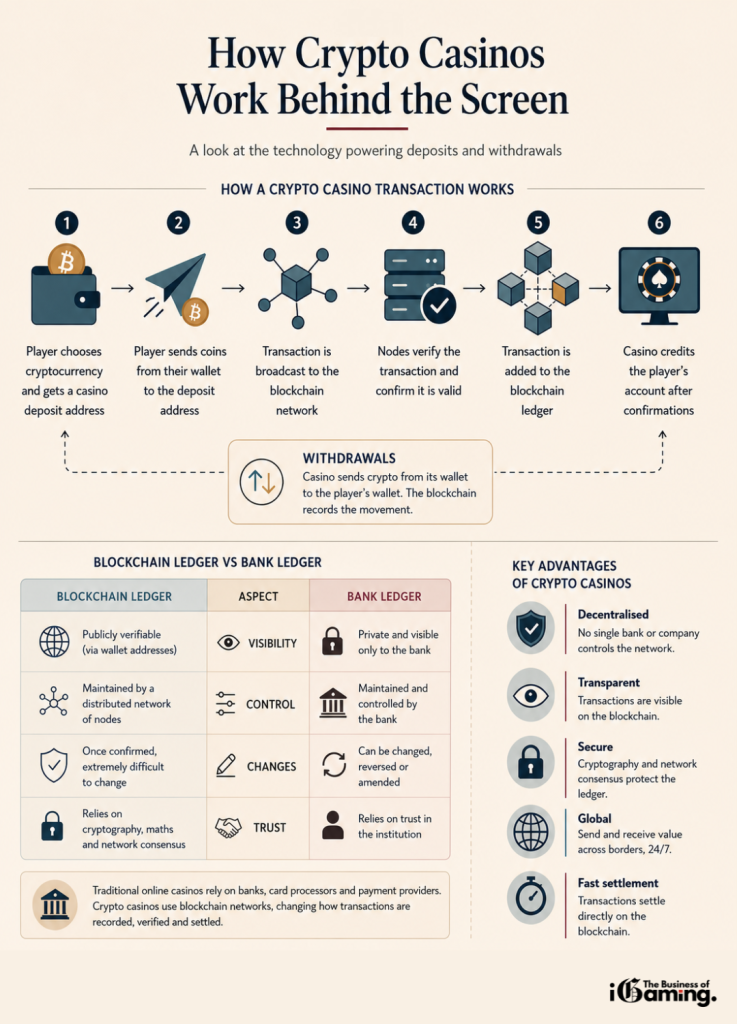
Traditional online casinos usually rely on banks, card processors and payment providers. Crypto casinos use digital currencies such as Bitcoin, Ethereum, Tether and Solana, which run on blockchain networks. That changes how deposits and withdrawals are recorded, verified and settled.
Read more: The Largest Crypto Casinos by Deposit Volume
Why the Ledger Matters
To understand how crypto casinos work, start with the word ledger. A ledger is simply a record of transactions. It says what moved, from where, to where, and when.
Banks use ledgers too. The difference is that a bank ledger is closed. The bank controls it, stores it, updates it and decides what customers can see. You can view your own balance, but you don’t see the full system.
A blockchain ledger works differently. It is distributed across many computers, often spread around the world. These computers, commonly called nodes, help keep the shared record accurate. No single bank, company or office owns the entire ledger.
Open Ledgers vs Bank Records
The contrast between a blockchain and a bank ledger is the easiest way to make sense of the whole thing.
- Visibility: A blockchain is public. Transactions can be viewed on the network, although they are shown between wallet addresses rather than personal names. Bank records are private and controlled internally.
- Control: A blockchain is maintained by a network of participants. A bank ledger is maintained by the bank.
- Changes: Once a blockchain transaction is confirmed, altering it is extremely difficult. Bank records can be corrected, reversed or amended by the institution that controls them.
- Trust: Blockchain systems rely on cryptography, mathematics and network verification. Banking systems rely on trust in the organisation managing the records.
A rough analogy helps. Imagine a spreadsheet that thousands of computers constantly check against each other. If one copy suddenly says something false, the others reject it. That’s closer to how a blockchain behaves. A bank ledger is more like a private spreadsheet kept inside one organisation.
What Happens When You Send Crypto to a Casino
When a player deposits cryptocurrency at a casino, the money doesn’t move through a card network or high-street bank. It moves from one wallet address to another on the relevant blockchain.
In plain terms, the process usually looks like this:
- The player chooses a cryptocurrency and generates or copies a casino deposit address.
- The player sends coins from their own wallet to that address.
- The transaction is broadcast to the relevant blockchain network.
- Nodes check that the sender has the funds and that the transaction is valid.
- Once confirmed, the transaction is added to the blockchain ledger.
- The casino credits the player’s account balance after the required confirmations.
Withdrawals work in the opposite direction. The casino sends crypto from its wallet to the players chosen wallet address, and the blockchain records that movement.
A Simple Banking Comparison
Suppose you send £1,000 to a relative through a bank. You ask the bank to make the transfer. The bank checks your balance, updates its own records, reduces your balance and increases theirs. Everyone involved trusts the bank’s systems to process the payment correctly.
Now imagine sending the equivalent value in cryptocurrency. You enter your relative’s wallet address, sign the transaction using your private key, and the transaction is published to the blockchain. The network checks that you have the coins and that your signature is valid. Once confirmed, the ledger shows that value moving from one wallet address to another.
The point isn’t that one system is perfect and the other is useless. It’s that they are built on very different assumptions. Banking is institution-led. Blockchain is network-led.
Why Wallet Addresses Aren’t the Same as Names
Blockchain transactions are often described as anonymous, but that’s not quite precise. A better word is pseudonymous.
The blockchain does not usually record your name, home address or date of birth. It records wallet addresses. Anyone can see that one wallet sent coins to another wallet, but the ledger itself doesn’t automatically say who owns those wallets.
This is one reason crypto is popular with some casino users. It can offer a degree of financial privacy compared with conventional payment methods. However, it does not make activity invisible, and regulated gambling operators may still require identity checks depending on the jurisdiction, withdrawal size or compliance rules.
Bitcoin and Its Role in Crypto Casinos
Bitcoin remains the best-known cryptocurrency and is commonly supported by crypto gambling platforms. It was introduced in a 2008 paper under the name Satoshi Nakamoto, with the network launching in 2009. Whether Satoshi was one person or a group is still unknown.
The timing mattered. Bitcoin appeared shortly after the global financial crisis, when trust in banks and monetary authorities had taken a serious hit. Its design reflected a clear idea: digital money that could move between people without needing a central bank, commercial bank or payment company to approve every transaction.
Satoshi later stepped away from the project, leaving its development and maintenance to the wider community.
How a Bitcoin Payment Is Confirmed
Although the technical detail can get deep very quickly, the basic Bitcoin payment flow is manageable:
- The sender enters the recipients Bitcoin wallet address and the amount.
- The sender signs the transaction with a private key, proving they have authority to move those coins.
- The transaction is sent out to the Bitcoin network.
- The network checks that the coins exist and have not already been spent.
- Valid transactions are confirmed and added to the blockchain.
That same general idea sits beneath many crypto casino deposits and withdrawals, even when the currency being used is not Bitcoin.
Other Cryptocurrencies Use Their Own Networks
Bitcoin is not the only coin used in crypto casinos. Many platforms support a mix of digital currencies, each with its own features, fees and confirmation speeds.
For example, Ethereum runs on the Ethereum network. USDT, often called Tether, can exist on networks such as Ethereum and Tron. SOL is native to Solana. The principle is similar: transactions are recorded on a blockchain or blockchain-style network, but the specific network rules and costs vary.
This is why players need to be careful when choosing a deposit network. Sending a coin over the wrong network can cause delays or, in some cases, loss of funds. It’s not glamorous advice, but it’s important: always check the coin, the network and the wallet address before confirming a payment.
Why Players Use Crypto at Casinos
There are several reasons cryptocurrency appeals to casino users, though the benefits depend on the coin, the network and the operator.
- Faster movement of funds: Crypto payments can be quicker than some bank withdrawals, particularly across borders.
- Lower reliance on banks: Payments are made wallet-to-wallet, rather than through traditional banking channels.
- Global access: Anyone with internet access and a suitable wallet can use cryptocurrency, subject to local laws and casino rules.
- Privacy: Wallet addresses are used on-chain instead of personal banking details.
- Limited supply in Bitcoin’s case: Bitcoin has a maximum supply of 21 million coins, which is part of its appeal to people who dislike inflationary fiat money systems.
That said, crypto values can move sharply, fees can vary, and transactions are usually hard to reverse. Convenience doesn’t remove the need for caution.
The Core Idea in One Place
At its heart, a crypto casino uses blockchain-based money rather than relying solely on conventional payment systems. Deposits and withdrawals are recorded between wallet addresses on public networks. Those networks are checked by many computers rather than controlled by one central organisation.
Once you understand that, the rest becomes less mysterious. The games may look familiar, but the payment layer is different. It is open, cryptographic, decentralised and, in many cases, faster than the old routes.
For players, that knowledge is useful. It helps you understand where your funds go, why confirmations take time, why wallet details matter, and why crypto casinos are not just ordinary online casinos with a digital coin logo added on top.