




Prediction markets have existed for years in relatively niche corners of finance, academia and crypto. But over the last two years, they have started evolving into something much bigger.
What was once primarily associated with election betting and experimental forecasting is increasingly becoming a mainstream financial product category — one now attracting major consumer brands, retail traders, crypto platforms and institutional attention.
The latest figures illustrate just how quickly the sector is expanding.
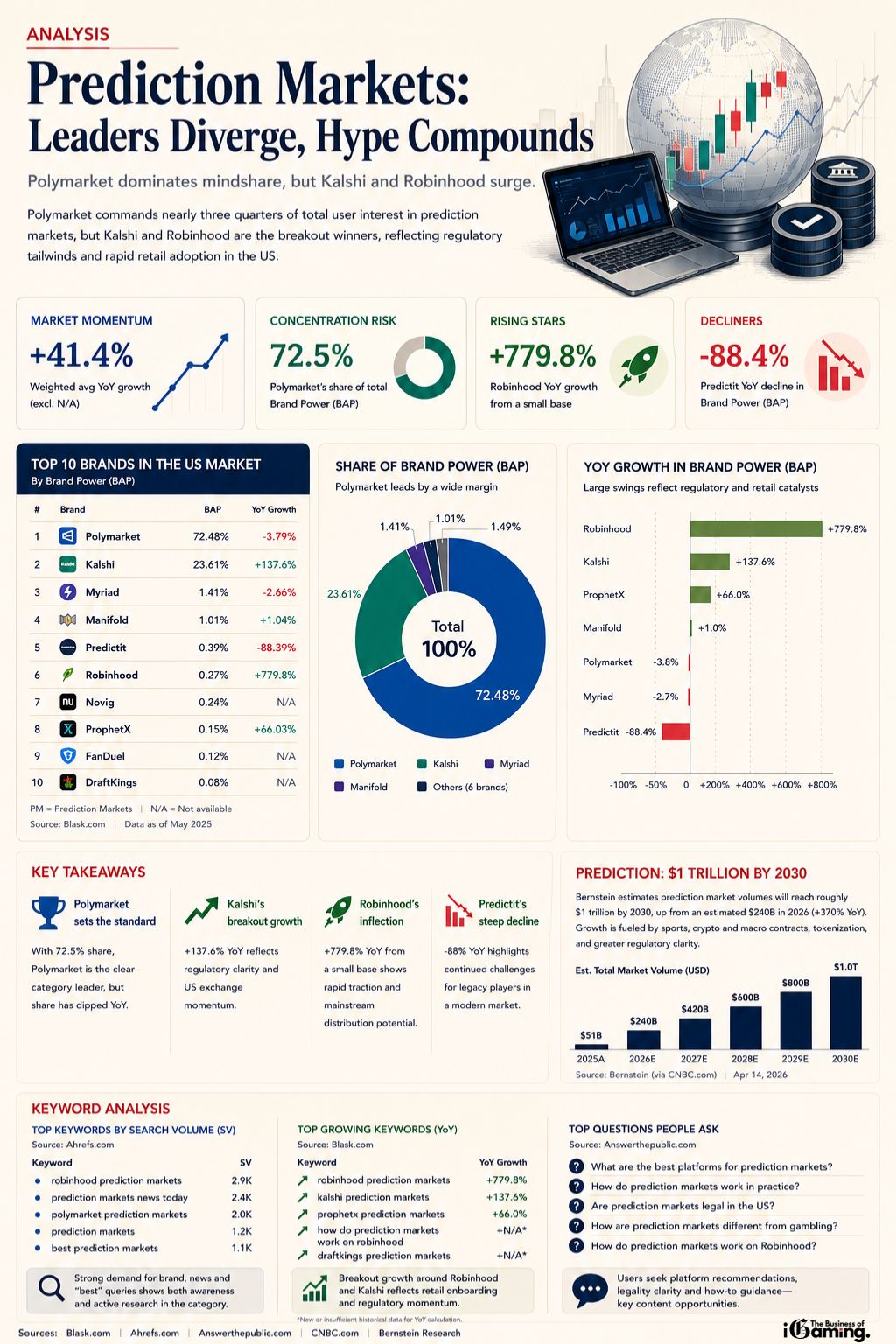
According to Blask data, Polymarket currently dominates the category with a Brand’s Accumulated Power (BAP) of 72.48%, giving it by far the strongest share of total accumulated market attention among tracked prediction market brands. Kalshi follows with 23.61%, while the remaining platforms are significantly smaller in relative market visibility.
At the same time, however, the fastest growth is no longer necessarily coming from the market leader.
Robinhood’s prediction market vertical recorded a staggering +779.8% year-on-year growth in BAP, while Kalshi surged +137.6%, signaling that the market is entering a much broader expansion phase rather than remaining concentrated around a single crypto-native platform.
What BAP Actually Means
One of the more important metrics in the prediction market landscape right now is Brand’s Accumulated Power (BAP), a metric used by Blask to measure a brand’s share of total accumulated user interest within a category.
Rather than purely measuring trading volume or revenue, BAP reflects how much relative market attention and awareness a brand commands compared to competitors over a selected period.
In prediction markets, this matters because the sector is still in an early-stage discovery phase. Mindshare, platform familiarity and consumer awareness may ultimately become just as important as liquidity itself.
Polymarket’s dominance in BAP therefore reflects more than just transaction activity. It reflects cultural relevance and category leadership.
Top Prediction Market Brands In The U.S.
The U.S. market is becoming increasingly competitive as regulated exchanges, fintech companies and sportsbook operators enter the prediction market sector.
While Polymarket and Kalshi currently dominate overall market attention, the broader ecosystem is rapidly expanding.
| Rank | Brand | BAP | YoY Growth | Analysis |
|---|---|---|---|---|
| 1 | Polymarket | 72.48% | -3.79% | Remains the dominant prediction market brand globally despite slight post-election normalization |
| 2 | Kalshi | 23.61% | +137.6% | Fastest-growing regulated U.S. exchange benefiting from regulatory positioning and mainstream visibility |
| 3 | Myriad | 1.41% | -2.66% | Smaller emerging player attempting to establish niche market share |
| 4 | Manifold | 1.01% | +1.04% | Community-driven forecasting platform maintaining relatively stable engagement |
| 5 | Predictit | 0.39% | -88.39% | Legacy prediction market platform rapidly losing visibility and relevance |
| 6 | Robinhood | 0.27% | +779.8% | Explosive growth driven by mainstream retail trading integration |
| 7 | Novig | 0.24% | N/A | Mobile-first prediction market platform focused on simplified user experience |
| 8 | ProphetX | 0.15% | +66.03% | Sports-focused event exchange benefiting from betting-adjacent demand |
| 9 | FanDuel | 0.12% | N/A | Sportsbook giant increasingly exploring prediction market opportunities |
| 10 | DraftKings | 0.08% | N/A | Strategically positioned operator likely to expand further into event contracts |
Source: Blask.com, May 2026.
One of the clearest trends in the data is that traditional sportsbook and fintech companies are now aggressively entering prediction markets rather than leaving the space entirely to crypto-native operators.
Robinhood’s +779.8% year-on-year growth is particularly notable because it demonstrates how powerful mainstream distribution can become once prediction markets are integrated directly into existing retail trading ecosystems.
At the same time, Kalshi’s continued expansion shows that regulatory positioning may become one of the biggest long-term competitive advantages in the sector.
Meanwhile, legacy operators like Predictit appear to be losing relevance as newer platforms offer broader contract categories, stronger liquidity and more modern user experiences.
Why Prediction Markets Suddenly Exploded
The sector’s acceleration can largely be traced back to the 2024 U.S. presidential election cycle, which introduced millions of new users to event-based trading. But unlike previous election-driven spikes, activity did not disappear afterward. Instead, prediction markets expanded into:
- Sports
- Cryptocurrency events
- Macroeconomic forecasting
- Politics
- Financial indicators
- Entertainment and culture
According to CNBC and Bernstein Research, total prediction market volumes could reach roughly $240 billion during 2026 alone – a projected 370% increase year-over-year.
Bernstein further estimates the sector could eventually grow into a $1 trillion market by 2030. That projection may sound aggressive at first glance, but the underlying growth trends already resemble what many analysts previously observed during the early AI boom.
Kalshi’s weekly trading volume reportedly climbed from roughly $100 million a year ago to more than $3 billion weekly, according to figures referenced by Bank of America analysts in the CNBC report.
The Prediction Market Forecast: $1 Trillion By 2030
Bernstein’s long-term prediction for the industry is one of the boldest forecasts yet made for the sector. The investment firm estimates that global prediction market volumes could expand from approximately $51 billion in total volume during 2025 to roughly $1 trillion annually by 2030.
That would represent one of the fastest-growing financial-adjacent sectors in the broader digital economy. Several major drivers are expected to fuel that growth:
- Regulatory clarity in the U.S.
- Increased institutional participation
- Sports and macroeconomic contracts
- Tokenization and crypto integration
- Retail adoption through platforms like Robinhood
- Expansion beyond politics into finance and business forecasting
- Increased mainstream media exposure
Perhaps most importantly, analysts increasingly believe prediction markets are evolving into something larger than gambling. Instead, they are gradually becoming a hybrid between:
- Financial trading platforms
- Retail speculation products
- Forecasting tools
- Information markets
- Real-time event exchanges
That distinction matters because it fundamentally changes how regulators, investors and institutions may eventually treat the category.
Robinhood May Become One Of The Biggest Stories In The Entire Sector
One of the most interesting developments is not coming from crypto-native companies at all. It is coming from Robinhood.
The retail trading giant has quietly become one of the fastest-growing names in prediction markets, largely because it already controls one of the most valuable assets in fintech: distribution.
Unlike many prediction market startups, Robinhood does not need to educate users from scratch. Its existing customer base already understands trading mechanics, mobile-first investing and speculative financial behavior.
That creates an unusually powerful onboarding funnel.
According to Bernstein, Robinhood’s prediction markets hub already generates an estimated $350 million in annual recurring revenue and accounts for roughly 30% of Kalshi’s total volume. The implication is significant.
Prediction markets may ultimately evolve less like online betting products – and more like financial trading infrastructure.
Fanatics — The Next Big Success Story?
One of the more interesting names quietly entering the broader prediction market conversation is Fanatics. While the company is still primarily associated with sports merchandise and sportsbook operations, several industry leaders at NEXT Summit Valletta pointed to Fanatics as one of the companies best positioned to capitalize on the convergence between sports betting, prediction markets and mainstream consumer behavior.
Evolution Chief Product Officer Todd Haushalter described Fanatics as “a master class” in how to gradually convert a large sports audience into a betting and trading ecosystem.
According to Haushalter, Fanatics’ biggest advantage may not necessarily be technology alone — but rather distribution, customer ownership and patience.
That strategy is already becoming increasingly visible. Unlike many prediction market startups attempting to acquire users from scratch, Fanatics already controls one of the largest sports-commerce ecosystems in the United States through:
- Merchandise
- Fan loyalty programs
- Sports media partnerships
- Ticketing integrations
- Sportsbook products
- Mobile-first sports engagement
The company is now gradually expanding further into event-driven trading mechanics and prediction-style experiences. Its Fanatics Markets platform already operates as a CFTC-regulated introducing broker connected to Crypto.com’s derivatives infrastructure, offering event contracts across sports and other categories.
From a strategic perspective, Fanatics may represent something even more important than another sportsbook competitor. It could become one of the first true mainstream “sports ecosystem” companies to successfully merge:
- Sports fandom
- Betting
- Trading
- Event speculation
- Loyalty programs
- Real-time engagement
into a single consumer experience. That is particularly important because prediction markets increasingly resemble financial entertainment products rather than traditional sportsbooks.
The UI and user experience of newer prediction market platforms are already moving closer to trading apps than casino products – something multiple panelists at NEXT.io also highlighted during the discussion.
Fanatics may therefore be uniquely positioned to benefit from younger audiences increasingly blurring the lines between:
- Investing
- Trading
- Sports betting
- Speculation
- Fan engagement
There are also early SEO signals supporting this possibility.
Ahrefs data from Fanatics Markets shows rapid backlink growth and increasing organic keyword visibility, despite the platform still being relatively early in its lifecycle. The domain recently climbed to a DR 55 with approximately 188K backlinks and growing search visibility.
That may not sound massive compared to mature betting brands yet, but it illustrates how quickly mainstream consumer companies can scale visibility once prediction markets become integrated into larger ecosystems.
In many ways, Fanatics may ultimately become one of the clearest examples of where the prediction market industry is heading next: Not toward niche crypto traders, but toward mainstream sports audiences.
Search Trends Reveal Where The Market Is Heading
The SEO and search data surrounding prediction markets also paints a very revealing picture. Ahrefs data shows that the largest search growth areas are increasingly tied to:
- Robinhood prediction markets
- Kalshi
- Regulation
- Legality
- Trading mechanics
- News and live updates
Some of the highest-volume keyword clusters include:
| Keyword | Search Volume |
| robinhood prediction markets | 2.9K |
| prediction markets news today | 2.4K |
| polymarket prediction markets | 2.0K |
| prediction markets | 1.2K |
| best prediction markets | 1.1K |
Interestingly, many of the fastest-growing searches are not directly tied to gambling behavior. Instead, users are increasingly asking:
- “Are prediction markets legal?”
- “How do prediction markets work?”
- “How are prediction markets taxed?”
- “How are prediction markets different from gambling?”
This suggests the category is transitioning from curiosity-driven speculation into a more structured financial and regulatory discussion. That evolution is important.
It indicates that users increasingly view prediction markets as an investment or forecasting product rather than purely entertainment.
The Regulatory Battle May Shape The Next Decade
Regulation remains the biggest long-term variable. Currently, the sector exists in a complex overlap between:
- Financial derivatives
- Sports betting
- Commodity markets
- Event contracts
- Securities law
Several U.S. states have already challenged prediction market operators, while the Commodity Futures Trading Commission (CFTC) continues asserting federal authority over the category. Yet despite these legal tensions, most major analysts remain bullish.
The reason is simple: prediction markets solve a real consumer demand. People increasingly want to speculate on real-world outcomes in real time. And unlike traditional sportsbooks, prediction markets can theoretically expand into almost any information category imaginable.
That creates enormous scalability potential.
Sports May Not Dominate Forever
One of the more interesting forecasts from Bernstein is that sports contracts — while currently representing more than 60% of prediction market activity — could eventually decline to closer to 30% by 2030. Why?
Because institutional use cases may become much larger over time. Potential future categories include:
- Corporate hedging
- Political forecasting
- Economic indicators
- Insurance event risk
- Commodity forecasting
- Financial event contracts
In other words, prediction markets may gradually evolve into a hybrid between:
- Trading platforms
- Information markets
- Retail speculation products
- Forecasting infrastructure
That possibility explains why companies like Coinbase, Robinhood and DraftKings are already positioning themselves aggressively.
Why Prediction Markets Matter To iGaming
For the iGaming industry, prediction markets represent both a threat and an opportunity. On one hand, they compete directly for speculative entertainment spending. On the other, they may also create entirely new acquisition funnels, engagement mechanics and trading-based betting experiences.
The overlap between prediction markets and sportsbooks is already becoming increasingly blurred. Especially among younger audiences, the distinction between betting, trading, investing and speculation is becoming less relevant.
That behavioral convergence could reshape online gambling over the next decade. And judging by both the search data and growth metrics, the market is still in the very early stages.
Sources
- Blask.com
- Ahrefs.com
- Answerthepublic.com
- CNBC.com / Bernstein Research