


For many players, a crypto casino is simply a faster, more private way to place a bet. Deposit, play, withdraw, move on. That’s the familiar story.
But in parts of the world where banks are expensive, currencies are unstable and international payments are painfully difficult, the same platforms can end up serving a very different purpose. Not officially, and not always neatly, but in practice. They can become a route into digital money.
That is the more interesting story: crypto casinos as financial on-ramps, especially in emerging markets where traditional banking often leaves people waiting outside the door.
Why the Casino Label Doesn’t Tell the Whole Story
It’s easy to dismiss the sector as entertainment with a blockchain wrapper. To be fair, gambling is still the central product. Nobody should pretend otherwise.
Yet crypto casinos also sit at the meeting point of several useful technologies: digital wallets, stablecoins, instant settlement, low-value transfers and cross-border access. When those features are combined, the platform can become more than a gaming account. It can act as a small liquidity hub for someone who needs to move value quickly and cheaply.
That matters most in places where the financial system is not particularly friendly to ordinary users. High bank fees, limited branch access, slow transfers and strict documentation requirements can make basic financial participation harder than it looks from London, Manchester or Edinburgh.
Crypto gambling platforms are not banks. They’re not built to be public infrastructure. Even so, users often adapt technology for whatever problem is in front of them. In some markets, the problem is not entertainment. It’s access.
The Pressure Points in Emerging Economies
To understand why informal crypto routes appeal, you have to look at the conditions pushing people towards them.
In countries affected by inflation, currency controls or weak banking access, holding local money can feel like standing on melting ice. Prices rise quickly. Savings lose purchasing power. Foreign currency becomes difficult to obtain. Banks may restrict withdrawals, limit transfers or require paperwork that many people cannot easily provide.
There are also millions of people who are unbanked or underbanked. Some have no bank account at all. Others technically have one, but still rely on cash agents, money transfer shops, mobile money or informal lenders because the formal system is too slow, costly or limited.
In that environment, any service that offers a way to convert local currency into a more useful digital asset becomes attractive. Crypto casinos are one such route, partly because they often accept small deposits and support coins that can be moved onwards to a private wallet.
Stablecoins Sit at the Centre of It
Bitcoin may get the headlines, but stablecoins are usually the practical tool here. Tokens such as USDT and USDC are designed to track the value of the US dollar, making them easier to use for saving, pricing and sending money than more volatile crypto assets.
That doesn’t mean they are risk-free. Pegs can come under pressure, reserves differ between issuers and users still need to trust the systems behind them. Still, compared with a rapidly weakening local currency, a dollar-linked token can look like a useful shelter.
Stablecoins work especially well for everyday digital transfers because they are:
- Portable: they can be moved through a phone wallet rather than a bank branch.
- Divisible: users can send very small amounts without needing a full bank transaction.
- Familiar in Value: dollar-linked pricing is easier to understand in markets already used to thinking in US dollars.
- Fast to Settle: many transfers clear in minutes, sometimes seconds, depending on the network.
- Useful Across Borders: they can be sent internationally without relying on traditional correspondent banking routes.
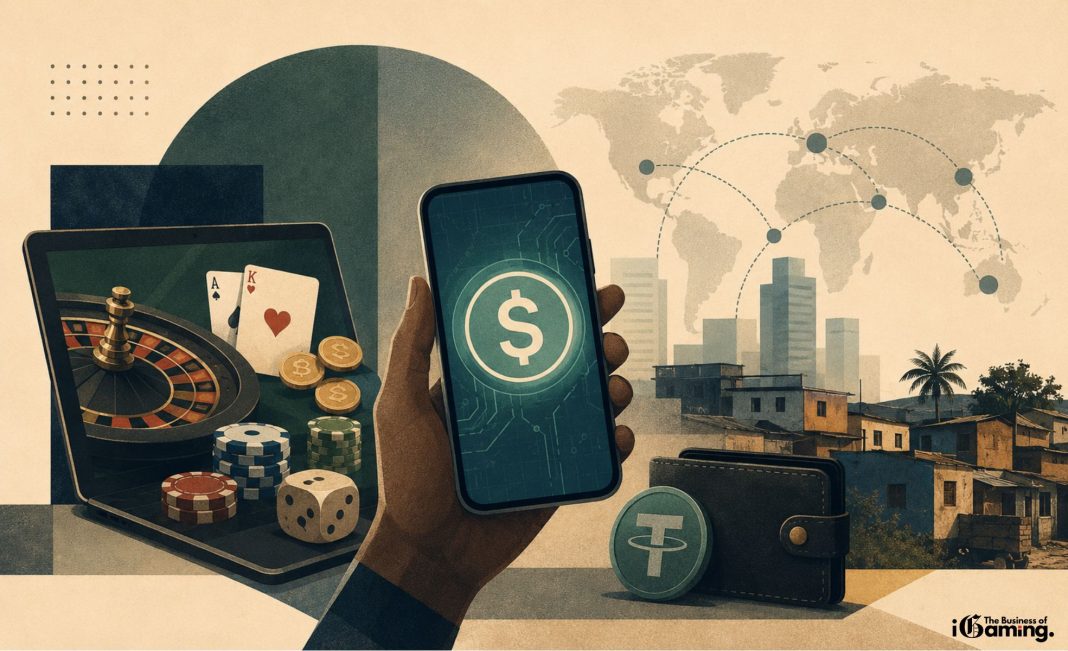
This is where crypto casinos become part of a wider pattern. A user may buy stablecoins through a platform, deposit them, withdraw to a wallet, then use that wallet for savings, peer-to-peer payments or remittances. The gambling product may be the doorway, but not always the final destination.
Smartphones Changed the Access Problem
In many lower-infrastructure economies, mobile phones spread faster than bank accounts. That fact cannot be overstated.
A person who does not have easy access to a bank branch may still own a smartphone. With that phone, they can download a wallet, receive a one-time password, scan a QR code, join a messaging group and interact with digital services that were previously out of reach.
Crypto casinos benefit from the same mobile-first shift. Their onboarding tends to be simple, their interfaces are built for phones, and many platforms integrate third-party payment providers. In practice, a user can often move from local currency to crypto without opening an account at a traditional exchange.
That ease is one reason they have become informal financial entry points. The route may not be elegant, but it is accessible. For people used to friction, accessibility wins.
How the Informal On-Ramp Actually Works
The process varies by country and by platform, but the general pattern is fairly straightforward.
- A user reaches a crypto gambling platform on a mobile device.
- They use an integrated payment option, card payment, bank transfer or local third-party provider to buy crypto.
- The purchased asset lands in the casino account, often as a stablecoin or another widely accepted token.
- The user may gamble with part of the balance, or withdraw funds to an external wallet.
- Once in a private wallet, the crypto can be held, sent to another person, swapped, or used in other decentralised finance tools.
For some users, the casino account is only a temporary stop. For others, it functions as one piece of a larger financial routine that includes mobile wallets, peer-to-peer trading and stablecoin storage.
This is why the phrase financial on-ramp fits. The platform enables conversion from ordinary money into crypto rails. Once value is on those rails, it can move in ways that local banking systems may not allow, or may make too expensive.
What the Data Appears to Show
Exact numbers are difficult to pin down because much of the sector is offshore, privately operated and spread across multiple jurisdictions. Still, the direction of travel is hard to ignore.
Industry estimates have suggested that crypto casino revenue rose sharply in 2024, with some figures placing global gross revenue at roughly US$81 billion. That would represent a major jump compared with only a few years earlier.
It is not possible to cleanly divide that activity by region from public data alone. However, several indicators point towards significant participation from countries with gambling restrictions, currency controls or weak banking infrastructure. VPN usage, payment patterns and the popularity of stablecoin deposits all suggest that demand is not limited to wealthy markets where players simply prefer crypto for convenience.
Another revealing detail is the rise of built-in Buy Crypto tools. These payment widgets allow users to purchase coins from inside the gambling platform rather than going through a separate exchange. Some estimates suggest a substantial share of deposits now come either directly in stablecoins or through these embedded conversion tools.
That is important. If a platform lets someone convert fiat currency into crypto inside the same account used for gaming, it has effectively become a gateway into the crypto economy.
The Role of Privacy and Light Verification
Privacy is part of the attraction, although it is also where the controversy begins.
Many offshore crypto casinos have historically required less identity verification than regulated gambling sites or mainstream crypto exchanges. Low-value accounts, first deposits and small withdrawals may face limited checks, depending on the operator and jurisdiction.
From a user perspective, this can feel like freedom: fewer forms, fewer refusals, less exposure to local restrictions and less dependence on institutions they may not trust.
From a regulatory perspective, it raises obvious concerns. Weak know-your-customer and anti-money-laundering controls can make it harder to trace funds, prevent fraud, protect vulnerable users or stop criminal activity. Regulators in several markets, including the UK, have warned about offshore gambling platforms that sit outside local licensing rules.
Both views can be true at once. Light verification may help excluded users access digital finance, but it can also create serious risks. That tension is one of the reasons this trend is so difficult to manage.
Not a Perfect Substitute for Banking
It would be a mistake to romanticise any of this. A crypto casino is not a savings account, a regulated payment institution or a consumer protection scheme.
Users face real dangers, including:
- Gambling Harm: a financial workaround built around a betting platform can expose users to losses they did not intend to take.
- Platform Risk: offshore sites can freeze accounts, change rules or disappear.
- Stablecoin Risk: dollar pegs are designed to hold, but they are not magic.
- Regulatory Risk: governments may block access, restrict withdrawals or pursue enforcement action.
- Security Risk: wallet mistakes, phishing and lost seed phrases can permanently destroy access to funds.
So the point is not that crypto casinos are a good replacement for banks. They are not. The point is that, in some markets, people use them because the available alternatives are also flawed.
A Bigger Shift Is Under Way
The rise of crypto casino on-ramps is part of a broader change in how people access financial services.
Stablecoins are increasingly being used as practical money in places where local currencies are unstable. Smartphones have become the main financial device for millions. Wallets, exchanges, payment apps, peer-to-peer markets and gambling platforms now overlap in messy but functional ways.
This creates an informal ecosystem. It is not centrally planned. It is not always compliant. It is certainly not tidy. But it works well enough for enough people that it keeps growing.
That should make banks, regulators and payment companies pay attention. When people choose a casino platform as a route into digital dollars, they are not necessarily making a statement about gambling. They may be making a statement about the failure of existing financial access.
Read more: The Largest Crypto Casinos by Deposit Volume
Where This Leaves the Industry
Crypto casinos occupy an awkward position. On one side, they are gambling businesses with all the social and regulatory baggage that comes with that. On the other, they are becoming accidental gateways into global digital finance.
For players in wealthy countries, the attraction may still be speed, novelty and privacy. For users in more fragile economies, the appeal can be much more practical: a way to receive value, preserve purchasing power, move money across borders or reach financial tools that local banks do not provide.
That dual identity is unlikely to disappear. If anything, it may become more pronounced as stablecoins spread and mobile-first finance continues to grow.
The uncomfortable truth is that informal systems often grow where formal systems fail. Crypto casinos were not designed to solve financial exclusion, but in some places they have become part of the workaround. Whether regulators can reduce the risks without cutting off useful access is the question that now matters.