


At The Business of iGaming, we pay close attention when studios attempt something genuinely different. The industry is saturated with iterations of familiar mechanics, so when a provider challenges the basic assumptions of how casino entertainment works, it deserves a closer look.
That appears to be exactly what ICONIC21 is aiming for with the launch of Arrow Chase, a release that doesn’t sit neatly within any of the established iGaming categories.
For decades, online casino gaming has followed predictable patterns. A slot spin begins and ends. A roulette wheel is launched, lands, and resets. Crash games build tension toward a decisive moment before starting over again. Even the most engaging formats rely on repetition built around clear rounds and pauses.
Arrow Chase takes a different approach.
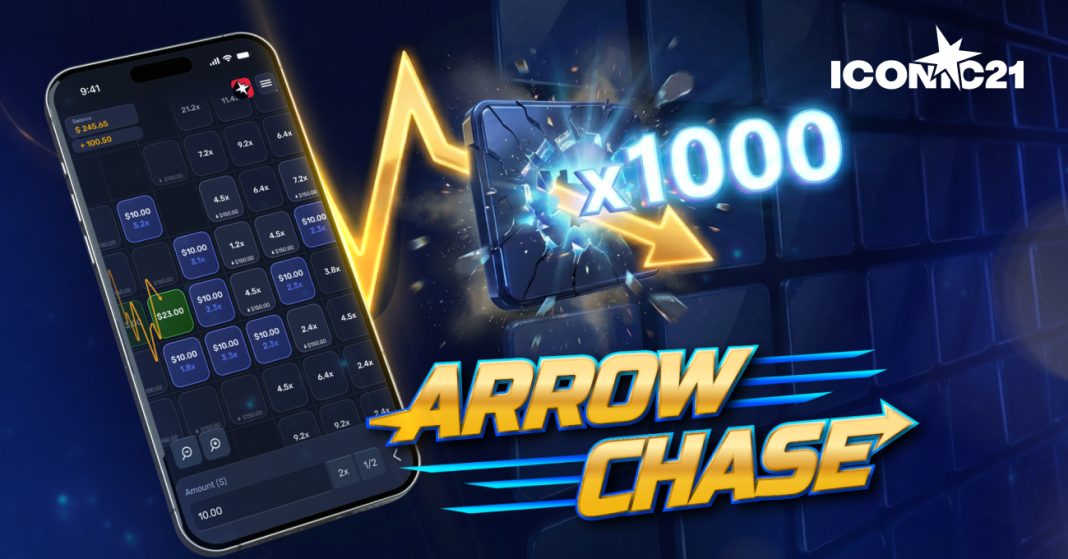
Instead of operating in fixed rounds, the experience is built around uninterrupted movement. An arrow continuously travels across the screen, interacting with multiplier blocks as the action unfolds in real time. Players are not waiting for a new round to begin—they choose when to participate, when to exit, and which multipliers to target.
That shift alone makes the concept stand out in a market where gameplay loops are often highly familiar.
Arrow Chase at a Glance
| Category | Details |
|---|---|
| Game | Arrow Chase |
| Developer | ICONIC21 |
| Category | Emerging / continuous multiplayer prediction-style game |
| Core Mechanic | A continuously moving arrow interacts with multiplier blocks in real time |
| Round Structure | No traditional rounds or resets |
| Player Interaction | Players choose when to enter, which multiplier targets to back, and when to exit |
| Multiplayer Element | Shared real-time gameplay experience |
| Potential Appeal | Crash game players, crypto-native audiences, younger engagement-driven demographics |
| Differentiator | Continuous gameplay rather than stop-start wagering cycles |
| Business Angle | Potentially stronger retention through persistent engagement and shared tension |
Breaking Away From Traditional Game Loops
What makes Arrow Chase interesting isn’t just its presentation, but the structural departure from traditional casino design.
The most obvious difference is continuity. There is no start-stop rhythm interrupting the action. The gameplay simply keeps moving, creating a sense of momentum that feels closer to live digital entertainment than classic online casino mechanics.
There is also a stronger multiplayer dynamic than most RNG-led experiences. Rather than isolated gameplay sessions where each player interacts independently with a backend result, participants are observing the same action unfold simultaneously.
That creates something online casino gaming often struggles to deliver: shared tension.
Crash games demonstrated how powerful timing-based decision making can be, particularly among younger player demographics and crypto-native audiences. Arrow Chase appears to build on that psychological appeal while pushing the mechanic into a more communal and persistent format.
Simplicity Meets Tension
Another notable aspect is accessibility. The concept appears visually intuitive. Even without lengthy explanations, the premise is easy to grasp – watch movement, anticipate outcomes, and make timing-based decisions.
That simplicity matters.
Some innovative mechanics fail not because the idea lacks potential, but because the onboarding friction is too high. In fast-moving acquisition environments, products that require heavy explanation often struggle to gain momentum.
Arrow Chase seems designed with immediate recognition in mind. The question, of course, is whether novelty translates into retention.
Innovation Is Easy to Claim – Harder to Prove
The iGaming sector is no stranger to ambitious product launches positioned as category-defining breakthroughs. Not all of them live up to the narrative.
But genuine format innovation remains one of the few ways providers can meaningfully differentiate themselves in an increasingly crowded market.
If Arrow Chase manages to capture the same engagement dynamics that helped crash games become mainstream – while offering something operationally distinct – it could become more than a curiosity.
One factor working in ICONIC21’s favour is its product development philosophy. The studio has emphasised close collaboration with operator partners, using player behaviour insights and market demand signals to shape its releases.
If that feedback loop genuinely informed Arrow Chase’s design, this may be less of a creative experiment and more of a calculated response to changing player preferences.
A New Category – or Just a New Twist?
Perhaps the most interesting question is classification. What exactly is Arrow Chase?
It doesn’t comfortably fit within slots. It isn’t crash in the traditional sense. It doesn’t resemble roulette, live casino, or game show mechanics. That ambiguity may actually be its biggest opportunity.
New categories are rarely labelled on day one. They emerge when enough momentum builds around a mechanic that the market starts defining it collectively.
Whether Arrow Chase becomes a standalone category or simply inspires competitors to rethink continuous gameplay remains to be seen.
But one thing is clear: in an industry often accused of repeating itself, this is at least an attempt to do something different. And that alone makes it worth watching.