


A new data release from Blask is challenging long-held assumptions about what truly drives player demand in global iGaming markets. More importantly, it introduces a powerful new feature designed to give operators a clearer, more granular understanding of player behavior – potentially reshaping how companies approach market strategy.
A Shift from Assumptions to Actual Demand
For years, sports betting has often been positioned as the dominant force in online gambling. However, Blask’s latest dataset reveals a far more nuanced picture – one that varies significantly depending on geography, culture, and regulation.
France offers a striking example. Despite the global narrative around sports betting growth, lottery dominates the French market, accounting for roughly 78% of all gambling-related search demand. Online casino trails far behind at around 10%, while betting, poker, and live dealer formats each represent only a small fraction of interest.
This divergence highlights a broader reality: player demand is not universal – it is deeply local.
The New Feature: Category-Level Demand Analysis
At the core of this release is Blask’s newly launched category-level analysis feature, a tool that could significantly impact how operators evaluate and enter markets.
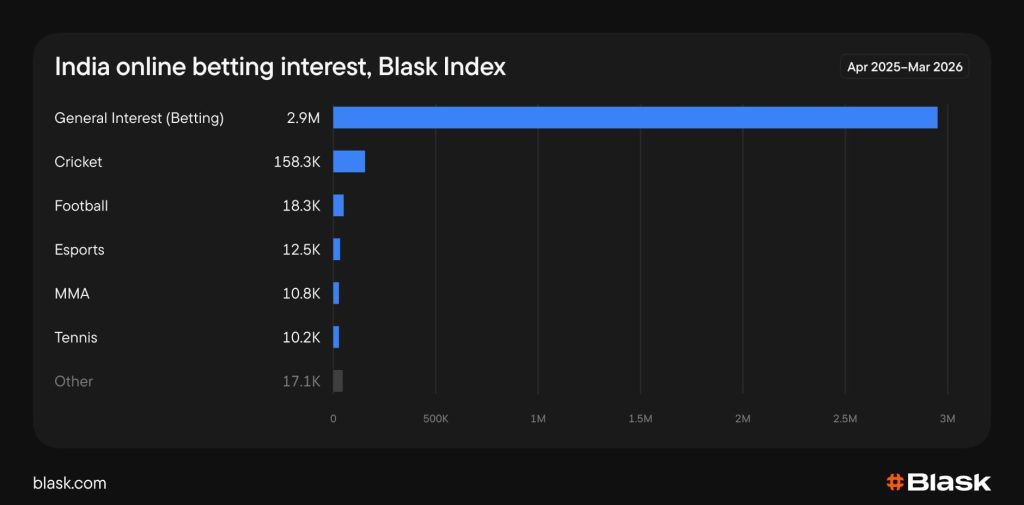
The feature is built on non-branded search data, meaning it captures what players are actively searching for – not what brands are pushing. This distinction allows operators to move beyond surface-level metrics and understand underlying intent at both category and subcategory level.
Case Study: Germany
Germany provides one of the clearest examples of how the feature works in practice. Based on the category breakdown and YoY development visible in the Blask dashboard, the market reveals both legacy dominance and rapid growth in newer verticals.
| Category | Subcategory | YoY Change |
|---|---|---|
| Lottery | General Interest (Lottery) | +2% |
| Lottery | Keno | -6% |
| Online Casino | General Interest (Casino) | +448% |
| Online Casino | Slots | +107% |
| Online Casino | Plinko | -65% |
| Online Casino | Crash | +175% |
| Live Dealer | Blackjack | +213% |
| Live Dealer | Roulette | +109% |
| Live Dealer | Baccarat | +196% |
| Online Poker | — | +24% |
| Online Betting | General Interest (Betting) | +11% |
| Online Betting | Football | +122% |
| Online Betting | Esports | +12% |
| Fantasy | — | +79% |
| Racing | Formula 1 | +84% |
| Prediction Markets | — | +104% |
| Bingo | — | +51% |
What stands out immediately is the contrast between stability and acceleration:
- Lottery remains structurally dominant, but with minimal growth (+2%), reinforcing the idea that legacy verticals anchor demand.
- Online casino is the fastest-growing segment, with triple-digit YoY increases across key subcategories, particularly general interest (+448%) and live dealer formats.
- Emerging formats such as crash games (+175%) and prediction markets (+104%) are gaining traction, pointing to evolving player preferences.
- Within betting, football remains the primary driver, but its growth is part of a broader, more diversified ecosystem.
The German case illustrates how category-level analysis moves beyond top-line assumptions and exposes where momentum is actually building within a market.
Global Markets: A Fragmented Landscape
The broader dataset reinforces how dramatically demand structures differ across regions:
- Brazil is heavily driven by betting (around 52%), largely tied to football, yet lottery still maintains a significant ~25% share.
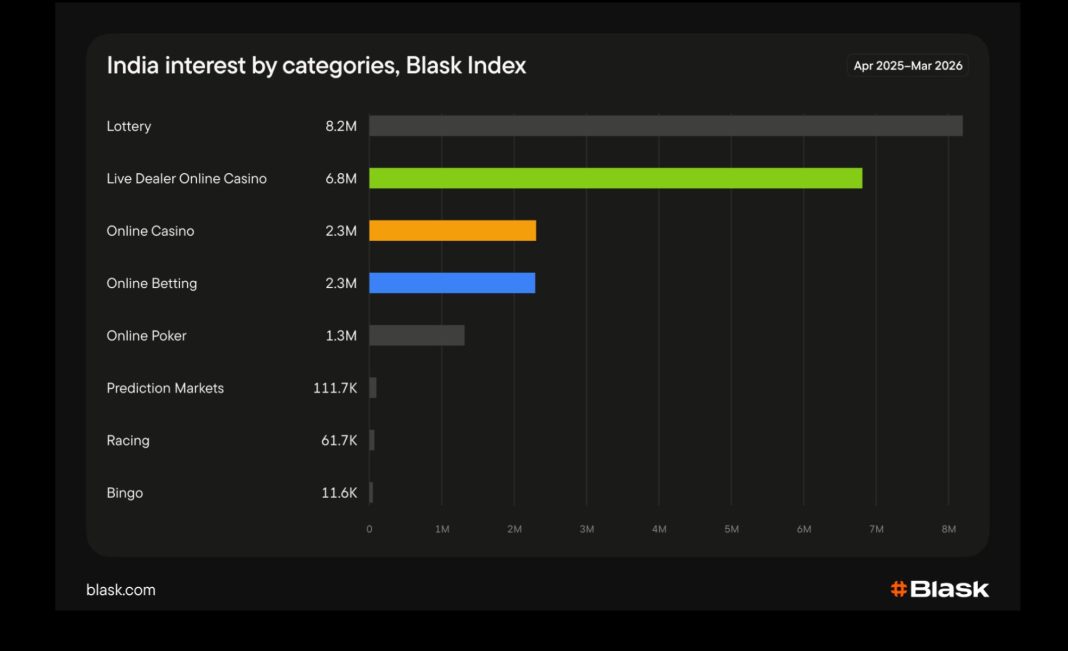
- India presents a more balanced ecosystem, with lottery (35%) and live dealer (29%) leading the way.
- Italy shows strong seasonality, where fantasy sports dominate at approximately 37%.
- Switzerland stands out as a casino-first market, with online casino capturing around 38% of demand.
These differences underline a key takeaway: global strategies rarely translate directly across borders.
Regulation and Legacy Still Shape Demand
Beyond cultural preferences, two structural forces continue to define market behavior:
Legacy products still dominate
Older formats such as lottery consistently command the largest share of demand, even in mature digital markets.
Regulation redirects demand rather than eliminating it
Where certain verticals are restricted, interest shifts into adjacent categories or offshore channels rather than disappearing entirely.
Read more: Blask launches Global Games – The First Real-Time Casino Game Ranking System
A Strategic Tool for a More Competitive Market
The introduction of category-level analysis comes at a time when competition in iGaming is intensifying, and margins are increasingly tied to precision rather than scale.
For operators, affiliates, and investors, the implications are clear:
- Market entry strategies need to be data-led, not assumption-driven
- Product focus must align with local demand structures
- SEO and acquisition strategies can be refined using real search intent
Blask’s new feature is ultimately less about presenting data—and more about enabling smarter, faster decision-makingin a fragmented global landscape.
The Bigger Picture
As the iGaming industry continues to expand, the ability to understand what players actually want – not what the industry assumes they want – is becoming a defining competitive edge.
With its category-level demand analysis, Blask is effectively providing a new lens on the market, one that turns raw search behavior into actionable intelligence, and in doing so, reshapes how the industry approaches growth.